Taijiquan Family Styles: Chen, Yang, Wu, Wu (Hao) and Sun
太极拳五大家:陈式、杨式、吴式、武(郝)式与孙式
Chen, Yang, Wu, Wu (Hao) and Sun are the five family names most often used to organise modern taijiquan. They are useful signposts: each points to a history of teachers, forms and training methods. They are not five sealed systems, and a label alone cannot tell you how a particular class will move or what it will teach.
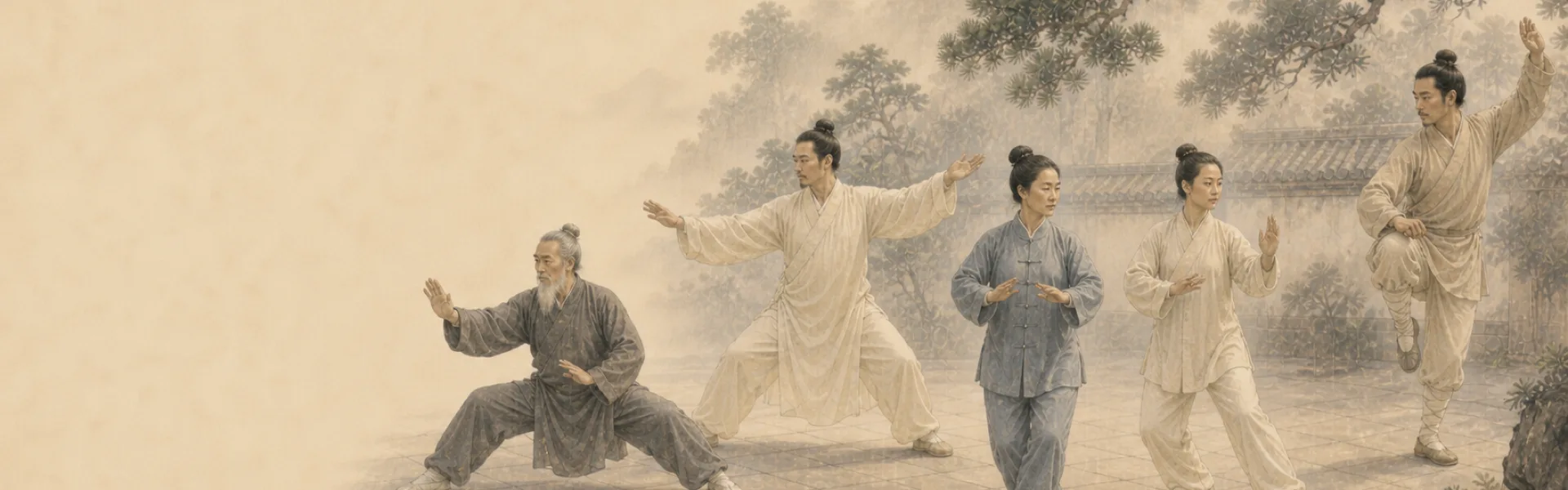
This guide compares the traditions without turning their most visible features into rules. It also explains why a teacher’s curriculum, feedback and partner work usually matter more to a beginner than choosing the “best” style.
Five names, not five sealed boxes
A family-style name usually marks a line of transmission associated with a surname. It does not mean that every descendant practises one unchanged form. Teachers adjusted sequences, frames, pace and teaching order; students sometimes learned across family lines; public instruction and printed manuals made certain versions more visible than others.
UNESCO’s Taijiquan heritage description recognises both clan-based transmission and master–apprentice teaching. That is a better model than imagining five fixed brands. A family name tells you where to begin asking questions, not everything you need to know.
What the traditions share
Across the five, practitioners work with recognisably related ideas: distinguishing full and empty, coordinating the body, reducing unnecessary tension, directing movement through intention and responding rather than meeting force rigidly. Their solo routines, partner work, weapons and terminology vary, but the family resemblance is real.
The written tradition also crossed lineage boundaries. Li Yiyu’s 1880 Brief Preface to Taijiquan, for example, records connections among Yang Luchan, Wu Yuxiang and Chen Qingping before presenting principles such as mental quiet, agility, integrated power and opening and closing. Later schools did not all interpret or teach these ideas in precisely the same way.
Chen style: rhythm, spiralling and several frames
Chen-style transmission is closely associated with Chenjiagou in Henan. Its histories contain several frames and branches rather than one universal syllabus. Commonly encountered curricula include a first road and a more forceful second road often called paochui, but names and contents differ between lines.
Visible changes of tempo, spiralling coordination and explicit releases of power are often prominent in Chen teaching. Lower postures may appear, yet they are training choices rather than an entrance requirement: a responsible teacher can raise the frame and reduce range or speed. Not every Chen class uses the same depth, stamping, breathing or sequence.
Chen is therefore not simply “the hard style.” Slow continuity, listening, softness and body organisation remain part of the work. The useful question is which frame and lineage a school teaches, and how it develops those qualities safely.
Yang style: open shapes and a broad public inheritance
Yang-style histories centre on Yang Luchan and later generations of his family. The large, open and continuous practice associated with Yang Chengfu became especially influential through twentieth-century public teaching. The International Yang Family Tai Chi Chuan Association likewise describes its family practice in terms of large, open movements.
That familiar slow form is not the whole tradition. Yang branches preserve different long forms, short forms, weapons, pushing hands and applications; some also retain faster or more visibly issuing methods. “Yang is slow and has no power release” describes a common public presentation, not every Yang curriculum.
Because Yang-derived teaching is widespread, the name covers a particularly large range of methods and standards. Availability is an advantage, but it makes checking the actual school more important.
Wu style (吴): compact work shaped in Beijing and Shanghai
Wu style written with 吴 is associated with Quanyou and his son Wu Jianquan. Its transmission developed from Yang-family teaching in Beijing and became strongly established in Shanghai. The Shanghai heritage description credits Wu Jianquan with shaping the style’s modern practice and records the founding of the Jianquan Taijiquan Association.
Wu classes often use a moderate or compact frame and give sustained attention to neutralisation and pushing hands. Some branches show an inclined torso while maintaining connected alignment; others look more upright. It is misleading to turn one photograph or one branch’s posture into a rule for the entire style.
Ask how the school relates solo form to partner practice. Compact movement should not mean collapsed posture, and softness should not mean an absence of structure.
Wu (Hao) style (武/郝): a different Wu and a textual legacy
Wu (Hao) uses the surname 武, not the 吴 of Wu Jianquan’s line. It is associated with Wu Yuxiang, his nephew Li Yiyu and the later teacher Hao Weizhen; “Hao” is commonly added in English to keep the two Wu traditions distinct.
Li Yiyu’s preface is valuable because it is a dated voice from within this transmission. It says that Wu Yuxiang first compared methods with Yang Luchan and later studied with Chen Qingping at Zhaobao. That account is evidence for how the lineage described itself in 1880; it does not make every later claim automatically certain.
Wu (Hao) practice is often described as compact, upright and internally precise, with movements that can be difficult to read from a distance. Its smaller practitioner base means that teacher availability may be the practical limitation. Small-looking movement still requires clear stepping, whole-body connection and tested function.
Sun style: agile stepping and explicit opening and closing
Sun Lutang developed his taijiquan after substantial study of xingyiquan and baguazhang and after learning from Hao Weizhen. In the preface to his 1919 Study of Taijiquan, Sun describes the three arts as different in form but united in principle, and says that he brought his study of them together.
Sun-style practice is commonly recognised by a relatively high, mobile frame, lively advancing and following steps, and clearly marked opening-and-closing actions. These features can feel accessible to some students, but “high stance” does not automatically mean easy: continuous stepping can demand balance and coordination.
Sun should not be reduced to a mixture of three arts. It is a coherent taijiquan tradition with its own forms, pedagogy and later branches. Ask whether a class teaches the stepping, opening and closing as connected skills rather than surface choreography.
Beyond the five-family map
Zhaobao, He-style and other local or family transmissions do not disappear because a modern overview lists five. Nor does the five-family scheme explain every contemporary system taught under the name Wudang. These histories sometimes intersect, but they should not be compressed into a single family tree without evidence.
Our history of taijiquan separates documented records, lineage memory and later interpretation. The same discipline is useful here: a style map is a guide to communities of practice, not a final verdict on one inventor or one exclusive source.
Standard routines are curricula, not family lineages
Modern teaching and sport also use standardised routines. A short public-health form, an examination syllabus or a combined competition routine may simplify one line or select movements associated with several styles. Its purpose is comparability, accessibility or judging—not the preservation of a complete family curriculum.
This distinction prevents two common mistakes. Performing a combined routine does not make a student a lineage holder in every style represented, and practising a short Yang-derived sequence does not show everything taught in Yang-family schools. Ask what the routine was designed for and what training accompanies it.
How to compare real classes
Start with what happens week after week. Does the teacher give individual corrections? Are stepping, alignment and relaxation developed progressively? Is the purpose of each exercise explained? If partner work is offered, is it cooperative at first and increasingly responsive without becoming reckless?
Then ask concrete questions: Which teacher and branch does the curriculum come through? Which solo forms, partner practices and weapons are taught? Are applications optional, central or absent? How are age, injury and mobility accommodated? A clear answer is more useful than a grand lineage claim.
Observe the students as well as the teacher. Their balance, attention and treatment of beginners reveal what the school reliably transmits. A dramatic demonstration reveals much less about ordinary instruction.
Choosing a style without ranking them
If several sound schools are available, your goals can guide the first visit. Someone drawn to visibly changing rhythm may explore Chen; someone seeking a widely available, expansive form may begin with Yang; compact partner work may lead toward Wu; a rare precise small-frame tradition may point to Wu (Hao); mobile stepping and opening–closing may make Sun appealing.
These are invitations, not promises. Branch, teacher and curriculum can overturn every shorthand description. Try a class, disclose relevant health or mobility limits, and notice whether the teaching helps you understand and improve. The best starting style is usually the one taught responsibly, at a level you can practise consistently.
Key points
- The five names identify important transmissions, not five uniform or isolated systems.
- Chen, Yang, Wu, Wu (Hao) and Sun each contain branches with different forms and teaching emphases.
- Frame, pace, stepping and visible power can help you recognise a curriculum, but none is a universal rule.
- Standardised health, examination and competition routines should not be confused with complete family lineages.
- Choose by the quality, safety and completeness of the teaching—not by a claim that one family style is superior.