Wudang Taijiquan: History, Revival and Living Practice
武当太极拳:历史、复兴与当代实践
“Wudang Taijiquan” does not name one uniform form or one curriculum shared by every teacher on the mountain. It can refer to Wudang as a place of practice, to the cultural memory linking internal martial arts with Zhang Sanfeng, or to a modern school and its named routines. Keeping those meanings distinct makes the tradition easier to understand without making it less meaningful.
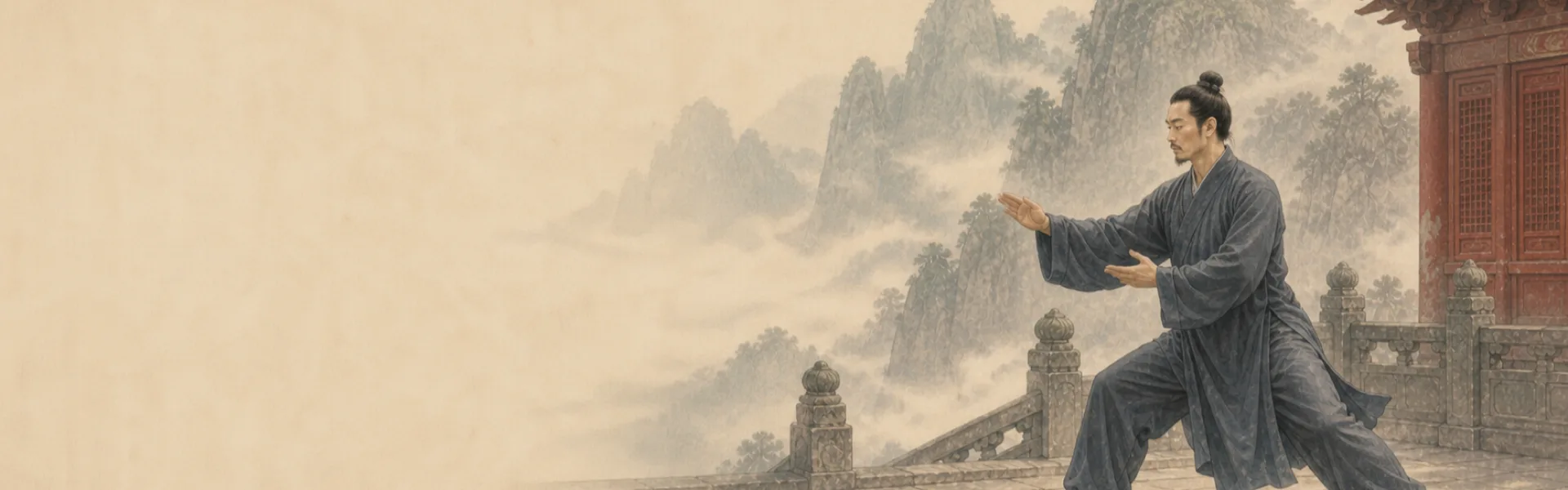
What “Wudang Taijiquan” can mean
A visitor may use the name geographically: taijiquan studied at Wudang. A school may use it institutionally for its own programme. A practitioner may use it historically or devotionally, placing practice within Wudang’s Taoist culture and the memory of Zhang Sanfeng. These uses overlap, but they are not proof that every school teaches the same sequence or inherits one documented chain.
Begin with the exact course in front of you. Ask for the form’s name, the teacher who transmitted it, the length of the sequence and the other training that accompanies it. Those details are more useful than assuming that the word “Wudang” settles the whole history.
Zhang Sanfeng and Wudang’s martial memory
Zhang Sanfeng is a Ming-period Taoist figure of enduring importance to Wudang. The official History of the Ming records his association with Wudang and the court’s attempts to find him. Huang Zongxi’s 1669 Epitaph for Wang Zhengnan opens with an internal school attributed to Zhang Sanfeng and connected with Wudang.
These texts establish a substantial historical memory; they do not provide the choreography of a present-day form. Respecting Zhang Sanfeng does not require turning every later routine into an unchanged Ming transmission. The fuller origins and history guide compares these records with later Taijiquan evidence.
The mountain’s documented Taoist setting
Wudang’s religious setting is not an invention of modern martial tourism. UNESCO describes a Taoist centre with surviving Yuan, Ming and Qing architecture, shaped especially by a major Ming building campaign. Palaces, temples, ritual life and the mountain landscape give practice there a cultural setting unlike an ordinary urban studio.
Architecture cannot prove that a particular boxing sequence passed unchanged through the same centuries. It does show why Wudang remains a powerful place for relating movement, self-cultivation and Taoist culture. A careful account can recognise that living setting without using it as a substitute for form-by-form evidence.
Disruption and revival in the twentieth century
Jean DeBernardi and Wu Xu’s peer-reviewed study traces the modern revival through people involved in it. They place it after decades in which religious institutions and traditional martial practice faced political pressure, and after China’s post-1978 reopening created new space for public teaching, research, sport and travel.
Their account is not a story of one person inventing Wudang martial arts from nothing. It describes surviving practitioners, remembered material, renewed institutions and new teaching structures coming together. The Wudang Taoist Martial Arts Academy opened in 1989, while other schools and performance groups also developed. Revival preserved, selected, reorganised and presented material for new audiences at the same time.
The 1980 demonstration: evidence and limits
One episode became especially important. In 1980, a member of the Qing royal family performed Taiyi Wuxing Boxing at a national martial arts event. He said that he had spent seven months at Wudang in 1929 and had learned the form there from a Taoist priest. The demonstration drew official and practitioner attention and helped stimulate research and teaching.
This establishes a documented 1980 performance and a specific transmission claim. It does not, by itself, date every movement in the routine or prove an unbroken line back to Zhang Sanfeng. Nor should the testimony be dismissed simply because corroboration is limited. The responsible conclusion is narrower: the episode is part of the modern record, while the earlier history of the exact form remains a question for further evidence.
Why there is no single present-day syllabus
Current schools may teach short and long routines, basics, standing practice, qigong, sword and other weapons, partner exercises, meditation or scripture-related study in different combinations. Even when two programmes use the same form name, their sequence, emphasis and teaching progression may differ.
That variation is not automatically a defect. A living tradition is carried by particular teachers and institutions. Problems arise when a local curriculum is presented as the only authentic Wudang system without identifying its source. Treat labels such as “Sanfeng,” “traditional” or a numbered form as the beginning of a question, not the end of one.
Movement, cultivation and classroom practice
Some Wudang programmes connect form practice with quiet standing, breathing awareness, meditation or ideas drawn from Taoist cultivation. A teacher may emphasise continuous transitions, coordinated stepping, relaxed power or the relationship between attention and movement. These are teaching choices to observe, not visual rules that define every Wudang form.
Ask how such ideas are trained. Does “relaxation” come with precise corrections? Is breathing allowed to remain natural before more deliberate methods are introduced? Are martial applications, health-oriented movement and religious cultivation clearly distinguished? Good instruction turns broad concepts into safe, comprehensible practice and does not promise medical cures.
Wudang systems and family styles
Wudang Taijiquan is not simply a sixth family style, and its relationship with Chen, Yang, Wu, Wu (Hao) and Sun cannot be reduced to one straight family tree. Modern Wudang teachers have worked in a martial world where methods, terminology and people move between institutions. Some routines are presented as specifically Wudang transmissions; other course material may show wider Taijiquan influence.
Difference does not create a ranking. A family-style school may be strong in solo form, partner work or martial application; a Wudang school may integrate movement with Taoist study or mountain life. Either can teach well or poorly. Use the family styles guide to compare documented lineages, then judge the actual teacher and programme you can attend.
How to read lineage claims
A useful lineage account names recent teachers, dates, places and the exact material transmitted. It also distinguishes religious lineage, martial apprenticeship, institutional affiliation and the history of a form. These can reinforce one another, but they are not interchangeable.
Long charts may express identity and respect even when each link cannot be independently documented. Read them as tradition claims, then ask what evidence supports the recent generations. Be cautious when a school relies on secrecy to avoid ordinary questions, claims exclusive authenticity, or changes a form’s history according to the audience.
Choosing a school or study visit
Start with your purpose: cultural experience, health-oriented movement, sustained martial training, Taoist study or some combination. Confirm the named instructor, who teaches daily classes, class size, language, schedule, accommodation and what beginners actually practise. A demonstration video shows performance quality, not necessarily teaching quality.
Ask whether corrections are individual, how progression is assessed and what physical preparation is expected. Partner work and resistance matter if your goal includes applied skill, but they need not define a contemplative or introductory course. Disclose injuries, avoid training through sharp pain, and seek qualified medical advice for health concerns rather than treating a martial school as a clinic.
Key points
- “Wudang Taijiquan” can name a place, cultural attribution, school or particular curriculum; it is not one universal syllabus.
- Zhang Sanfeng is a Ming-period Taoist figure central to Wudang’s martial memory, while early texts do not specify today’s forms.
- The twentieth-century revival joined surviving people and material with renewed institutions, public teaching and new audiences.
- The 1980 Taiyi Wuxing Boxing demonstration is documented; the earlier age of its exact sequence remains a separate question.
- Judge schools by identifiable teachers, transparent curricula, appropriate correction and fit with your goals—not by a label alone.