Core Principles and the Taiji Classics
太极拳经典与核心原则
The writings now called the Taiji Classics are short, compressed records of practice. They discuss balance, continuity, timing, attention and contact, but they do not form one book written at one moment. Reading them well means keeping two questions together: what can be established about a text, and what can be tested responsibly in training.
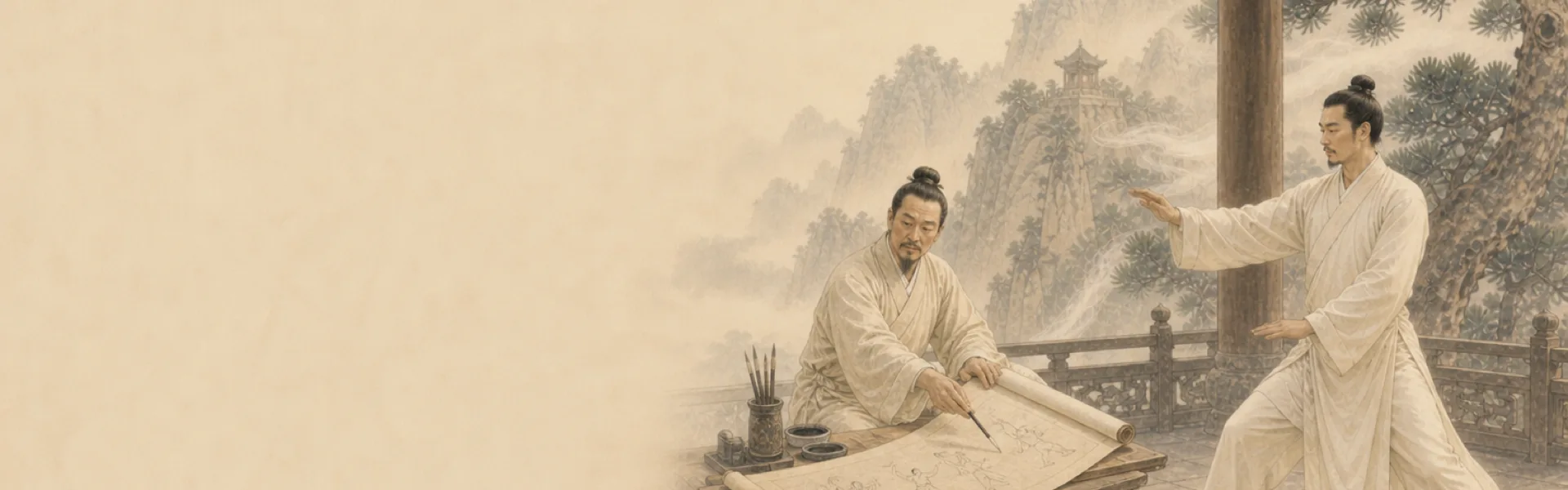
This guide introduces the received corpus, its nineteenth- and early twentieth-century witnesses, Yang Chengfu’s Ten Essentials, the thirteen postures and several phrases that are often reduced to slogans. It treats attribution as a historical question without dismissing Zhang Sanfeng’s enduring importance to Wudang tradition.
What counts as a Taiji Classic
“The Taiji Classics” is a convenient collective name, not a fixed ancient table of contents. Different manuals group and title the pieces differently. A commonly received core includes the Taijiquan Treatise, writings on the thirteen postures, the Song of Pushing Hands, and texts associated with Wu Yuxiang and Li Yiyu.
Some pieces are verse, some are compact prose, and some read like notes for people already familiar with a method. Douglas Wile’s study describes five core texts transmitted through the Yang-family line while also examining additional late-Qing manuscript collections. The label therefore identifies a textual tradition whose boundaries changed, rather than exactly five or six universally agreed works.
Surviving witnesses, attributions and dates
Late-Qing copies associated with Li Yiyu are important dated witnesses; three handwritten compilations are commonly dated to 1881. They preserve received writings together with work linked to the Wu–Li circle. The corpus then became more widely visible through printed manuals, including a group of Yang-line texts published in Beijing in 1912. A witness proves that wording circulated by that date; it does not by itself prove when every passage was composed.
Names inside the tradition must be read with the same care. Some texts are attributed to Wang Zongyue, while received material also invokes Zhang Sanfeng and Wudang. Surviving copies do not establish that every attribution is contemporary with its named figure. That uncertainty should not be turned into a dismissal of Zhang Sanfeng, a Ming-period Taoist figure whose memory has long shaped Wudang identity. Our Origins and History guide separates early records, later martial texts and cultural memory in more detail.
How to read compressed technical writing
The classics contain instruction, mnemonic verse and explanation, but most passages are highly compressed. Phrases such as “distinguish empty and full” or “follow the other” do not specify a complete exercise, partner role or progression. They make better sense when a teacher can demonstrate the condition and a student can compare the words with repeated practice.
This does not make the texts obscure for obscurity’s sake. A useful reading turns a phrase into a test: Can you change direction without first stiffening? Can pressure move through the whole body without one joint taking over? Can you remain responsive while keeping your own balance? More elaborate language is not necessarily a deeper explanation.
The Ten Essentials in their publication context
Yang Chengfu’s Ten Essentials are later than the nineteenth-century texts usually called classics, but they are one of the clearest summaries of their practical concerns. Chen Weiming presented them as Yang Chengfu’s oral teaching in his 1925 Taijiquan shu. That publication context matters: today’s English and French lists are translations and paraphrases of a Chinese record, not ten modern fitness tips written independently.
The ten headings concern suspending the head without stiffness; containing the chest and lifting the back; relaxing the waist; distinguishing empty and full; sinking shoulders and elbows; using intention rather than clumsy force; coordinating upper and lower; uniting inner attention and outward movement; maintaining continuity; and seeking stillness within movement. Each heading opens a field of correction. None is a command to force a posture into a fixed shape.
Eight gates and five steps
The thirteen postures are traditionally organised as eight gates—peng, lü, ji, an, cai, lie, elbow and shoulder—and five steps: advance, retreat, look left, gaze right and central equilibrium. These are not simply thirteen named techniques. They are a vocabulary for relationships of force, direction and position, whose expression varies among schools.
Received texts correlate the eight gates with the eight trigrams and the five steps with the five phases. The Chinese text preserved on Wikisource displays those correspondences directly. A reader need not choose between reverence and ridicule: the correlations provide a traditional cosmological classification, while the mechanical meaning of each gate still has to be demonstrated through posture, contact and change.
Substantial and insubstantial
“Empty” and “full” are relational terms. They may describe how weight is borne, which leg can move, where pressure is accepted, or which part is available to change. They do not mean that one side is literally empty of all load, nor that every moment must place all body weight on one foot.
A practical check is whether a part committed to supporting or issuing can be distinguished from a part free to adjust. If both legs, both arms or the whole trunk become equally committed, changing may require an extra preparatory movement. Clear differentiation allows one part to stabilise while another responds, and the roles can reverse without a break.
What “double weighting” may describe
The received treatise warns that “double weighting” (shuangzhong, 双重) produces stagnation. One interpretation concerns equal weight in the feet; another extends the warning to two sides pressing directly against each other, or to parts of one body that have lost their ability to differentiate. Practice traditions do not all draw the boundary in the same place.
It is therefore unhelpful to declare one diagram of force the sole meaning. Test several situations: an evenly weighted stance that remains mobile, a one-legged stance that has become rigid, and partner pressure that traps both people on one line. The useful question is not whether a scale reads fifty–fifty, but whether the relationship can change without bracing, collapsing or taking an unnecessary step.
Following without becoming passive
“Abandon the self and follow the other” (she ji cong ren, 舍己从人) does not ask a practitioner to surrender judgment. It warns against imposing a rehearsed answer after contact has already supplied different information. Following begins with listening: recognising direction, pressure and timing before deciding how to respond.
Nor does following mean drifting wherever a partner pushes. Good partner practice maintains one’s own structure and safety while adapting to what is actually present. A teacher can make this test progressively harder, from cooperative fixed-step work to freer exchanges. The phrase is a training principle, not permission to accept unsafe force or an opponent’s claim without question.
“Four ounces” as timing, angle and structure
The Song of Pushing Hands says that a small input can lead a much larger force away. This is often summarised as “four ounces deflect a thousand pounds.” The line does not promise that physical size and strength cease to matter. It directs attention to what happens when a force is already committed and can be affected through timing, angle, leverage and loss of balance.
Partner drills can explore the idea under controlled resistance: change the line rather than collide with it, preserve a base while the partner’s base becomes uncertain, and increase pressure only when both people can remain safe. Claims should remain proportional to the drill. A successful cooperative demonstration is evidence of that exercise, not proof of effortless victory in every encounter.
Translation choices and practical testing
Technical terms resist one-word equivalents. Peng is more than “ward off,” lü is not captured completely by “roll back,” and jin may refer to trained force or a quality of force rather than ordinary muscular effort. Even punctuation can be editorial because early witnesses did not present modern sentence breaks.
Keep the Chinese term beside a provisional translation when the distinction matters. Compare editions, identify who supplied the title or attribution, and separate the source wording from a commentator’s explanation. The site’s reading guide lists the manuscript study and early manuals used here. In training, compare any interpretation with observable movement instead of treating a translation as a final verdict.
What texts cannot replace
A short text cannot supply tactile feedback, correct a joint position or decide how much range and resistance are appropriate for a particular person. It also cannot provide the full curriculum of stepping, solo form, partner work, applications, conditioning and safety practices through which a school understands these phrases.
Read the classics beside qualified teaching, not instead of it. Ask a teacher to show how a quoted principle changes a specific exercise, what failure looks like, and how the drill progresses. Stop when pain, dizziness or unsafe joint pressure appears. Historical prestige never removes the need for sound instruction and ordinary care.
Key points and further reading
- The Taiji Classics are a changing received corpus, not one ancient book with a universally fixed table of contents.
- Late-Qing manuscripts and early printed manuals establish stages of transmission; they do not settle every authorship claim.
- Zhang Sanfeng’s historical and cultural importance to Wudang should be respected while textual attributions are examined carefully.
- The Ten Essentials, thirteen postures, empty and full, following and “four ounces” become useful when turned into bounded tests.
- Translations are interpretations; retain key Chinese terms and distinguish source text from commentary.
- For the wider bibliography and edition notes, continue with the linked reading and history guides.