How to Read a Chinese Dao: Edge, Curve, Mountings and Context
怎样读懂中国刀:刃口、弧度、装具与时代语境
Dao (刀) is often translated as “sabre” or “single-edged sword,” but the word names a broad family rather than one timeless outline. Straight and curved blades, military sidearms, courtly equipment, later civilian forms, theatrical props and modern practice tools belong to different histories. A reliable reading therefore begins with a particular object and its record, not a silhouette recalled from film.
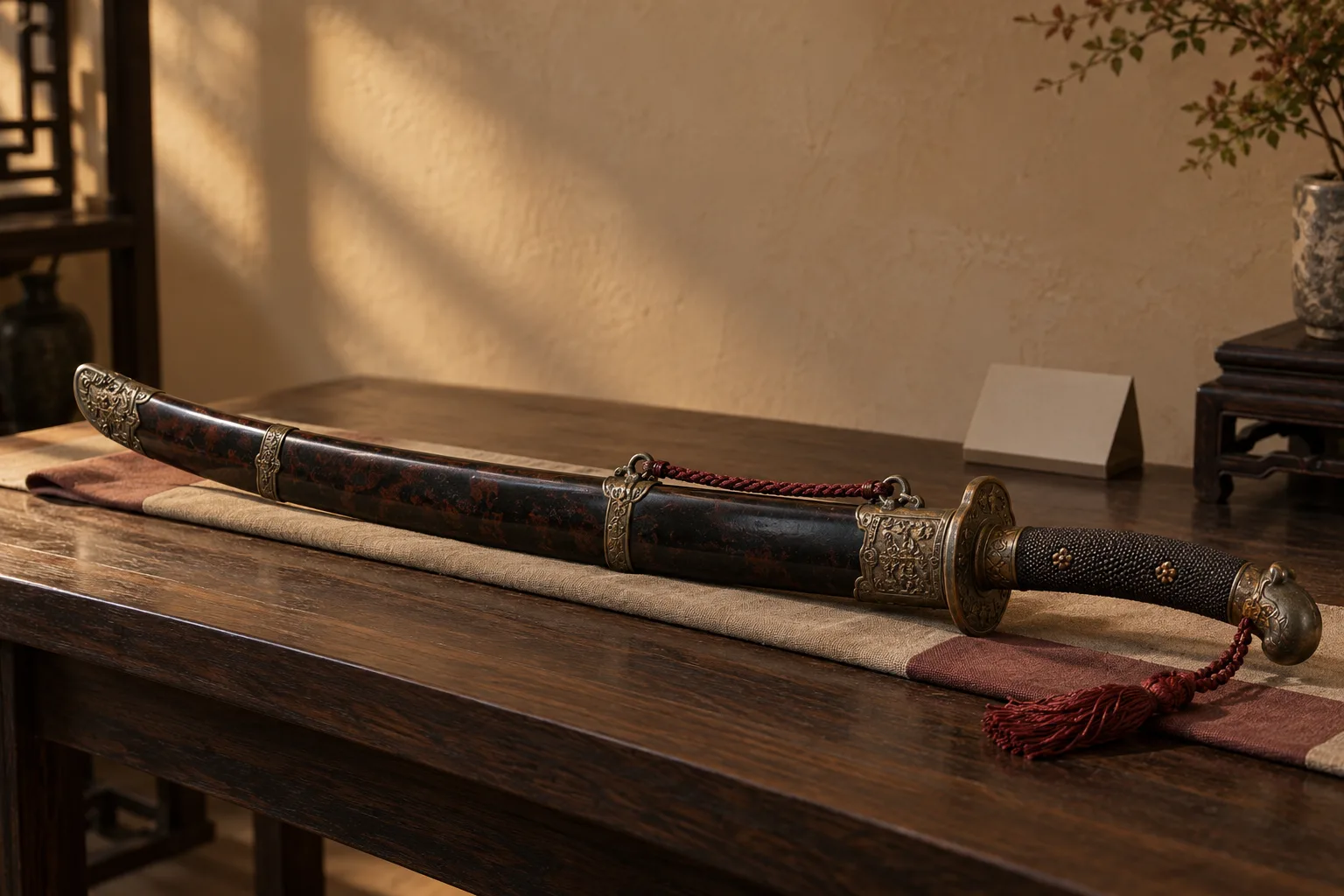
This guide complements The Sabre, Staff and Spear and the material guide to the Chinese jian. It focuses on what can be observed in blade, hilt, scabbard, mountings and provenance. It does not turn a museum sabre into proof of a modern routine, lineage or Wudang origin.
A broad category, not one silhouette
Begin with edge and profile
The first useful distinction is structural: a dao normally has one principal cutting edge, whereas a jian is normally double-edged. Beyond that, profiles vary. The British Museum records a Han-period iron sword with one edge, a loop at the end and remnants of a wooden scabbard. Much later Qing examples in the Metropolitan Museum have steel blades, developed hilts and fitted scabbards. These objects belong to the same large vocabulary of single-edged weapons without sharing one blueprint.
Read curvature as description
Observe where a blade begins to curve, how strongly it curves and whether the back and edge follow the same arc. Do not convert that observation immediately into a fixed type name. Philip M. W. Tom’s Metropolitan Museum Journal study of Qing sabres stresses the breadth of the category: examples may be long or short, nearly straight or conspicuously curved. Curvature helps describe an object; by itself it does not prove date, unit, workshop or fighting method.
Treat names as evidence, not answers
Catalogue terms such as yaodao (腰刀, waist sabre) and peidao (佩刀, worn sabre) can preserve useful historical framing. English labels—sabre, sword, broadsword—may reflect museum convention rather than a one-to-one Chinese taxonomy. Record the exact title, Chinese characters, date and collection number supplied by the source. If a later collector’s label is uncertain, keep that uncertainty visible.
Blade, hilt and scabbard
Blade surface and section
Look for the cutting edge, back, point, bevels, ridges and grooves or fullers. Patterning may come from deliberate construction, polishing, corrosion, conservation or later treatment. The Met describes one probably eighteenth-century sabre as noteworthy for a complex pattern-welded blade, but that catalogue judgment belongs to that documented object. A photograph alone cannot establish how an unstudied blade was forged.
The hilt is an assembly
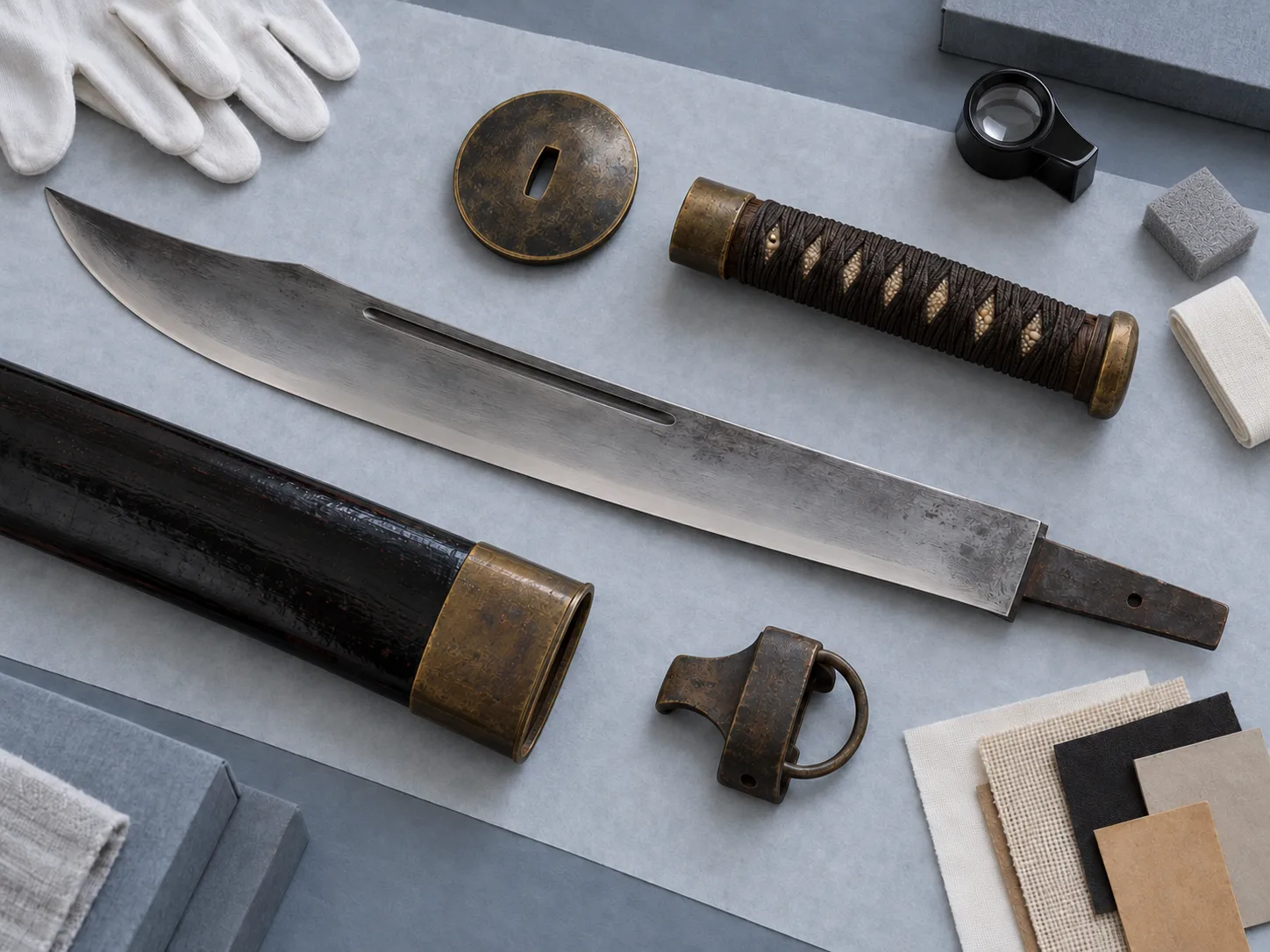
Guard, grip, pommel and the blade’s hidden tang form a system. Their outline, materials and method of attachment may differ even among objects dated to the same century. Wrapping can hide a wood core; a metal collar may cover a joint; repair can alter the original relationship. Describe what is visible before guessing what lies beneath.
The scabbard is evidence
A scabbard protects the blade and organizes how the weapon is carried. Its wood core, lacquer or covering, mouth, suspension fittings and chape can be as informative as the blade. The Met’s eighteenth-century sword with scabbard and belt hook records steel, gold, brass, shark skin, wood and textile. Those materials show that a complete sabre is a composite object, not simply a steel blade.
Object histories and use
Measure named objects
Dimensions are most useful when attached to a specific catalogue record. The Met’s pattern-welded sabre measures 91.4 centimetres overall with a 72.4-centimetre blade. Another eighteenth-century example measures 100.3 centimetres with an 80.7-centimetre blade. These figures help compare two objects; they are not ideal lengths, school standards or authentication tests.
Mounts can outlive blades
Blade, hilt and scabbard may not share one origin or date. A revealing Met object combines a Japanese blade with Chinese mountings from about 1750–1800. That record warns against assigning a whole weapon to one place or moment from a single component. Remounting, repair and reuse are part of an object’s history, not merely damage to an imagined original state.
Decoration, rank and caution
Gold, coral, mother-of-pearl, lacquer, textile and skin can indicate expense, taste and networks of supply. They do not automatically prove imperial ownership, military rank or ritual use. The Met’s seventeenth-century sword and scabbard combines steel with mother-of-pearl, coral, shark skin, textile, gold and semiprecious stones. Interpret such materials through provenance and cataloguing, not through motif alone.
A historical weapon, a deity’s attribute, a stage prop and a modern training sabre answer different questions. Never test an antique’s sharpness, flexibility or balance by handling it without permission. For movement study, use a purpose-made blunt trainer, clear space and qualified supervision; continue with The Weapon and the Body.
A six-step object-reading method
Observe before naming
- Identify the record. Note museum, collection number, stated date, provenance and whether blade and scabbard are catalogued together.
- Describe the edge and curve. Record the principal edge, back, point and location of curvature without forcing a type name.
- Separate the components. Distinguish blade, guard, grip, pommel, scabbard core, suspension and end fittings.
- List materials cautiously. Use catalogue or analytical evidence rather than colour and shine alone.
- Look for later change. Ask whether wrapping, mounts, polish, repair or scabbard may be later than the blade.
- Match each claim to its source. Keep direct observation, catalogue description, scientific analysis and interpretation separate.
Compare records, not stereotypes
Place two secure records side by side and compare only what each actually supplies: date, dimensions, materials, construction notes and provenance. The early British Museum single-edged iron sword, the Met’s Qing sabres and the cross-cultural remounted blade do not form a simple ladder toward a “perfect” dao. They reveal continuity in the usefulness of a single cutting edge and diversity in form, carrying and craft.
Connect to Wudang without forcing lineage
Wudang practice is best studied through dated manuals, living instruction, safe training and well-described objects, each doing a different job. A museum sabre can illuminate material choices but cannot, by itself, identify a Wudang form or teacher. Compare the 1931 Wudang sword curriculum, the broader Weapons gateway and Weapons Sources and Reading Paths without treating different kinds of evidence as interchangeable.
The goal is not to memorize a typology. It is to keep edge, curve, components, materials, date, use and later change visible together—and to state clearly where the record ends.