Wudang Straight Sword: The 1931 Curriculum and Its Context
武当剑:1931年课程、十三势与史料边界
“Wudang straight sword” can name a broad family of later practices, but one curriculum is unusually visible in print: Huang Yuanxiu’s Essentials of the Wudang Sword Art, published in 1931 from teaching attributed to Li Jinglin. Its photographs, named methods and staged partner work let us discuss what that book actually taught without treating every statement in its prefaces as proven lineage history.
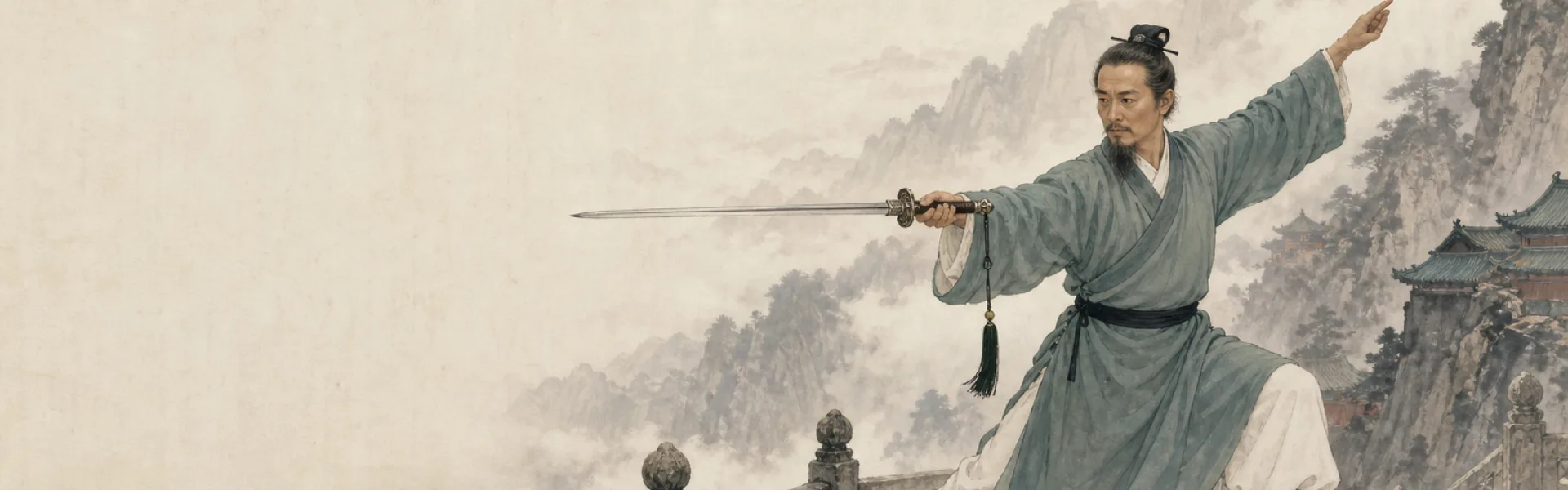
This guide reads the 1931 witness closely, compares it with dated museum objects and separates its curriculum from modern competition. It does not turn one book into a rulebook for every jian tradition.
What this article can—and cannot—establish
A dated manual can establish that particular language, exercises and claims were in circulation when it appeared. It can show how an author arranged learning and what photographs the edition chose to include. It cannot, by itself, prove that the material remained unchanged for centuries or that every school using the same name teaches the same methods.
Accordingly, “Huang writes” and “this curriculum uses” are important phrases here. Modern coaching suggestions are labelled separately. Questions that depend on an uninspected edition, an unnamed ritual source or a generalisation from replicas are left open rather than filled with legend.
Dated objects before universal specifications
The jian is a straight, double-edged sword, but surviving examples differ. The Royal Armouries catalogues a Chinese sword and scabbard dated about 1420, probably made in the Yongle emperor’s court workshops. Its particular decoration, construction and presentation context belong to that object; they do not define every Ming or later sword.
Other Royal Armouries records describe nineteenth-century and Qing-period examples with different fittings and motifs. This range is why the article does not prescribe one historical length, mass or balance. A training sword should instead be described by its own measured properties and intended task.
Huang Yuanxiu’s 1931 witness
The inspectable bilingual presentation of 武当剑法大要 identifies Huang Yuanxiu as recorder of teaching by Li Jinglin. Huang’s preface is dated summer 1930; the edition is identified as a Commercial Press publication issued in Shanghai in July 1931.
The contents extend well beyond a solo routine. They include five cautions for learners, thirteen methods with photographs, hand-position circles, graded practice, two-person triangles, active and passive circles, an arranged sparring set, moving-step sparring, free-sparring methods, fundamentals, and training of eyes, body, hands and steps. That sequence is a valuable record of how one Republican-era author presented progression.
The thirteen methods are Huang’s vocabulary
Huang gives a compact thirteen-word sequence: 抽、带、提、格、击、刺、点、崩、搅、压、劈、截、洗. The bilingual page glosses them as drawing, dragging, lifting, blocking, striking, stabbing, tapping, flicking, stirring, pressing, chopping, checking and clearing. One-word translations are only signposts; the following photographs and explanations supply the action.
抽、带、提 change contact while drawing, carrying or lifting along a line.
格、击、刺、点 cover distinct forms of interception or arrival in Huang’s descriptions.
崩、搅、压 organise upward, circling and downward changes.
劈、截、洗 retain their Chinese graphs because “chop,” “check” and “clear” do not capture every described variation.
This is Huang’s classification for the curriculum he records. Other jian traditions may divide, combine, name or perform actions differently; disagreement in a list is not proof that one branch is incomplete.
From individual actions to paired decisions
The book’s arrangement moves from fundamentals and individual methods toward increasingly variable partner formats. Arranged work can teach line, distance and a safe response sequence. Moving-step work changes where contact occurs. Freer exchange requires choice rather than recall. Huang’s own note warns learners not to enter free sword work before the preceding paired stages are competent.
This supports a progression, not a fixed timetable. Present teachers must adapt pace and equipment to the people in front of them. Nor does the existence of free sparring in one book prove that every later group practised it continuously. The page describes the printed curriculum; it does not invent an unbroken performance history.
Eyes, body, hands and steps in a period teaching system
Huang names eye method, body method, hand method and stepping as four fundamentals, then relates them to attention, courage, power, speed and calmness. Elsewhere the book uses period concepts such as intention, qi, the dantian, fullness and emptiness. These terms belong to its explanatory world and should first be read in that context.
A present-day drill can make parts of the instruction observable: keep the point within an agreed line, change steps without colliding, maintain a controlled grip, or stop on signal. That translation into tasks is a coaching choice, not a claim that traditional language secretly states modern anatomy. Sword-finger gestures and their religious history also require their own sources; this article does not assign them a single origin.
The lineage preface and Zhang Sanfeng
The 1931 prefatory material presents Li Jinglin’s teaching through Song Weiyi and connects the lineage to Zhang Sanfeng. Zhang Sanfeng is a Ming-dynasty figure of enduring importance in Wudang culture and later martial memory. Treating that importance respectfully does not require confusing types of evidence.
The preface documents what this Republican-era publication claimed about lineage. The technical chapters document what Huang chose to teach and illustrate. Neither supplies, by itself, a continuous set of dated records from the Ming to 1931. The reported 1923 Song Weiyi manual should not carry exact historical or technical claims until an inspectable copy or institutional catalogue record is located.
Modern routine competition is another context
The International Wushu Federation’s 2019 traditional competition rules distinguish individual routines, choreographed sparring, group routines and performance events. They require approved weaponry and list deductions for a deformed, broken or dropped weapon and for partner errors in choreographed work.
Those rules show that modern competition has explicit formats and equipment controls. They do not show that a competition sword reproduces Huang’s equipment, that blade sound is an authenticity test or that a routine implement is safe for free contact. Historical curriculum, current competition and partner fencing should be named separately.
Practise with explicit limits
Begin with an intact blunt trainer suited to the drill, a clear floor and enough overhead and lateral space. Agree on speed, targets, contact, stopping distance and a stop signal before paired work. Progress from isolated actions to pre-arranged exchanges and only then to constrained choice. Sharp blades, damaged weapons and uncontrolled contact do not belong in ordinary partner practice.
Protective equipment reduces only the risks it was designed for; it does not replace control. If a teacher cannot explain the task, resistance and stopping condition, the drill is not ready to speed up. Return to the Wudang sword and weapons gateway for the wider evidence map and the other weapon categories.