How to Read a Chinese Jian: Blade, Hilt, Scabbard and Context
怎样读懂中国剑:剑身、剑柄、剑鞘与时代语境
A Chinese straight sword can be recognized quickly, yet understood badly. The word jian (剑) names a long-lived family of double-edged straight swords, not one timeless set of dimensions or fittings. Bronze examples, later iron and steel blades, courtly objects, practical weapons, ritual images and modern training tools belong to different settings. The useful question is therefore not “What is the correct jian?” but “What does this particular object allow us to say?”
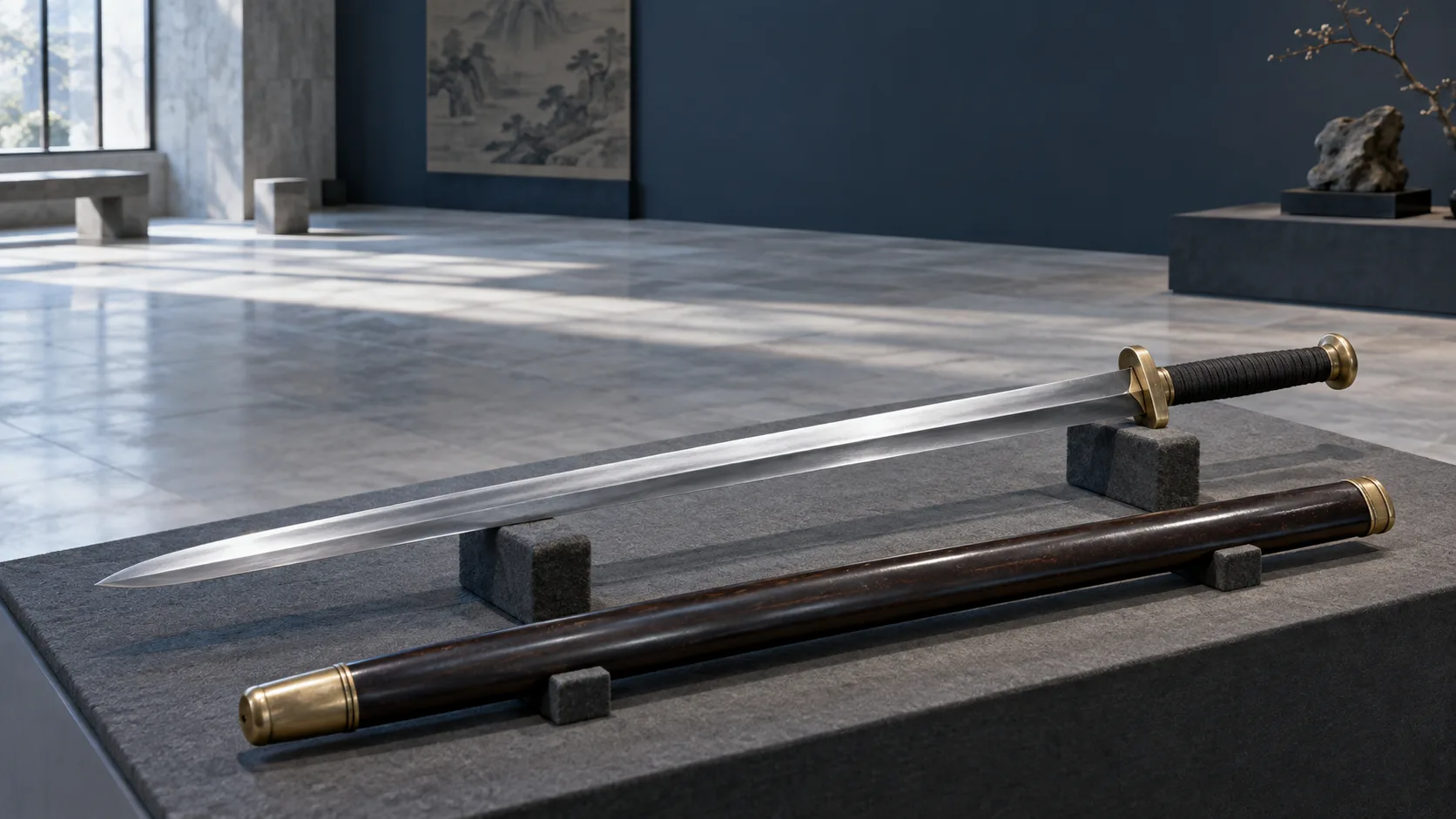
This guide concentrates on material evidence. It complements the history and practice described in Wudang Straight Sword: The 1931 Curriculum and Its Context without turning a museum object into proof of a modern routine or lineage.
A category, not a single blueprint
Begin with the blade
A jian is normally identified by a straight blade with two edges. From there, variation matters: overall length, blade length, width, taper, point, central ridge, cross-section and surface treatment can differ. The Royal Armouries describes a fifteenth-century Ming jian as a straight, double-edged sword, while museum catalogues also preserve much earlier bronze forms and later steel examples. That definition is a starting point, not permission to treat every surviving sword as mechanically identical.
Read the hilt as an assembly
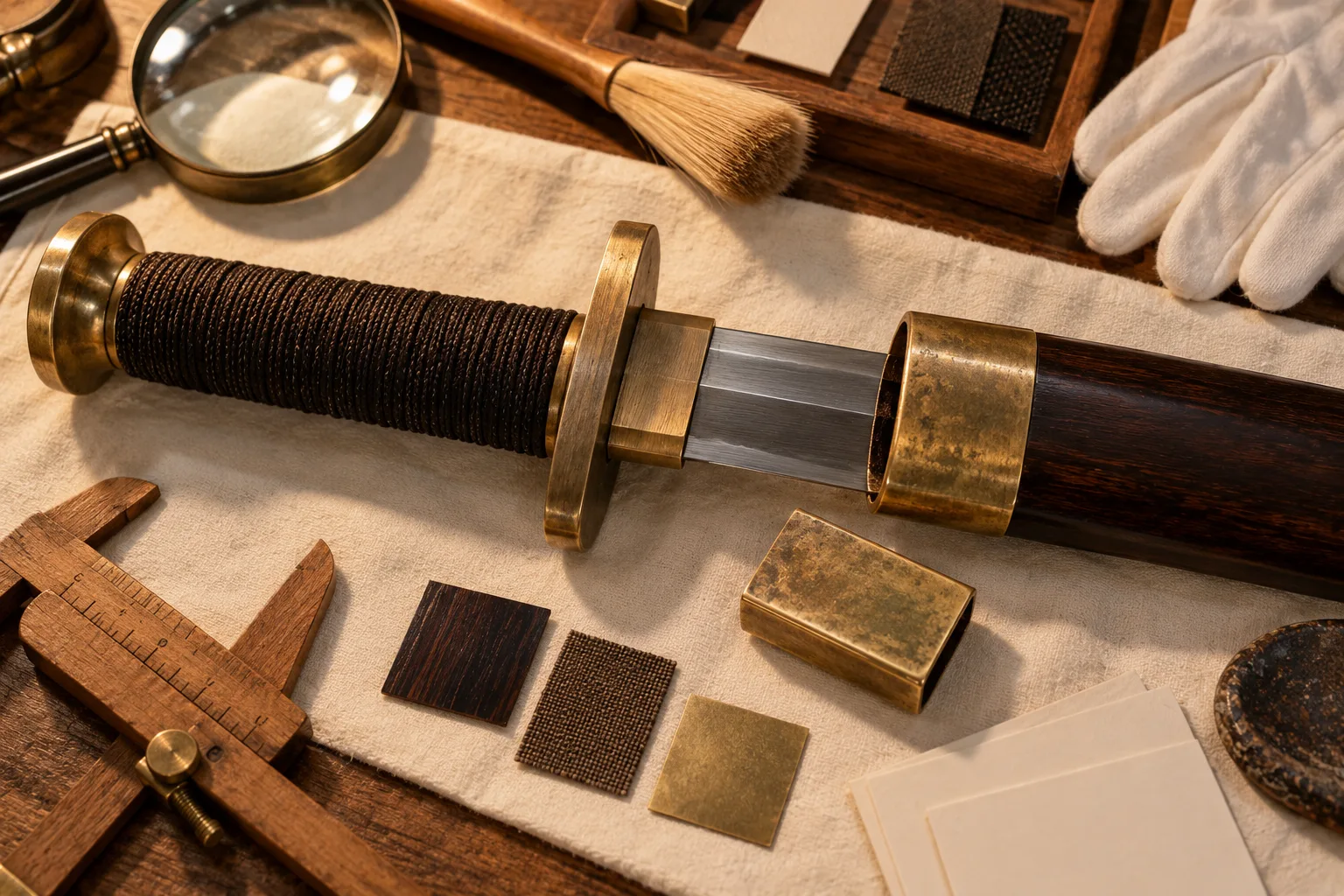
The hilt joins guard, grip and pommel to the blade’s hidden tang. Their shapes can help describe an object, but a photograph rarely reveals how the internal joint was made. On one Spring-and-Autumn-period bronze sword, the Palace Museum catalogues a thick guard, round tang and round pommel; later swords may combine a steel blade with separately made metal fittings and an organic grip. Use the museum’s own terminology for the object in front of you rather than forcing one vocabulary across centuries.
The scabbard is evidence too
A scabbard protects the blade, supports carrying and creates another surface for craft. Its wooden core may be lacquered, wrapped or fitted with metal and other materials. Look for the mouth, suspension or slide fittings and the protective end mount, often called the chape. The British Museum records one Chinese sword with an iron blade, lacquered wooden guard and pommel, and a lacquered wooden scabbard with carved slide and chape. Blade and scabbard should be read together, while still allowing for later remounting.
Read materials and making
Bronze and steel belong to different histories
The celebrated Sword of Goujian in the Hubei Provincial Museum is a bronze sword with a disk-shaped pommel, decorated guard, inscription and lacquered wooden scabbard. A scientific study of six Han-period iron swords from Xi’an, by contrast, identified more than one iron-production route. These records demonstrate technological change and diversity; they do not establish one uninterrupted recipe for every later jian.
A sword is a composite object
Even when “steel” names the blade, the whole object can include wood, lacquer, brass, silver, enamel, textile, horn or skin. Two Metropolitan Museum swords make the point clearly: a seventeenth-century example combines steel, brass, enamel and wood, while an eighteenth- to nineteenth-century example combines steel, silver and wood. Materials can indicate workshop choices, status, regional taste or later repair, but only when tied to a secure object record.
What the surface cannot prove
A bright line, dark pattern or polished ridge is not, by itself, a metallurgical diagnosis. Grinding, polishing, corrosion, conservation and modern decorative treatment can all change appearance. Scientific claims about forging or heat treatment require methods such as metallography, microscopy or compositional analysis. Do not label a blade “folded,” “laminated” or “ancient steel” from an online photograph alone.
Read date, use and later change
Measurements are records, not universal rules
Record the measurements of a named object precisely, then stop. The Metropolitan Museum’s seventeenth-century sword has a 72.7-centimetre blade, while its eighteenth- to nineteenth-century example has an 83.8-centimetre blade. Their different overall lengths and weights belong to those two catalogue records; they are not minimums, ideals or proof of a particular school.
Decoration and inscription need context
Motifs, inscriptions and precious fittings can reveal ownership, rank, wishes or workshop practice, but interpretation begins with secure reading and provenance. The Sword of Goujian’s eight-character inscription is unusually informative because archaeology, script and scholarship connect it to a named ruler. Most swords do not offer evidence that complete. Avoid assigning Daoist, imperial or Wudang meaning to a motif simply because it looks auspicious.
Antique, ritual image and training tool are not interchangeable
A historical weapon, a sword held by a deity, a theatrical prop, a competition implement and a blunt practice replica answer different questions. Their balance, materials, edge, durability and permitted use may differ. For movement study, continue to The Weapon and the Body; for practice structure and consent-based partner work, use Forms, Drills and Applications. Never test an antique’s sharpness, flex or balance by handling it without authorization.
A six-step object-reading method
Observe before naming
- Identify the record. Note the museum, collection number, stated date, provenance and whether blade and scabbard are catalogued together.
- Describe the form. Record straightness, edges, point, ridge, cross-section and proportions without guessing function from appearance.
- Separate the parts. Distinguish blade, guard, grip, pommel, scabbard core and fittings; note which joints are hidden.
- List materials cautiously. Use catalogue or analytical evidence, not colour alone, to identify metals, wood, lacquer, textile or other materials.
- Look for change. Ask whether mounts, wrapping, polish, repair or scabbard might be later than the blade.
- Match claim to source. Keep direct observation, catalogue description, scientific analysis and interpretation visibly separate.
Connect the object to Wudang without forcing it
Wudang sword practice is best studied through dated manuals, living instruction, safe training and well-described objects, each doing a different job. Use the Weapons Sources and Reading Paths guide to compare them. Useful object records include the Royal Armouries overview, the Hubei Provincial Museum’s Sword of Goujian, the Metropolitan Museum’s seventeenth-century sword and later sword with scabbard, and the metallurgical study of Han iron swords.
The aim is not to reduce a sword to a checklist. It is to let form, material, date, use and later change remain visible together—and to recognize where evidence ends.