Whisk, Fan and Other Wudang Implements: Objects and Practice
拂尘、扇与其他武当器械:器物、文化与练习
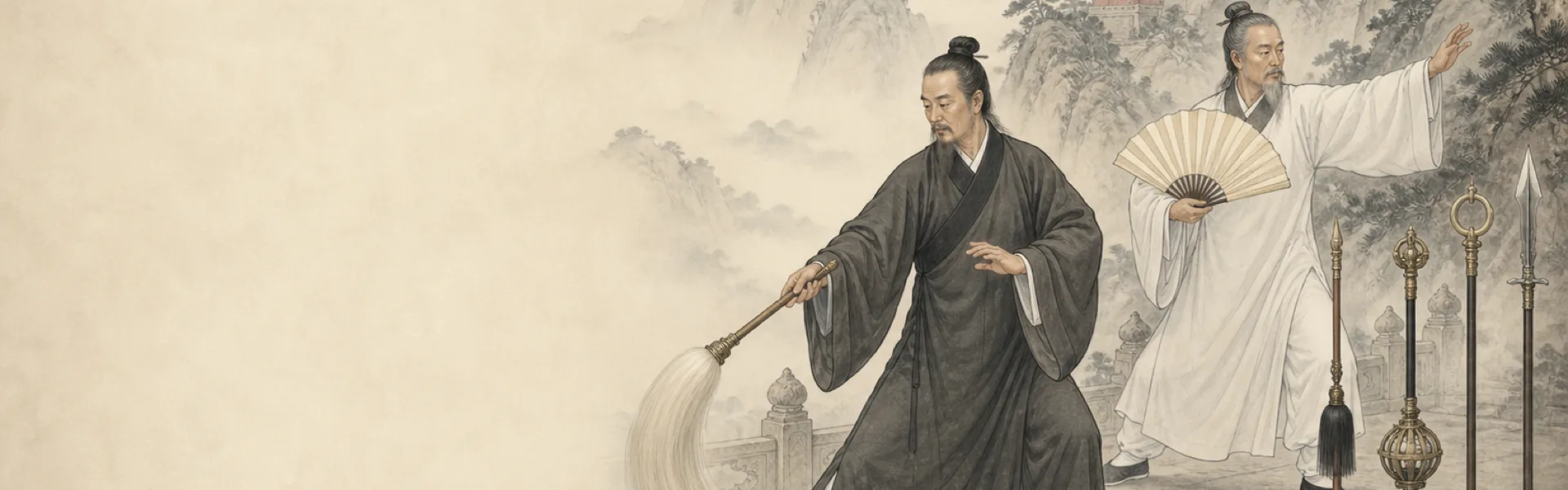
Look first at the object, then at the practice
A trailing whisk and an opening fan bring a different visual rhythm to a demonstration from a straight sword or a staff. To understand them, begin with three separate questions: what is the object made to do, what meaning does it carry in this setting, and what does this particular sequence teach? An answer to one question does not automatically answer the others.
The same object can appear in religious imagery, a collection, a performance or a teaching session. This guide offers a way to look closely at those settings without assuming that every whisk is a weapon, every fan is a ritual implement, or every practice presented under the Wudang name has the same history.
The whisk: handle, fibres and context
The fly whisk, or fuchen (拂尘), combines a handle with a bundle of trailing fibres. In an actual specimen, examine the attachment, handle length, material and condition rather than assuming a standard design. The handle and fibres do not behave like a single rigid rod: the fibres may continue moving after the hand changes direction. That visible difference is a useful starting point for observation, not proof of a special power.
Meaning also depends on context. A figure carrying a whisk in a religious image, an implement used in a ceremony and an object used for a martial sequence require different explanations. Where religious use is involved, seek the explanation of the relevant community or officiant. A movement learned in an ordinary class does not by itself confer a ritual role or authority.
What an image can—and cannot—tell us
Museum interpretation offers a helpful model of precision. The Isabella Stewart Gardner Museum describes its small silver repoussé figure, accession M18e102, as possibly Lü Dongbin. Its 2023 conservation account retains that qualification. An identification can be useful while remaining provisional; removing “possibly” would make the evidence sound stronger than the museum presents it.
Similarly, an image may help us identify an attribute or understand a religious theme, but it does not supply the missing steps of a martial routine. To connect it to a named practice, we would need further evidence about movements, instruction and transmission. Respect for an image and careful treatment of its evidential limits belong together.
Fans are not all the same object
A folding fan has ribs that open around a pivot and support its leaf. This construction differs from a fixed fan, and neither category identifies one material, weight or intended use. A delicate painted fan, a performance prop and an implement manufactured for a particular training syllabus should not be treated as interchangeable merely because each is called a fan.
Fans also provide surfaces for art. The Metropolitan Museum of Art holds The Immortal Lü Dongbin Appearing over the Yueyang Pavilion, accession 17.170.2: a painting on silk catalogued as a fan mounted as an album leaf. This is a concrete example of a fan bearing a Daoist subject. It is not a record of a folding-fan fighting sequence, nor evidence that every fan associated with Daoism served a martial purpose.
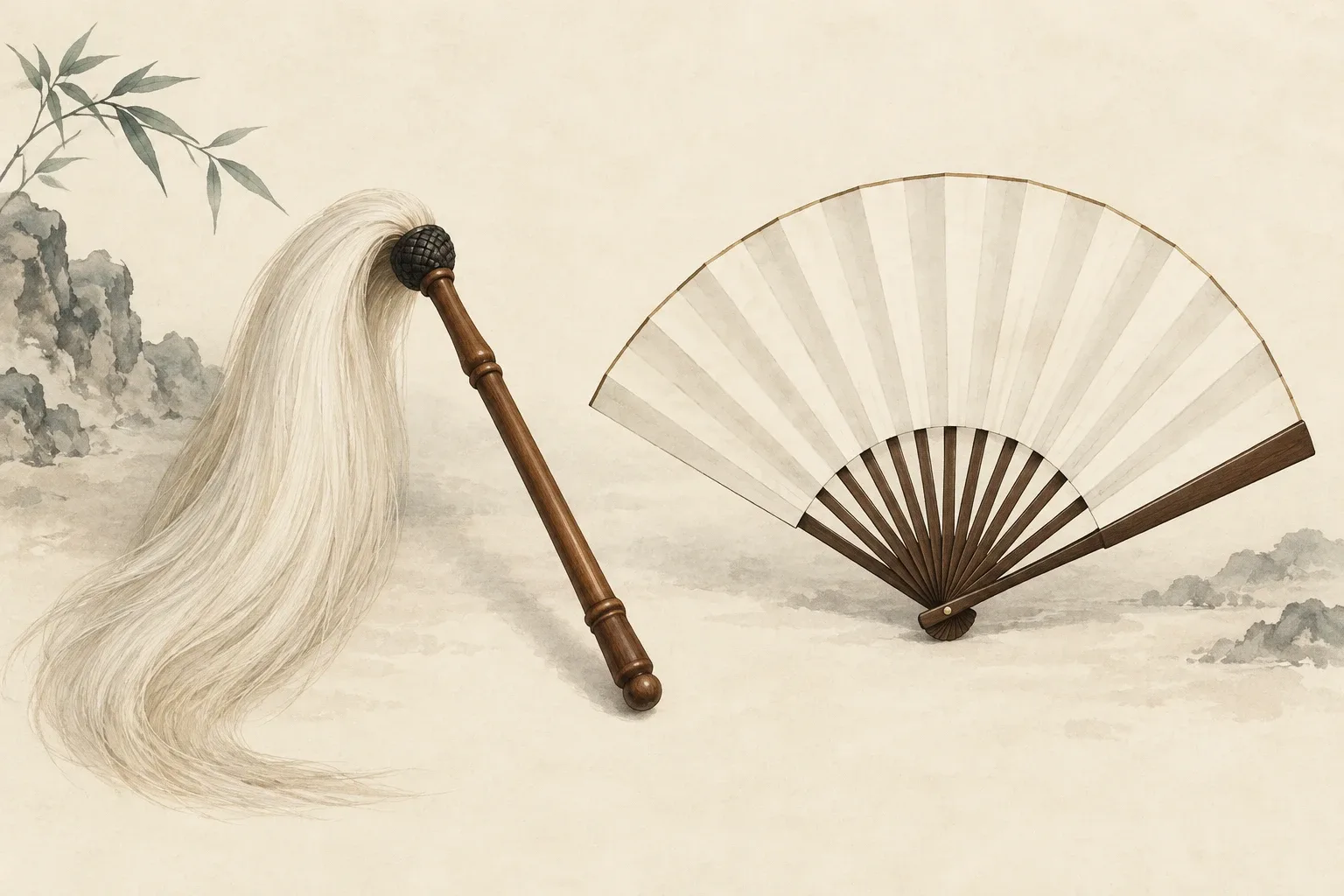
AI-generated illustration of a whisk and folding fan. A conceptual comparison, not a historical object or technical diagram.
A documented modern setting for fan routines
For a different kind of evidence, the International Wushu Federation’s regulations issued on 30 December 2024 for the tenth World Kungfu Championships list Shanzi (fan) and Taijishan among individual single-weapon routines. This tells us that fan routines were explicitly accommodated in that competition framework.
It does not date the invention of those practices, certify every school’s lineage, or make a competition category a universal syllabus. When watching or joining a class, ask for the particular routine’s name, the version being taught and its teaching source. Those details tell you more than the broad label “Wudang fan” alone.
Watch how the implement changes the task
With a whisk, look at the relationship between the hand’s path, the handle and the trailing fibres. With a folding fan, notice when it opens or closes, where its edge travels, and how the practitioner makes room for it. These are observation questions, not a prescription for wrist angles, speed or force.
A sequence can invite attention to timing, direction changes and control of space. Whether it actually develops those abilities depends on the exercise, feedback and practice conditions. A flowing appearance or a loud fan opening is not, by itself, a measure of coordination, health benefit or fighting ability. Nor does proficiency with one implement automatically transfer to another.
Other implements: identify before classifying
When a demonstration includes an unfamiliar short implement, a paired set or an object with flexible parts, first establish its exact name and construction. Ask whether you are seeing a ceremonial object, a training tool, a performance prop or a reproduction—and whether the person presenting it is making a historical claim at all.
Labels such as “rare” or “unusual” describe an observer’s familiarity, not a date or a pedigree. An implement may be uncommon in one programme and familiar in another. Avoid turning a mixed display into a single ancient catalogue, but also avoid declaring an unfamiliar practice newly invented simply because you have not encountered its records.
Read a history claim at the right scale
A useful history identifies the object or routine, the source and what that source actually records. A dated photograph can document an appearance; a manual may preserve named movements; a teacher’s account can describe a remembered transmission. Each deserves to be read for its own contribution rather than silently substituted for the others.
Ask which edition or photograph is being used, whether the sequence is described in enough detail to compare, and how later versions relate to it. If a practice is absent from one manual, the limited conclusion is that this manual does not document it. Neither ancient origin nor modern invention follows from that absence alone. Honest uncertainty leaves room for further work without belittling a living tradition.
Choose an appropriate and controlled learning setting
Before handling an implement, have the instructor check that it suits the exercise and that its handle, attachments, ribs and pivot are sound. Begin with adequate clearance and non-contact work. A light object is not harmless: hard fittings, broken ribs or moving fibres can still cause injury. Do not experiment with eye-level contact, entanglement or striking a partner on the basis of a demonstration or written description.
Ask what the session is designed for and how the teacher will adapt it to your experience and available space. Performance, cultural study and martial training can all be meaningful purposes, but their standards and precautions are not identical. Historical objects belong in appropriate conservation care, not in improvised training tests.
Follow the question that interests you
For the broader distinction between material history, lineage accounts and modern teaching, return to Wudang Sword and Weapons. For a comparison with three other implement families, read The Sabre, Staff and Spear.
If the whisk or fan is what draws you to a class, that is a worthwhile starting point. Look for a teacher who can name the practice, explain its purpose, acknowledge the limits of its historical evidence and provide an appropriate learning environment. You do not need to choose between appreciating its beauty and asking clear questions about what you are learning.