The Weapon and the Body: Coordination, Perception and Practice
器械与身体:协调、知觉与练习
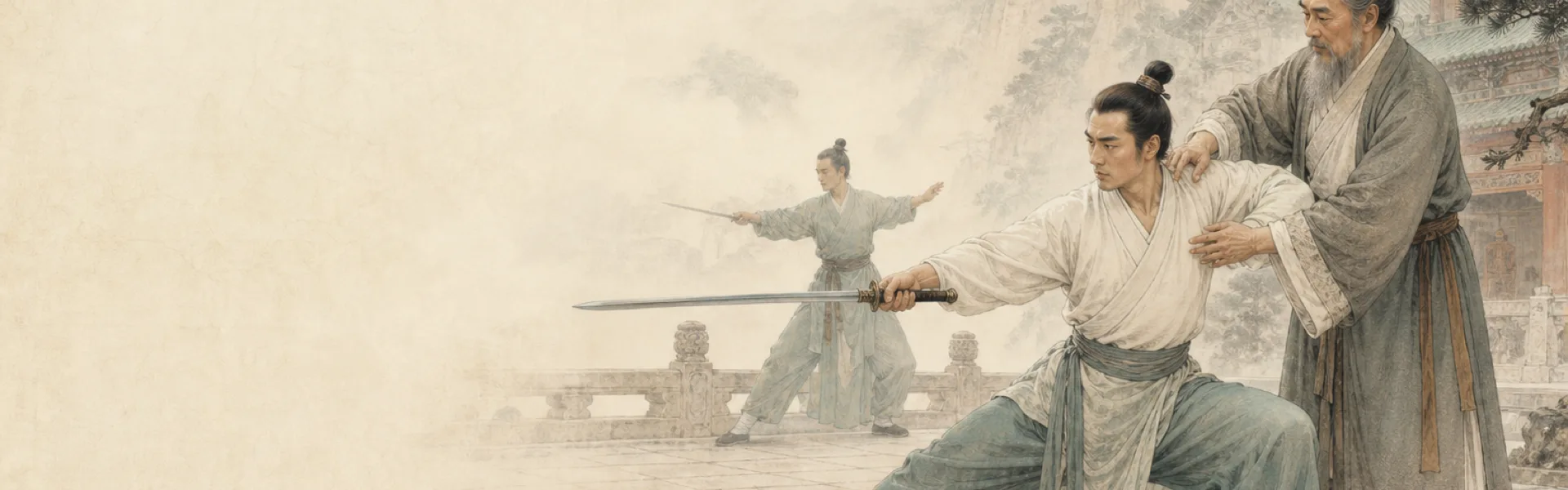
What does it mean to move with a weapon?
Calling a weapon an extension of the body can express a practical aim: moving while keeping the implement’s position, path and relationship to the surrounding space under control. The phrase can also convey an experience of familiarity, when handling an object no longer occupies attention in the same way as it did at the beginning.
Neither meaning supplies a universal test of mastery. This guide separates a historical teaching image, research on tool perception and concrete questions for practice. These perspectives can illuminate each other, but they should not be collapsed into a claim that science has verified an entire martial tradition.
A dated sword text gives the phrase a context
The opening inscriptions in Huang Yuanxiu’s 1931 Essentials of the Wudang Sword Art include Li Jinglin’s description of the body uniting with the sword through sustained practice, and Sun Fuquan’s statement of sword and body becoming one. These are identifiable statements in a particular publication, not anonymous sayings that need to be assigned an invented origin.
Their language belongs to the book’s presentation of sword practice. It need not be reduced either to a literal anatomy lesson or to empty ornament. When an instructor uses similar language today, ask which observable aspect of the exercise it describes: the relation between steps and hand movement, the control of the implement’s path, or a change in attention. That makes the instruction discussable without pretending to settle every meaning of the historical text.
What research on sensing through tools shows
In a 2018 study, Luke E. Miller and colleagues found that people could locate contact along a handheld wooden rod. Their experiments and models linked that ability to vibrations produced by the impact and to sensory processing. The work concerns a physical tool carrying information from a contact to the person holding it.
This is a useful comparison for discussing perception through an implement, but the experiment did not test Wudang swordsmanship. It does not establish a martial rank, a training timetable, or the ability to detect an untouched opponent beyond the tool. A laboratory finding about contact location is more specific than the broad claim that a weapon has simply become part of the body.
Changes in body estimates are not proof of better technique
A 2020 study led by Salam Bahmad examined twenty adults aged 51–69. Their free-hand reaching movements changed after using a mechanical tool; the same pattern did not appear in a comparison condition with equivalent weight attached to the wrist. The researchers interpreted the changes in relation to the body estimate used for movement control.
Here, “changed” does not mean “became a better martial artist”. The study was not a weapons curriculum or a test of fighting skill. It also distinguishes action-related body estimates from conscious judgements about the body. Treat such research as evidence for particular forms of adaptation, not as proof that every tool, person and training method produces the same result.
Let the equipment define part of the task
Length, mass, balance, stiffness and the number of hands used all affect the handling problem. A fan that opens, a staff held in two hands and a sword held in one hand cannot be made equivalent by repeating a single instruction about connection. Begin by identifying the actual implement and the movement the teacher wants you to learn.
Choose practice equipment for that task and your present experience, with the instructor’s guidance. Heavier is not automatically more educational, and lighter is not automatically incapable of giving feedback. Changing the equipment changes the exercise; it is not a shortcut to proving that a person’s technique is authentic or advanced.
Grip and support need specific explanations
A secure grip must keep the implement under control. Beyond that starting point, ask which hand positions, changes of grip and handling conventions belong to this method. Do not replace those details with an instruction to be as loose as possible. A teaching cue about relaxation should not become permission to let an object slip or travel unpredictably.
Likewise, language about using the whole body does not mean the arm stops supporting or controlling the implement. The instructor can explain how posture, hand position and movement relate in the chosen exercise. Shoulder discomfort or a particular number of minutes before fatigue cannot, on its own, diagnose whether a supposed connection is present or absent.
Attention belongs to the exercise, not one compulsory point
Sometimes a teacher may direct attention towards the implement’s end; at another moment, the useful observation may concern the hand, a step, clearance or a partner’s position. Ask what the cue is intended to change and how you will recognise that change. Avoid treating “always watch the tip” or “the body always moves first” as a rule for every weapon and every task.
A practical review can use a small number of clear questions: did the implement stay within the agreed space, was its path deliberate, and could the practitioner stop or reset when asked? These observations are more useful than assuming that a graceful appearance proves a particular internal mechanism. They remain exercise-specific checks, not universal certification tests.
Progress by changing a manageable part of the exercise
Start in a clear space with equipment and movements appropriate to the lesson. Keep introductory work non-contact. Ask the teacher whether the next change should concern direction, stepping, sequence length or another feature; increasing speed, weight and complexity together makes it harder to understand what changed. Stop and reset if control deteriorates or discomfort develops.
Partner exercises require their own instruction, agreement, equipment and stopping rules. Do not ask someone to push on a blade or the far end of an implement as a quick test of structural unity. Nor is a heavy weapon or paired work a compulsory gateway through a universal ladder of stages. Progress should be tied to the task and the learner, not to a dramatic test.
Check transfer rather than promise it
Weapons and empty-hand lessons may share questions about space, timing and coordination. A teacher can make that relationship explicit by naming what is being compared and observing it in each exercise. A useful comparison does not require the two movements to be identical, and resemblance alone does not establish their historical relationship.
Improvement with one implement should therefore be assessed separately from improvement without it. Laboratory after-effects following tool use are not evidence that weapons training automatically improves every empty-hand skill. Empty-hand practice also has its own worthwhile aims; it should not be dismissed as incomplete merely because a learner does not study weapons.
A useful meaning of becoming familiar
For a beginner, a sound aim is increasingly deliberate, repeatable handling under clearly understood conditions. Ask what you are learning, which feedback matters and what remains difficult. Familiarity need not mean forgetting the implement or ignoring its hazards; it can mean attending more effectively to the task while retaining control.
For the dated sword curriculum behind the historical language, read Wudang Straight Sword. For comparisons between equipment families and teaching purposes, continue with The Sabre, Staff and Spear. Let the phrase “extension of the body” open a precise conversation rather than close it.