The Sabre, Staff and Spear: A Guide to Chinese Weapons
刀、棍、枪:认识传统兵器与练习方式
A sabre, a staff and a spear make three different introductions to Chinese weapons practice. The sabre brings attention to an edge and its direction; the staff asks the learner to account for both ends of a long implement; the spear adds the relationship between a shaft and its point. Each offers a way to study movement, distance and control, while carrying its own histories and teaching traditions.
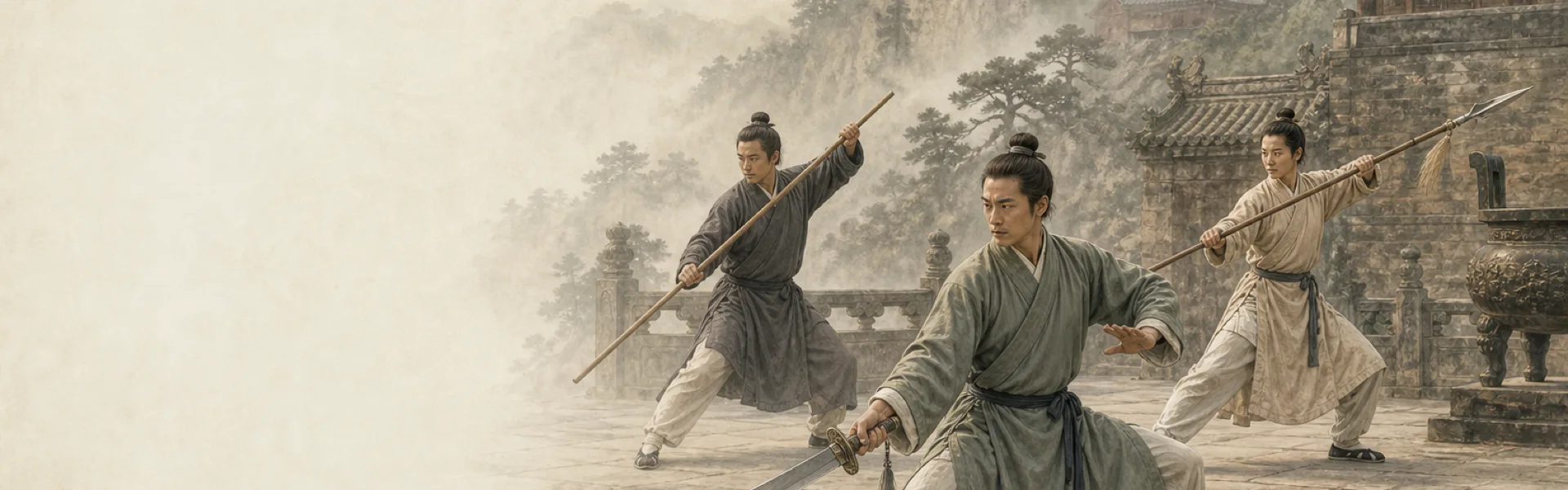
The Chinese names are dao (刀), gun (棍) and qiang (枪). They describe broad weapon families. A useful introduction begins with the particular implement and curriculum in front of you: its construction, the task being taught and the setting in which it is used.
Three weapon families, many forms
In this guide, dao means the single-edged weapon commonly called a Chinese sabre. Its blade may be relatively straight or curved, and its handle and proportions vary. A staff is a shaft used as the implement itself. A spear combines a shaft with a head whose point is a defining feature. These descriptions help readers recognise the families; they are not purchasing specifications.
Look at the complete object. Blade and handle, shaft and head, length and balance belong together. The name alone does not tell you its weight, flexibility, intended use or suitability for a beginner.
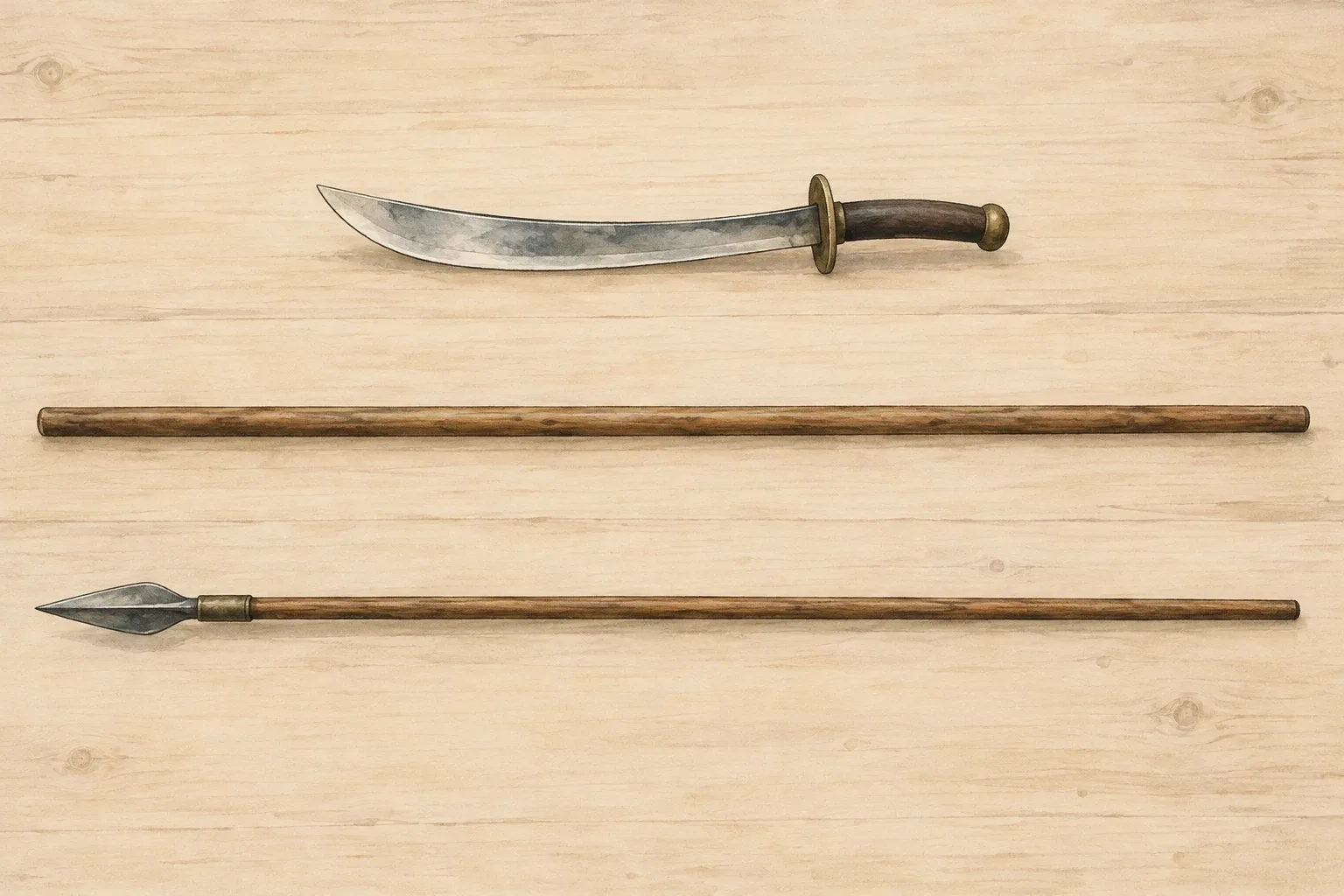
AI-generated editorial illustration of a sabre, staff and spear; generic examples, not shown to a measured scale.
The sabre: following the edge
For a newcomer watching a sabre form, useful details include the direction of the edge, the changing orientation of the blade and the place of the free hand. Follow how the practitioner begins, redirects and finishes a movement. A broad arc and a compact action can each have a place within a particular routine.
Lü Guanghua and Li Yuanzhi’s A Handbook for Plum Blossom Saber, published in 1931, compares two sabre designs and gives separate dimensions for them. This is a concrete example of variation within a named curriculum. Its preferred design belongs to that publication’s argument; it does not establish one ideal sabre for every school.
In a lesson, ask the teacher to explain which features of the training implement matter for the material being taught. A blade’s appearance, sound or apparent weight is not enough to assess the quality of the practice.
The staff: accounting for both ends
A plain shaft can make movement easy to see. Notice the distance between the hands, how the grip changes and where each end travels during a turn. The end behind the practitioner deserves as much attention as the end in front, especially in a shared practice space.
Jiang Rongqiao’s 1930 An Authentic Description of Shaolin Staff Methods discusses different grips and compares staff and spear work. It provides a dated example of these distinctions. Its broader origin stories require separate historical examination.
For present-day learning, ask which staff length and material the class uses, whether grips change during the form and how the teacher introduces those changes. An eyebrow-height staff is one option in Chinese practice, rather than a measurement that defines every staff tradition.
The spear: observing the point and the shaft
When watching spear practice, follow the point as well as the hands. How does its direction change as the practitioner steps? Is the movement intended for a solo sequence or an agreed exchange with a partner? What space does the whole implement need?
Qi Jiguang’s Jixiao Xinshu includes a discussion of long weapons alongside military coordination. The spear chapter distinguishes individual methods from the requirements of soldiers working in formation. It offers a Ming military perspective, not a description of every later spear school.
In a modern class, shaft construction, length and the training head should be explained together. Visible bending is a feature to understand in that equipment and exercise; it is not, by itself, a measure of skill or authenticity.
What to look for in a demonstration
These questions offer a simple way to watch more attentively. They are observation prompts, not a universal technical checklist:
- Sabre: can you follow the edge’s orientation as the movement changes?
- Staff: can you see where both ends travel and how the hands organise the movement?
- Spear: can you follow the point’s direction in relation to the practitioner’s steps?
- All three: does the practitioner retain enough control to finish the movement and stop when required?
Ask what the demonstration is intended to show. A solo routine, an arranged exchange and a competitive performance make different demands. Understanding the format makes the details more meaningful.
Reading weapons history in context
A military chapter, an illustrated teaching manual and an account of a teacher’s lineage answer different questions. A manual shows what its authors chose to explain. A photograph records a moment. A lineage account tells us how a community presents transmission. Each becomes more useful when its date, purpose and limits are clear.
The Ming discussion and Republican-era manuals used here are examples of particular settings. They do not establish an unbroken history for every modern routine. Likewise, memorable sayings about weapons should be read as teaching language unless a specific historical claim has been independently established.
Solo forms and learning with a partner
Solo practice lets a learner attend to sequence, direction and control without another implement entering the space. Arranged partner work adds an agreed relationship: roles, distance, timing and a known stopping point. Freer work introduces more uncertainty and requires its own equipment, rules and supervision.
These formats can complement one another. Progress should follow the learner’s control and the teacher’s assessment, rather than a fixed promise about how many weeks a weapon takes to master. Before joining paired work, ask exactly what is permitted, what remains out of scope and how either person stops the exercise.
Choosing equipment and preparing the space
Have the instructor specify equipment suitable for the intended activity. An implement sold for display or solo performance may be unsuitable for contact. Check for cracks, splinters, loose fittings and damaged tips; withdraw questionable equipment rather than testing it against a partner.
Allow clearance for the full movement, including the rear end of a staff or spear, and check the floor, ceiling and nearby people. Partner work needs explicit consent, agreed speed and contact limits, appropriate eye, face and hand protection, and an immediately respected stop signal. Padding and bluntness reduce particular hazards but do not make weapons practice harmless. Sharp blades do not belong in ordinary group or partner practice.
Learning weapons within a Wudang programme
A Wudang course can place weapons within a wider study of movement and culture. To understand a particular offering, ask for the form’s name, its teacher and transmission account, and the preparation expected before starting. Those details reveal more than a general label.
If a teacher relates weapon work to Taijiquan, Baguazhang or Xingyiquan, ask which exercise illustrates the connection. This can make a teaching idea concrete while leaving historical questions open to their own evidence. Choose a programme whose explanations, progression and practice conditions are clear.
Sources and your next step
The dated texts used here are Qi Jiguang’s Jixiao Xinshu spear chapter, Jiang Rongqiao’s An Authentic Description of Shaolin Staff Methods (1930), and Lü Guanghua and Li Yuanzhi’s A Handbook for Plum Blossom Saber (1931). Their Chinese texts were consulted alongside Paul Brennan’s bilingual presentations. The practical observation questions are this guide’s editorial suggestions.
Continue with Wudang Sword and Weapons for the broader context, or explore Wudang Straight Sword through a documented 1931 curriculum. Before choosing a class, write down the weapon and form you want to learn, then ask how that class will introduce them.