Should You Visit Wudang Mountain?
武当山适合你去吗?
Not everyone should go to Wudang, and saying so is more useful than encouragement. This is a specific destination that rewards specific interests and reliably disappoints certain expectations. What follows is an attempt to let you decide before you commit time and money, including an honest account of what disappoints people and what to do instead if it is not for you.
What Wudang actually is
Set expectations first, because most disappointment comes from arriving with the wrong picture.
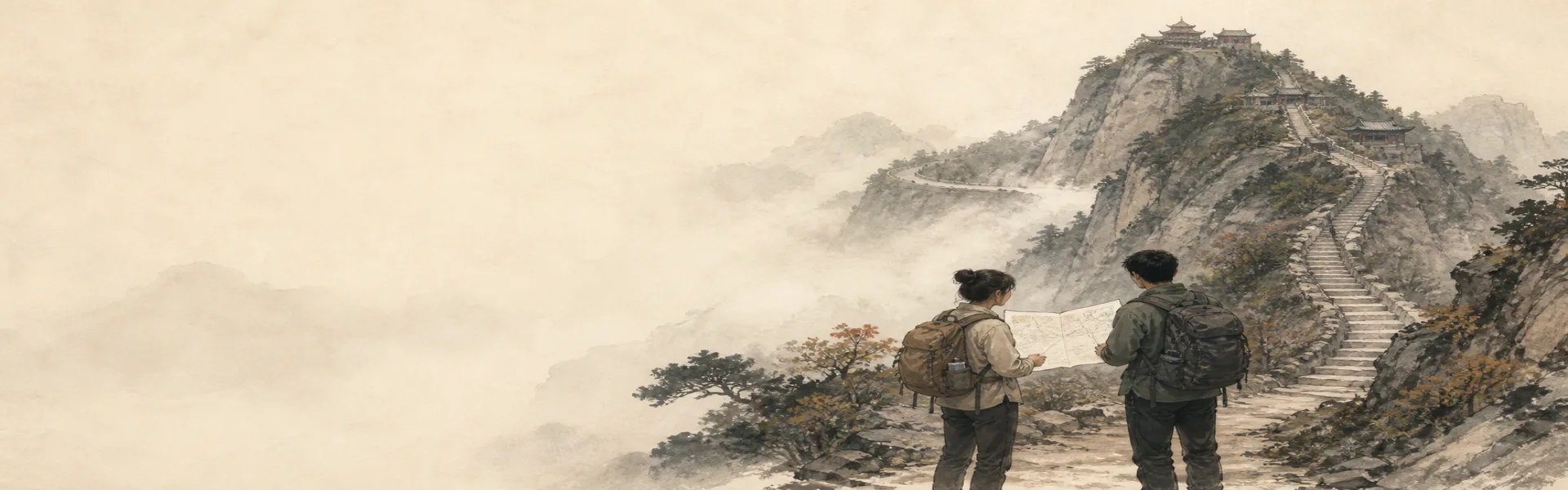
It is a large, steep, wooded mountain range carrying a managed heritage and scenic area, along which a chain of substantial Taoist palaces and temples climbs towards a summit crowned by a small bronze hall. The temples are in religious use, with resident clergy conducting daily services. The site receives very large domestic visitor numbers, with a corresponding infrastructure of entrances, buses, a cable car and commerce. In the town at the foot there is a cluster of private martial arts schools, many teaching foreigners, which have no institutional connection to the temples.
It is not a remote wilderness, not a secluded retreat, not a martial arts monastery of the kind films depict, not an untouched ancient site, and not a place where you can expect solitude on the main route in season. Each of those is a real thing people expect, and each is a reliable source of disappointment.
You will probably enjoy it if
Several kinds of interest are very well served here.
If you are interested in architecture and in the design of landscape, this is one of the best places in the world to see a religious complex composed across an entire range rather than enclosed in a courtyard, and the way the ascent is staged is the point of the whole thing. If you are interested in Chinese religion as a living institution rather than as a philosophy, you can watch liturgy performed as routine, see how a working temple actually operates, and observe the relationship between clergy, pilgrims and tourists. If you like walking, and specifically climbing stone stairways with long views, the mountain gives you a great deal of it. If you are interested in Chinese history, the site is a legible political document about a usurping emperor. And if you are seriously considering training here, seeing the place and meeting teachers in person before committing money is worth the trip on its own.
A quieter category also does well: readers who have studied Taoist ideas for years without ever seeing the physical setting, and who find that a few days on the mountain reorganises what they already knew. That effect is common and is not sentimental. Ritual and cosmology make different sense when you have stood in the room.
You may be disappointed if
Be blunt about the failure modes.
If you want wilderness and quiet, the main axis in season will frustrate you, and the quiet places require deliberate effort to reach. If you expect an unspoiled ancient site, you will be unsettled by how much is reconstruction and how many statues are modern. If you have come principally for martial arts and imagine training in temples with monks, you will find schools that are businesses in a town, and temples that are not martial arts institutions. If you dislike commercial pressure at cultural sites, there is a fair amount of it at the obvious nodes. If you need reliable English interpretation, it is thinner than at major international sites. If you have limited mobility, substantial parts of the site are difficult or inaccessible. And if you are hoping for a personal spiritual transformation on a schedule, the mountain is indifferent to that project.
The physical question
Be realistic, because this is the most common practical misjudgement.
The core of the visit is climbing stone steps, frequently in heat and humidity in the warm season, and the final approach to the summit is steep, sustained and in places exposed. Mechanical transport covers part of the way, and the cable car removes a portion of the upper climb, but no combination of transport removes the final stairways. Between mid-mountain sites there are connecting climbs and descents that are longer than they look. Descent is harder on knees than ascent, and many people underestimate it.
You do not need to be an athlete. You do need to be able to climb many flights of stairs repeatedly over several hours, with rests, and to do it on consecutive days if you want to see more than one part of the mountain. If that is not currently realistic, a shortened plan focused on the mid-mountain complexes and the outlying palaces is genuinely rewarding and involves far less ascent, and the access page discusses this in detail.
How long to allow
Think in terms of what each length of stay actually buys, rather than in terms of a minimum.
A single day gets you the main axis at speed and the summit if the weather cooperates, and you will spend a large share of it in transit and queues. Two days lets you take the main axis properly, with time inside the major halls rather than passing through them. Three to four days is where the mountain starts to make sense: you can reach at least one outlying complex, be on the mountain early or late when the crowds are thin and the light is good, and absorb a failed weather day without losing the summit. A week or more suits people with a specific interest — architecture, liturgy, or an intention to train — and allows the quiet valleys that most visitors never see.
If your total time in the region is one day, consider honestly whether it is worth the detour, or whether the same day spent at a more accessible site would serve you better.
When to go
Seasons matter here more than at most sites because of the vertical relief.
Autumn is generally the best compromise: driest, clearest, most comfortable for climbing, with the best chance of a summit view. Spring is pleasant and green, with more cloud and rain. Summer brings heat and humidity at low levels, thunderstorms, frequent cloud on the summit, and the heaviest crowds. Winter brings cold, strong wind and the possibility of ice on the upper steps, which can close sections; it also brings the emptiest halls and, on a clear day, the sharpest views, so it suits a certain kind of visitor very well.
Independently of season, avoid national holiday periods and school vacations if crowds matter to you, and expect the summit to be in cloud a substantial proportion of the time whenever you go. Build an alternative for that day rather than treating it as a disaster.
What is not asked of you
Some readers hesitate for reasons that turn out to be unnecessary, so it is worth stating what a visit does not require.
You are not required to be a Taoist, to believe anything, to participate in any ritual, to make offerings, or to bow to any image. Nobody will ask you to. Visitors of every persuasion and none walk through these halls daily. What is asked is ordinary respect in a place of worship: keep your voice down, do not walk in front of someone who is bowing, do not photograph people at prayer or where photography is prohibited, do not climb on or touch the images, dress with basic modesty, and step aside when a service is in progress. That is the whole of it, and it is set out in more detail in the etiquette pages.
You are also not required to buy anything, including incense, blessings, charms or divination, and declining is entirely normal and causes no offence.
If Wudang is not the right fit
If the honest answer is that this is not your trip, there are better matches, and it is worth naming them.
For Taoist sites with easier access and gentler terrain, Qingcheng near Chengdu is far less demanding physically and beautifully wooded. For the institutional heart of the householder tradition, Mount Longhu in Jiangxi is the seat of the Celestial Master line. For a major urban temple you can visit in a morning, with strong liturgical life and no climbing, the great Taoist temples of Beijing and other cities serve well. For the classic Chinese sacred mountain experience where the mountain itself is the deity, Taishan in Shandong is the canonical case. For living popular ritual on a scale you can see without a long journey inland, the temples of Taiwan and Hong Kong are unmatched, particularly during festival periods.
And if your interest is genuinely martial arts instruction rather than the mountain, remember that good teachers of internal arts exist in many cities in China and abroad, and that proximity to a famous mountain is not evidence of teaching quality. Choosing a teacher on merit is discussed in the studying section.
Sources and limits. This page is advisory and reflects the structure of the site and commonly reported visitor experience rather than any survey. Seasonal descriptions are patterns, not forecasts, and conditions vary considerably year to year. Suggested alternatives are offered as broad matches to different interests, not as rankings. Accessibility, crowding and interpretation provision all change, and the etiquette described is a general minimum that individual temples may extend.
Key points
Wudang is a managed heritage and scenic area with working temples, heavy domestic tourism, and private martial arts schools in the town below.
It suits interests in architecture, landscape design, living religious institutions, history, walking, and prospective training.
It disappoints expectations of wilderness, solitude, an unspoiled ancient site, or temple-based martial arts training.
The visit is genuinely physical: repeated stair climbing, with a steep final summit approach no transport removes.
Three to four days is where the mountain begins to make sense; one day buys the axis and a photograph.
Autumn is the best all-round season; expect summit cloud in any season and plan an alternative.
You need not believe anything, participate, or buy anything; ordinary respect in a place of worship is all that is asked.
If it is not a fit, Qingcheng, Mount Longhu, major urban temples, Taishan, or Taiwan and Hong Kong temples may serve you better.