Wudang Mountain Today: Temples, Tourism and Daily Life
今天的武当山:宫观、旅游与日常生活
What you actually encounter on the mountain is the product of the present arrangement rather than of its history, and the present arrangement is unusually complicated. Several authorities share the site, with different mandates and different sources of income, and a surprising number of the oddities visitors notice — inconsistent rules, uneven maintenance, a hall closed for no visible reason — follow directly from that division.
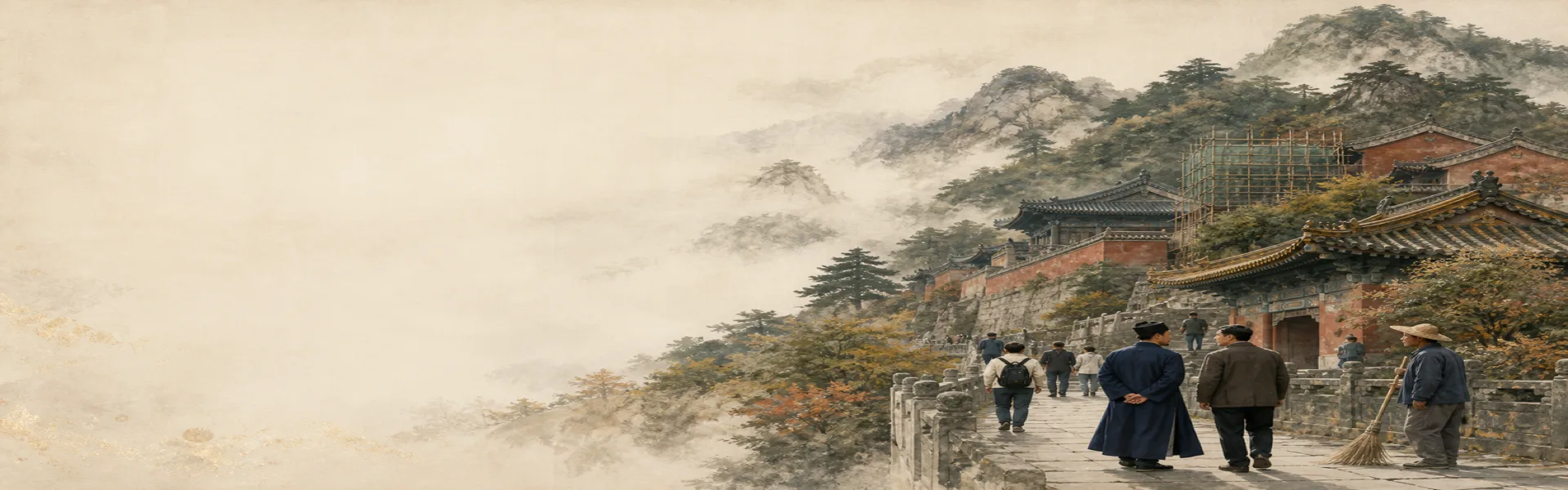
Who runs the mountain
There is no single body in charge, and it helps to know roughly who does what.
An administrative zone under the municipality of Shiyan governs the area as a unit, with a mandate that combines local government functions with the development of the tourism economy. A scenic area management operation handles the entrance, internal transport and visitor infrastructure, and it is the body whose staff you deal with when you arrive. The Taoist association for the mountain, which sits within the national religious framework, is responsible for the temples as places of worship and for the resident clergy. A cultural heritage authority is responsible for the protected structures themselves, which is a separate question from who worships in them or who sells tickets to see them. And the martial arts schools are private businesses, licensed as such, outside all of the above.
So a single hall can simultaneously be a nationally protected monument, a working place of worship, and a stop on a ticketed route, answering to three different masters. When you are told that photography is forbidden here but permitted twenty metres away, or that one hall is open and its neighbour is not, this is usually why. It is not arbitrary; it is jurisdictional.
Heritage listing and what it constrains
The ancient building complex was inscribed on the UNESCO World Heritage list in 1994, and the principal structures also carry national-level protection under Chinese law. Both matter practically.
The listing recognises the site for its architectural achievement, for the way an imperial programme composed buildings across an entire landscape, and for its association with the Zhenwu cult. In return it imposes obligations: interventions must be documented and justified, reconstruction is constrained, new building within the protected area and its surroundings is restricted, and the state reports periodically on the site's condition.
These constraints cut both ways, and it is worth being clear-eyed about it. They have prevented a good deal of damaging development and have brought conservation funding and expertise that the site could not otherwise command. They have also created friction with tourism revenue, which rewards access, capacity and new facilities, and with religious use, which wants halls to function as halls rather than as exhibits. When you see scaffolding, or a hall you cannot enter, or a modern visitor structure that sits awkwardly in its setting, you are looking at that negotiation.
Honest about what survives
This section of the site promised frankness, so here it is: a large proportion of what visitors photograph is not original, and knowing which parts are makes the genuine survivals far more interesting.
The most important authentic survivals are a small number of exceptional things. The bronze hall on the summit is genuinely early fifteenth century, cast in sections and assembled on the peak, and it is one of the most remarkable metal buildings anywhere. The principal hall of the great mid-mountain palace is a genuine Ming timber structure of high quality and is among the more significant surviving Ming halls in China. On the southern cliff there is a stone hall of earlier date, built in stone precisely because of where it sits. Stone tablets, terraces, retaining walls, stairways and gateways survive extensively, because masonry endures.
Against that: many halls are rebuildings, some of them recent; a great many statues are modern replacements, because the originals were destroyed; paintwork, roof tiles and interior fittings are generally renewed; railings, paving, lighting and safety works are contemporary; and at the foot of the range one of the largest palaces exists mainly as foundations and partial reconstruction. None of this is concealed by the site, and inscriptions and signage often say so.
The useful habit is to look at material rather than form. Bronze, dressed stone, and old timber with weathered joinery are likely to be old; bright paint, machine-cut stone and crisp carving are likely to be new.
The reservoir and Yuzhen Palace
One episode illustrates the modern condition of the mountain better than any general statement.
At the foot of the range stands Yuzhen Palace, built in the Ming programme in honour of Zhang Sanfeng, the immortal associated with the mountain's martial tradition. In 2003 its main hall was destroyed by fire. The building was at that time occupied by a martial arts school, and the loss became a well-known argument about the occupation of heritage buildings by unrelated uses.
Then came the water. The Danjiangkou reservoir immediately north was the source for the central route of the South-to-North Water Diversion Project, and raising the dam raised the design water level to a height that would have put the palace's surviving remains under water. Demolition was unacceptable and relocation to another site would have destroyed the relationship between the buildings and their place. The solution adopted in the early 2010s was to raise the structures where they stood, jacking the surviving buildings and their bases some fifteen metres onto a new foundation.
Treat it as a summary of the whole situation: an imperial building, damaged by a fire that happened because of how it was being used, saved from a reservoir built for a national water project, by an engineering operation that could only be justified because the site carries heritage status. Every layer of the modern mountain is present in that one story.
Tourism
Wudang today receives very large numbers of visitors, overwhelmingly domestic, and the site is organised around moving them.
Charging is layered rather than single. There is an admission to the protected area, internal transport is a separate matter, the cable car for part of the upper mountain is separate again, and certain individual sites are charged separately once you are inside. No figures are quoted here on principle, because they change; what stays stable is the layered structure, and the practical implication is that you should expect several separate transactions rather than one and should decide in advance which optional stages you want.
Crowding is concentrated rather than uniform. It clusters at the entrance, at transport interchanges, at the cable car and on the summit, and it peaks sharply during national holidays and school vacations. Because visitor flow is funnelled along one ascending line, walking even a short distance off that line changes the experience completely, which is the single most useful thing to know about tourism here.
The commercial layer follows the crowd: stalls, food, photography, souvenirs, incense and fortune-telling services concentrated at the same nodes. Some of it is licensed and unremarkable, some of it is aggressive, and some of what is sold as religious service near temple gates has no connection to the temples.
The martial arts scene
The schools are a large presence and are not what many visitors assume.
They are private businesses, mostly located in and around the town at the foot rather than in the temples, and they operate independently of the Taoist association and of the temples' religious life. Some are run by teachers with genuine lineage credentials, some by teachers with real skill and no lineage worth mentioning, and some by people whose main competence is marketing to foreigners. Quality varies enormously and is not correlated with the impressiveness of the website.
Foreign students form a significant part of the market, often staying for months, and a whole small economy of accommodation, visas, translation and equipment has grown around them. This is discussed at length in the studying section, including how to evaluate a school. The point to register here is structural: the presence of martial arts schools on this mountain is a modern economic phenomenon built on a traditional reputation, and it is not an activity of the temples.
The clergy today
There is a resident ordained community, considerably smaller than the Ming establishment and dependent on a very different economy. Its members conduct daily services, maintain the halls in religious use, receive pilgrims, perform rituals on request, and observe the festival calendar. Some are engaged in study, music and scriptural work; some deal with the constant flow of visitors as a substantial part of their day.
Their economic basis is now donations, ritual fees, state and heritage funding channelled through institutions, and the general revenue of a managed site, rather than the landed estates that supported monastic life historically. That change is worth understanding because it shapes behaviour: a community that lives on visitor-related income has a different relationship with visitors than one living on rents.
Most of the men and women in Taoist dress you see are clergy; a good many people in Taoist-style gowns are not, and are martial arts students or staff. The etiquette pages explain how to tell, and why it matters.
Tensions you will notice
Four tensions are visible to any attentive visitor, and none of them has been resolved. Worship against sightseeing, when a service is being conducted in a hall through which a ticketed route passes. Conservation against access, when the safest thing for a building is fewer people in it. Religious authority against commercial activity, when goods and services are sold at temple gates using religious vocabulary. And traditional reputation against modern business, in the martial arts economy. Recognising these as structural tensions rather than as failures of management will make the place far easier to understand, and will make you a better-behaved visitor.
Sources and limits. The description of governance reflects the general structure of scenic area, religious and heritage administration in China and how it applies here; exact institutional boundaries shift and are not always publicly documented. The Yuzhen Palace fire and the subsequent raising of the structures are well documented, and the height given is the figure commonly reported. Assessments of what is original follow published conservation material and visible evidence. Nothing here should be read as a current statement of fees, opening arrangements or the standing of any particular school.
Key points
No single body runs the mountain: local government, a scenic area operation, the Taoist association, a heritage authority and private schools all have roles.
Many apparently arbitrary rules and closures are jurisdictional consequences of that division.
World Heritage listing in 1994 and national protection bring funding and expertise but constrain rebuilding and development.
The outstanding authentic survivals are the summit bronze hall, the great Ming timber hall mid-mountain, an earlier stone hall on the southern cliff, and extensive masonry.
Many halls are rebuilt and most statues are modern replacements; judge age by material rather than by form.
Yuzhen Palace burned in 2003 while occupied by a martial arts school, then was raised about fifteen metres to escape the reservoir.
Charging is layered and crowding is concentrated at nodes, so leaving the main line transforms a visit.
Martial arts schools are private businesses in the town, independent of the temples, and of very uneven quality.