Zhenwu: The Taoist Deity at the Heart of Wudang Mountain
真武大帝:武当山的主神
Everything on this mountain is organised around one deity. The halls are dedicated to him, the Ming building campaign was undertaken for him, the summit is his, and the festival calendar follows his dates. If you understand Zhenwu you can read the site; if you do not, the buildings are just handsome architecture in a good landscape.
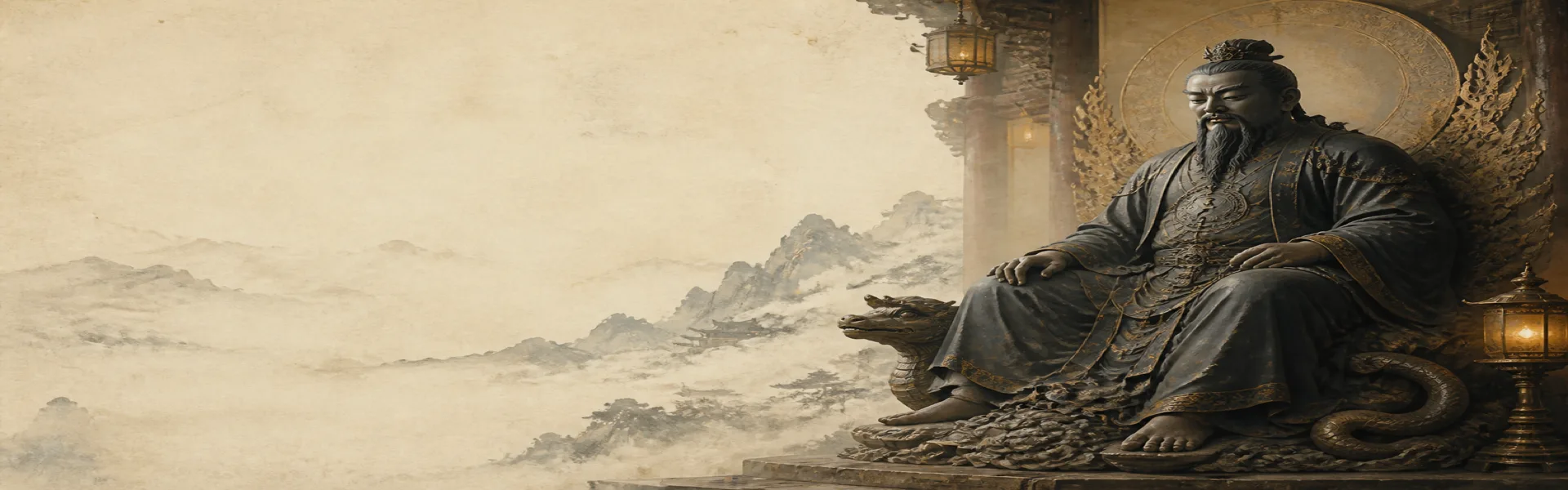
What he looks like and what he governs
Zhenwu, the Perfected Warrior, is normally shown seated, in dark or black robes, with a sword, and very often with bare feet and loose unbound hair. Beneath or beside him are a tortoise and a snake, usually entwined. He may appear as a mature bearded figure or as a beardless youth; both are standard, and the youthful form refers to the period of his cultivation on this mountain before attainment.
His portfolio is coherent once you know the correlative scheme. He is the deity of the north, and north in that scheme is the direction of water, of winter, and of darkness. He is a martial deity whose characteristic function is subduing demons, and one of his standard titles names him precisely as the one who sweeps away malignity. He is invoked against pestilence, disorder, drought and flood, and by extension for the security of the state. In late imperial practice he also acquired a wide protective role for individuals, households, seafarers and travellers.
The dark robes, the bare feet and the unbound hair are worth noticing because they are deliberate. Chinese deities are ordinarily dressed as officials, and rank is legible from costume. Zhenwu is shown partly outside that convention: a figure of enormous authority who nonetheless appears ascetic and unshod, which encodes the fact that he attained his position through cultivation rather than receiving it as an appointment.
From an emblem to a god
Zhenwu did not begin as a person. He began as Xuanwu, the Dark Warrior, one of the four directional emblems of early Chinese cosmology, alongside the Azure Dragon of the east, the Vermilion Bird of the south and the White Tiger of the west. In that early scheme Xuanwu is the north: an emblem, a constellation group, a quadrant of the sky, not a biography.
The transformation from emblem into a personal god with a life story, a cult and temples took place over centuries and was largely complete by the Song. This is one of the clearest examples in Chinese religion of a process that recurs constantly: an abstract correlative category acquires personality, then narrative, then institutions.
The change of name is itself instructive. Xuanwu became Zhenwu in the early eleventh century because the character xuan fell under a naming taboo at the Song court, having been used in the name of an imperial ancestor. A deity's name was altered to accommodate dynastic sensitivity, and the new name stuck permanently. Gods in this system are embedded in the political order, and the political order edits them.
The tortoise and the snake
The two animals at his feet are not pets and not trophies, and visitors reasonably ask what they are doing there.
At the earliest level they simply are Xuanwu: the northern emblem was itself conceived as a tortoise entwined with a snake, a composite creature rather than a god with animal companions. When the emblem became a person, the animals had to be given a new relationship to him, and the tradition offered several. In one common account they are his transformed internal organs, expelled during cultivation and subsequently subdued and taken into service. In another they are demons he defeated and converted into generals, and they appear in temples as two armoured attendant figures, the Tortoise General and the Snake General.
These explanations are mutually inconsistent, and that is normal. Chinese religion tolerates parallel accounts because the accounts do different work: one explains cosmology, one explains bodily cultivation, and one explains the two attendant statues you can see. Do not look for the correct version.
The biography, and when it was written
The standard hagiography runs like this. He was born a prince in a northern kingdom, to a queen whose name means Excellent Victory. As a youth he refused the throne, left the palace and came to this mountain, where he cultivated for a very long period, conventionally given as forty-two years, in the face of trials and temptations sent to test him. He attained the Tao and ascended from a cliff on the mountain, and the site of that ascent is still shown.
The important critical point is the dating. This biography is not ancient. It takes shape in the Song and is elaborated substantially in the Yuan and Ming, in scriptures and in collections of accounts of his manifestations, and finally in a popular Ming novel that gave the story wide circulation. Familiar episodes, including the well-known tale of an old woman grinding an iron bar into a needle to shame him out of abandoning his practice, belong to this late literary layer, and the mountain has a site named for it.
Saying this is not debunking. The point is that the mountain and the biography grew together: as the cult became institutionally important, its god acquired a life, and that life was set on the mountain that housed the cult. The stories are evidence about the tradition that produced them rather than reports about the second millennium before the present era.
Why the Ming court pushed him so hard
The Ming promotion of Zhenwu, and the vast construction that expressed it, is best understood as politics conducted in religious form.
The Yongle emperor took the throne by military force from his nephew, which left him with a legitimacy problem that no amount of administrative competence could solve. A dynasty that has just fought a civil war within the imperial family needs a visible sign that Heaven approves. Zhenwu suited the purpose unusually well: a martial deity, so appropriate to a victory won in the field; a northern deity, matching a ruler whose power base was in the north and who moved the capital to Beijing; and a deity already associated with protecting the dynasty, since the Ming founder had also patronised him.
The programme begun in 1412 was accordingly enormous, employing a workforce conventionally numbered in the hundreds of thousands over a period of years, and it produced not a temple but a composed sacred landscape. The mountain was formally styled a Great Peak, ranking it above the ancient Five Marchmounts. A tradition, which should be treated as tradition rather than record, holds that the face of the principal summit image was modelled on the emperor himself. Whether or not that is so, the political message was not subtle and was not meant to be.
His rank and jurisdiction
Readers new to Chinese religion often assume that the god of the most important building must be the highest god. That is not how the system works, and Wudang is a good place to learn the distinction.
The celestial order is arranged like an administration, with ranks, jurisdictions and delegated authority. Above Zhenwu stand the Three Pure Ones, who represent the Tao at its most abstract, and the Jade Emperor, who holds executive authority over the celestial administration. Zhenwu is not their superior. He is a very powerful officer with a defined portfolio, and on this mountain he is the resident authority in whose name the place operates.
This is why you will find halls to the Three Pure Ones and to other deities within the same complexes. A Wudang temple is not a single-deity shrine; it is a site whose principal officer is Zhenwu, arranged alongside the wider hierarchy. Recognising that pattern makes the internal layout of the halls legible rather than arbitrary.
Recognising him on site
You will see many statues, most unlabelled in any language you read, and a few reliable markers do most of the work.
Look for the combination of dark robes, a sword, and either bare feet or loose hair; then look down for the tortoise and snake. Two armoured attendants flanking a seated dark-robed figure often means the Tortoise and Snake Generals, which confirms the identification. By contrast, a figure in full imperial court dress with a flat crown and a tablet held before the chest is the Jade Emperor, not Zhenwu. Three near-identical seated figures in a row are the Three Pure Ones. A conspicuously aged figure holding a fan is the Most High Lord Lao. And a figure in an ordinary Taoist gown, often with a distinctive cap, sometimes disreputable-looking, is likely to be Zhang Sanfeng, who is a human immortal rather than a celestial officer.
Zhenwu and martial arts
Because Zhenwu carries a sword and is described as a subduer of demons, it is tempting to treat him as the patron of Wudang martial arts and to read the mountain's martial reputation as flowing directly from its god. The relationship is real but much looser than that.
Zhenwu's weapon is a ritual instrument, not a fencing technique. In Taoist practice the sword is an implement of exorcism and command, wielded in liturgy by an officiant, and its use has its own logic that has nothing to do with combat effectiveness. His martiality is cosmic and administrative: he enforces order against malignity, in the way a general enforces a state's authority.
What can honestly be said is that a mountain famous for a martial god was fertile ground for a martial reputation, that the sword occupies a genuine place in Taoist ritual which martial traditions later drew on, and that the two things became attached in popular understanding. What cannot honestly be said is that the temples taught fighting arts as an institutional function, or that Zhenwu's iconography is evidence for the antiquity of any particular style. The martial history of the mountain is discussed separately, on its own evidence.
Sources and limits. The account of Xuanwu as a directional emblem, the Song name change, the development of the hagiography and the Ming patronage follows the standard scholarship on the Zhenwu cult. Dates for the growth of the biography are approximate because the process was gradual and the texts are of uncertain composition. The claim that the summit image portrays the Yongle emperor is reported as a tradition, not as established fact. Iconographic guidance describes common conventions, and individual temples vary.
Key points
Zhenwu is the deity the entire mountain is organised around, and the site is unreadable without him.
He is shown in dark robes with a sword, often bare-footed with loose hair, and with a tortoise and snake.
He began as Xuanwu, an abstract directional emblem of the north, and became a personal god with a biography over centuries.
His name changed in the eleventh century because of a Song naming taboo, which shows how embedded gods were in politics.
The hagiography is late, taking shape from the Song onward, and is evidence about the tradition rather than ancient history.
Yongle's vast building programme was a legitimacy argument by an emperor who had seized the throne.
He is a powerful officer with a defined portfolio, not the highest god; the Three Pure Ones and Jade Emperor rank above him.
His sword is a ritual instrument; the link between Zhenwu and martial arts is real in reputation but not evidence of temple-taught fighting.