Reading Wudang’s Plaques and Couplets: Names, Calligraphy and Layers of Time
读懂武当匾额与楹联:名号、书法与历史层次
At Wudang, writing is part of the built landscape. A horizontal plaque can name a gate, hall or sacred place; a pair of vertical couplets can frame how visitors approach it. The words may invoke a deity, praise a view, record an imperial grant or preserve the voice of a donor. Yet an old-looking board is not automatically an old document. Its wording, calligraphy, material, date and present location may belong to different moments.

This guide offers a method for looking. It complements the separate introduction to Wudang’s steles and stone inscriptions, while concentrating on texts attached to buildings and encountered at eye level or above.
Words become part of architecture
Plaques, couplets and inscriptions
A plaque (bian’e, 匾额) is usually a horizontal panel bearing a short name or phrase. A couplet (yinglian, 楹联) is a matched pair of vertical lines, conventionally read from the right-hand side to the left. In practice, materials and formats overlap: words may be painted on timber, carved in stone or metal, reproduced on ceramic, or copied onto a later support. Researcher Shao Wentao therefore treats Wudang plaques and couplets as a broad documentary group rather than one uniform class of object.
Position gives meaning
Begin with placement. A panel above an entrance works differently from a text beside an altar or along a pilgrimage route. Height controls whether the viewer reads individual brush movements or receives the phrase as a distant emblem. Doorways make paired lines face one another; halls make a short title identify the space within. The mountain-wide architectural route helps explain why the same words would feel different at a threshold, a courtyard and a summit sanctuary.
A name is also an act
Names do not merely describe buildings. They can assign rank, announce patronage and connect a site to a religious programme. The Wudang Museum guide, for example, identifies the inscription “Zhishi Xuanyue” (治世玄岳, conventionally translated as “Mysterious Peak Governing the Age”) on a stone arch dated 1552, and records the Kangxi emperor’s 1703 plaque “Jinguang Miaoxiang” (金光妙相, “Wondrous Form of Golden Light”) at the Golden Hall. These are useful dated examples, not templates for attributing every plaque on the mountain.
Who is speaking?
Court, officials and clergy
Some inscriptions come with a name, seal, date or documentary record. Together, these can identify a court grant, an official commission or a clerical context. The strongest reading joins the object to a dated record; it does not infer authorship from an impressive phrase or prestigious style alone. Wudang’s gazetteers are especially valuable cross-checks because they sometimes preserve wording for objects that have moved, been remade or disappeared.
Pilgrims and donors
Other plaques came from worshippers, associations and local donors. They can document pilgrimage networks and the social life of a temple as clearly as an imperial gift documents the court. A study hosted by Renmin University’s Institute of Qing History, for example, discusses nineteenth-century pilgrim offerings that included wooden plaques. Such objects should be read for donor names, origin places and dates as well as for the main phrase.
Copies, replacements and lost originals
Survival is rarely a simple yes-or-no question. A phrase may remain while its first board is lost; an old panel may have been moved; a later copy may accurately preserve earlier wording; restoration may renew colour without changing text. Shao’s survey notes both surviving objects and plaques known only from records. A careful label therefore distinguishes the history of the wording from the history of the physical support.
How to look at the calligraphy
Script, scale and distance
Recognising seal, clerical, regular, running or cursive tendencies can help describe a work, but script labels are only a beginning. Look at the size of the characters, the balance between dense and open forms, and how the line reads from its intended viewing distance. The broader guide to Chinese calligraphy introduces these script families and ways of looking without turning stylistic impressions into firm dates.
Material, carving and colour
Brushwork changes when it is enlarged, carved, gilded or repainted. On wood, grain and weather may interrupt a stroke; on stone, the cut edge and raking light become part of what the viewer sees. Shao’s survey emphasizes that text, seals, carving, colour and ornament function together. Photograph the whole setting before isolating details, because a close-up can erase the relation between words and building.
Style is not a date
A familiar hand or archaic-looking script may tempt a famous attribution. Resist it. Later calligraphers copied earlier models, craftsmen transferred brush-written designs into other materials, and restorations can alter surfaces. Date first from explicit evidence: a reliable colophon (kuanzhi, 款识), seal, archival reference or securely documented building phase. Treat style as supporting evidence, not a signature by itself.
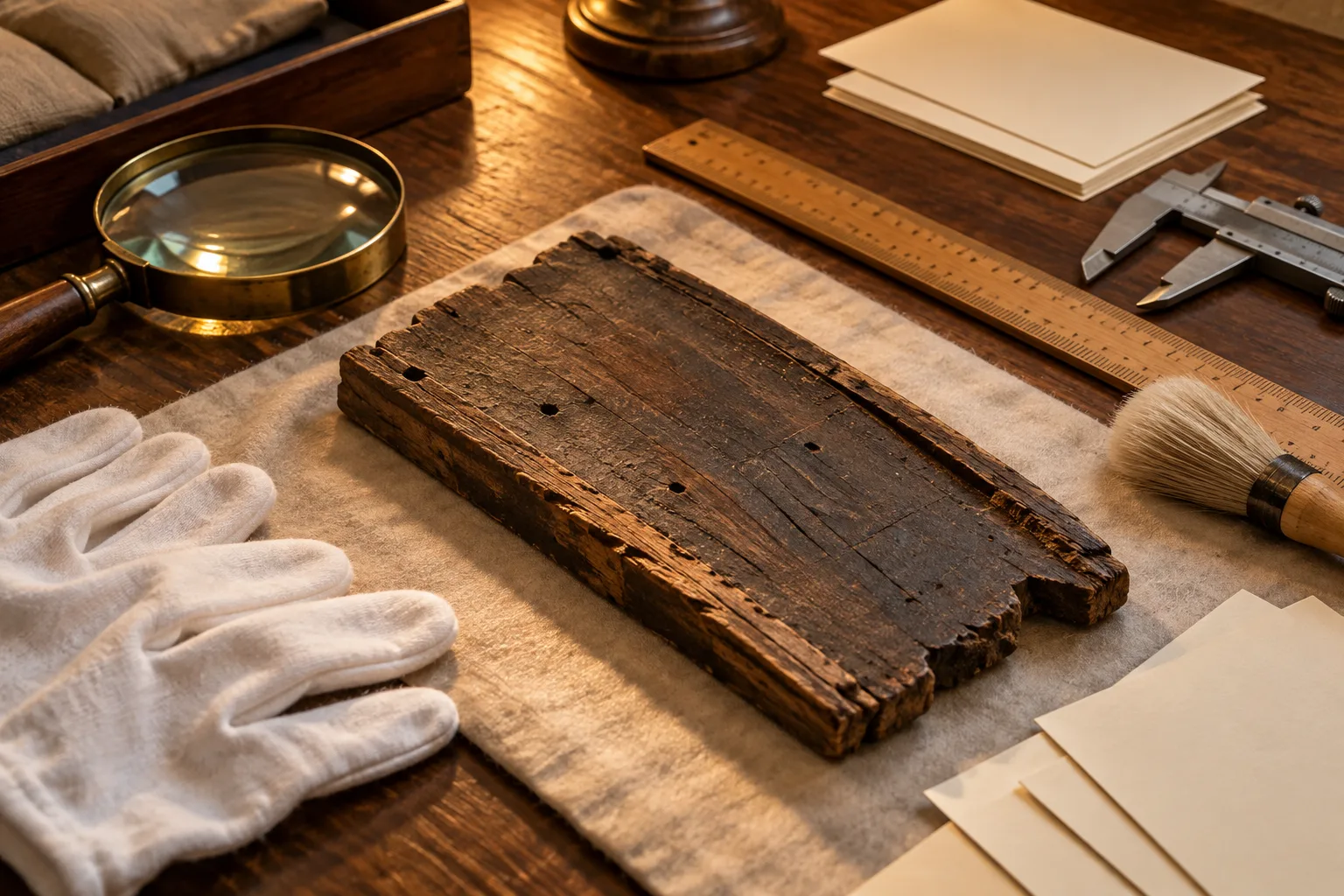
A six-step reading method
Observe before interpreting
- Locate it. Record the gate, hall, room or route position and the direction the text faces.
- Transcribe cautiously. Photograph the full object and individual characters; mark uncertain readings instead of filling gaps from expectation.
- Describe the support. Note wood, stone, metal or another material, plus carving, paint, gilding, repairs and mounting.
- Read the margins. Look for dates, seals, donor names, titles and place names outside the main phrase.
- Cross-check. Compare museum catalogues, gazetteers, temple records and scholarly studies; use the Wudang names and terms glossary for variant labels.
- Separate levels of confidence. State what is visible, what a record confirms and what remains an interpretation.
Further reading
For object history, consult Shao Wentao’s survey of Wudang plaques from the Tang period to the Republic and the Wudang Museum visitor guide. For a broader comparison of how plaques and couplets can articulate architectural function and ideals, see the Palace Museum’s study. The Institute of Qing History’s pilgrimage research adds the perspective of donors and travelling worshippers.
The reward of this method is not a quicker attribution. It is a richer encounter: words, brushwork, building, patron and later preservation can be read together without collapsing their different histories.