Chinese Flower Baskets: Weaving, Painting and the Vessel
中国花篮:编织、绘画与器物
A Chinese flower basket can be three different things: a woven container that holds living stems, a basket represented in a painting, or a basket motif translated into porcelain. Those categories overlap visually, but they do not offer the same evidence. This guide shows how to keep object, image and interpretation apart while connecting them to the wider Chinese flower-arrangement tradition.
Begin with the basket as a made object
Weave, rim and footprint shape the arrangement
A low woven basket spreads visual weight sideways. Its rim can hide a smaller water container, while a handle or raised edge creates a line that flowers may follow, cross or leave open. The weave has its own rhythm and shadow. These visible features matter before any symbolic reading begins.
Material names require evidence. A museum record may identify rattan, bamboo, porcelain or another medium; a photograph alone may not. A basket-shaped ceramic vessel and a fibre basket can resemble each other while behaving very differently. Shape, material, construction and function should therefore be recorded separately.
Water and support may be hidden
A woven basket is not automatically watertight. A historical painting may omit a liner or support, and that absence does not prove that none existed. For present-day practice, use a stable modern water container that fits without forcing the weave, protect the surface below, and keep sharp supports inaccessible. Do not test an antique or museum-type object with water.
For general vessel and tool safety, continue to Choosing Flower Vessels and Tools. The practical question is not how to reproduce an invisible historical mechanism, but how to support living material safely while preserving the basket’s visual character.
Read Li Song’s painted Flower Basket carefully
A Southern Song album leaf, not a photograph
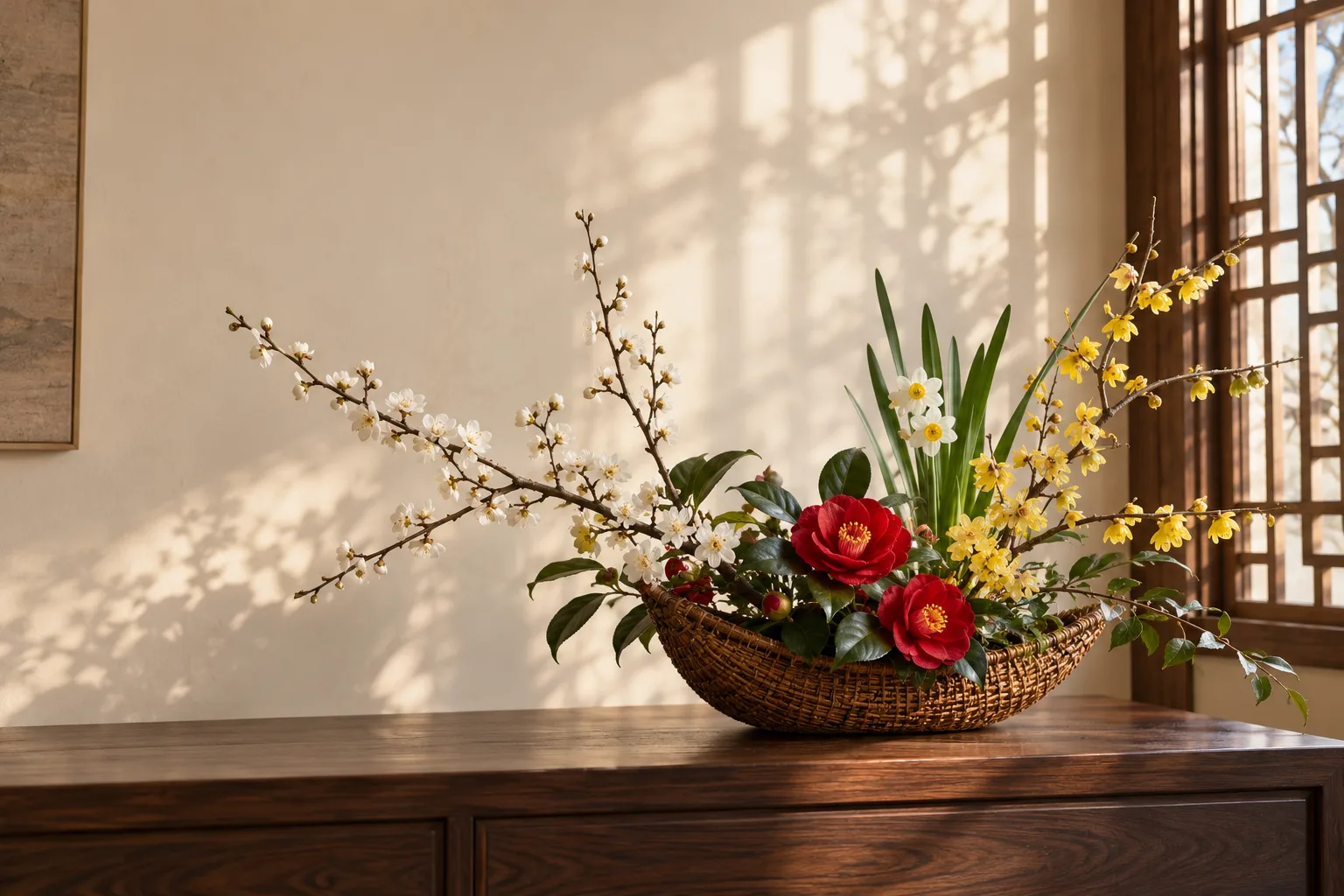
The National Palace Museum presents Li Song’s Flower Basket as a 26.1-centimetre-square album leaf in ink and colours on silk. Li Song was active around 1190–1264. The museum describes an early-spring group of red camellia, green-sepaled plum, narcissus, wintersweet and daphne in a crescent-shaped braided basket.
The work is valuable evidence for Southern Song court painting and for how a flower basket could be pictured. It is not a transparent record of every construction detail, nor proof that every Song arrangement followed the same model. Painterly selection, album format and courtly viewing all shape what survives on silk.
Fullness and balance belong to this composition
The arrangement is dense, with large camellias emphasized and other flowers extending to either side. The museum calls the colouring rich yet elegant and the balance carefully controlled. Those observations help a viewer study the picture; they should not become universal rules that all Chinese flower baskets must be symmetrical, crowded or auspicious.
A second National Palace Museum exhibition places the painting among vases, baskets, plates and other choices for arranging flowers. Together the records show variety rather than a single compulsory container. For plant-specific context, use Seasonal Flowers and Symbolism and keep each claim tied to a source, date and setting.
Follow the basket from container to motif
A basket pictured on a porcelain vase
The Metropolitan Museum of Art records an eighteenth-century Qing porcelain vase with a basket of auspicious flowers. Here the basket belongs to painted decoration on Jingdezhen porcelain; the supporting object is a vase. The title and catalogue date are evidence for this individual ceramic, not proof that a real woven basket was used in the same way.
Basket texture remade in clay
Another Met object, a Qing porcelain vase with moulded basket design from the first half of the nineteenth century, turns the visual idea of weaving into relief under a crackled glaze. The object asks a different question: not which stems a basket held, but how one material imitated the surface of another.
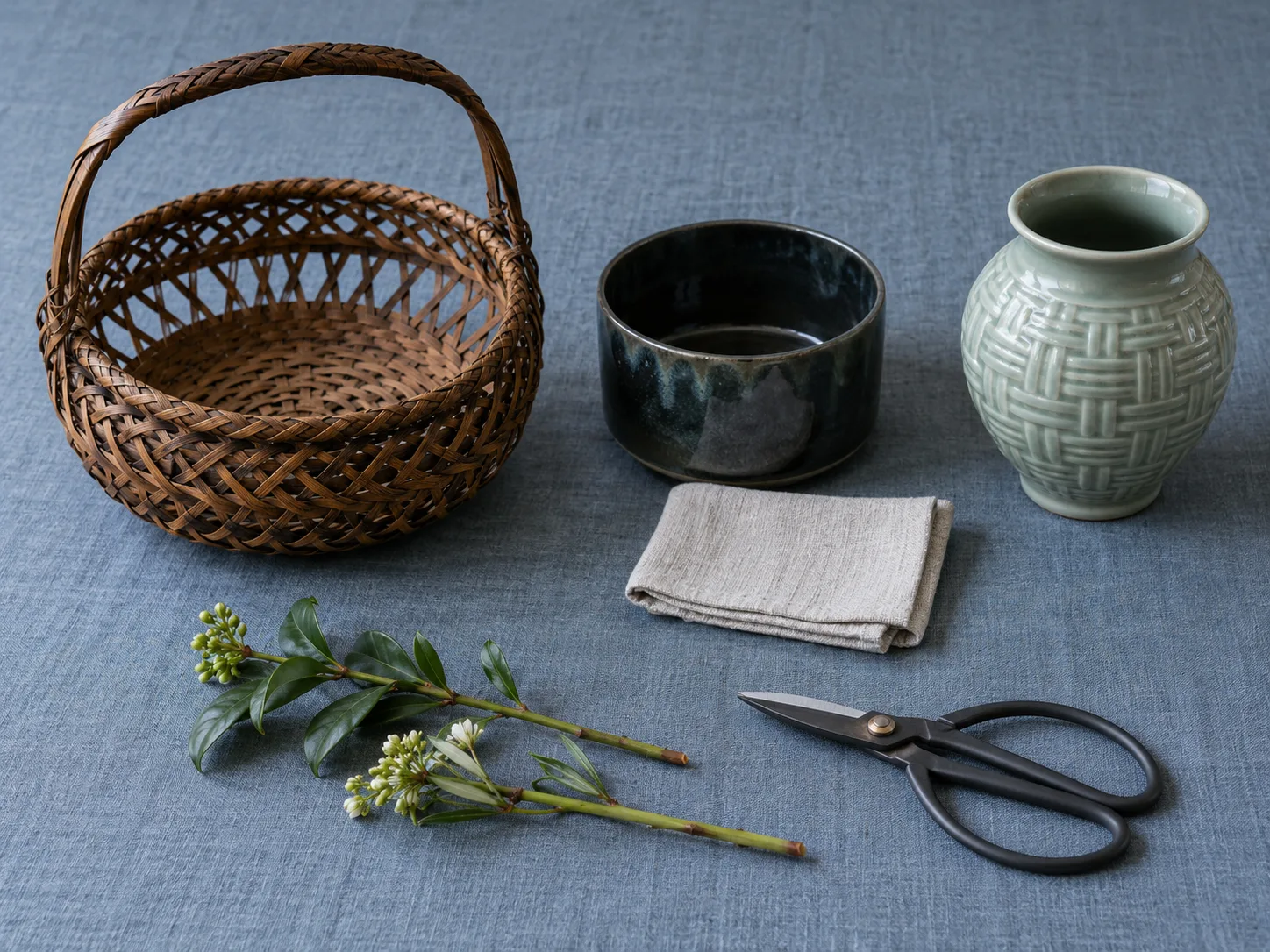
Similar-looking forms can therefore point to different histories. A catalogue may describe a functional container, a decorative motif, a ceramic imitation or a painting of an arrangement. Reading begins by naming which of these is actually before you. The same discipline is useful across Chinese painting and decorative arts.
Use a six-step museum method
Separate what is present from what is inferred
- Name the evidence: object, painting, photograph, text or later reproduction.
- Check the medium: fibre, ceramic, silk, paper or another documented material.
- Record date and attribution: distinguish “by,” “attributed to,” period and later catalogue label.
- Describe before interpreting: note footprint, rim, handle, weave, flowers, density and empty space.
- Test each meaning: identify which museum or text supports a seasonal or auspicious reading.
- Keep uncertainty visible: do not invent an unseen liner, owner, ceremony, workshop or lineage.
Try the form without copying a historical picture
For a modern exercise, place a clean watertight liner inside a sound contemporary basket, begin with a short stable group of stems, and compare the effect with the same material in a plain ceramic vessel. Photograph both from the intended viewpoint. Observe how the rim, weave and handle change visual weight; do not claim that the result reconstructs Li Song’s work.
This approach extends the source-led history of Chinese flower arrangement: paintings, surviving objects and practical experiments answer different questions. Their value increases when those questions remain distinct.