Further Reading and Practice: Sources, Museums and a First Month
延伸阅读与练习:史料、博物馆与第一个月
Learning Chinese flower arrangement is easier when sources are arranged before flowers are. A primary text records one historical voice; a museum catalogue anchors an object in material and date; modern scholarship tests transmission; a teacher demonstrates a method. None can substitute for all the others. This guide closes the Wudang flower-arrangement sequence with a source ladder and a practical first month.
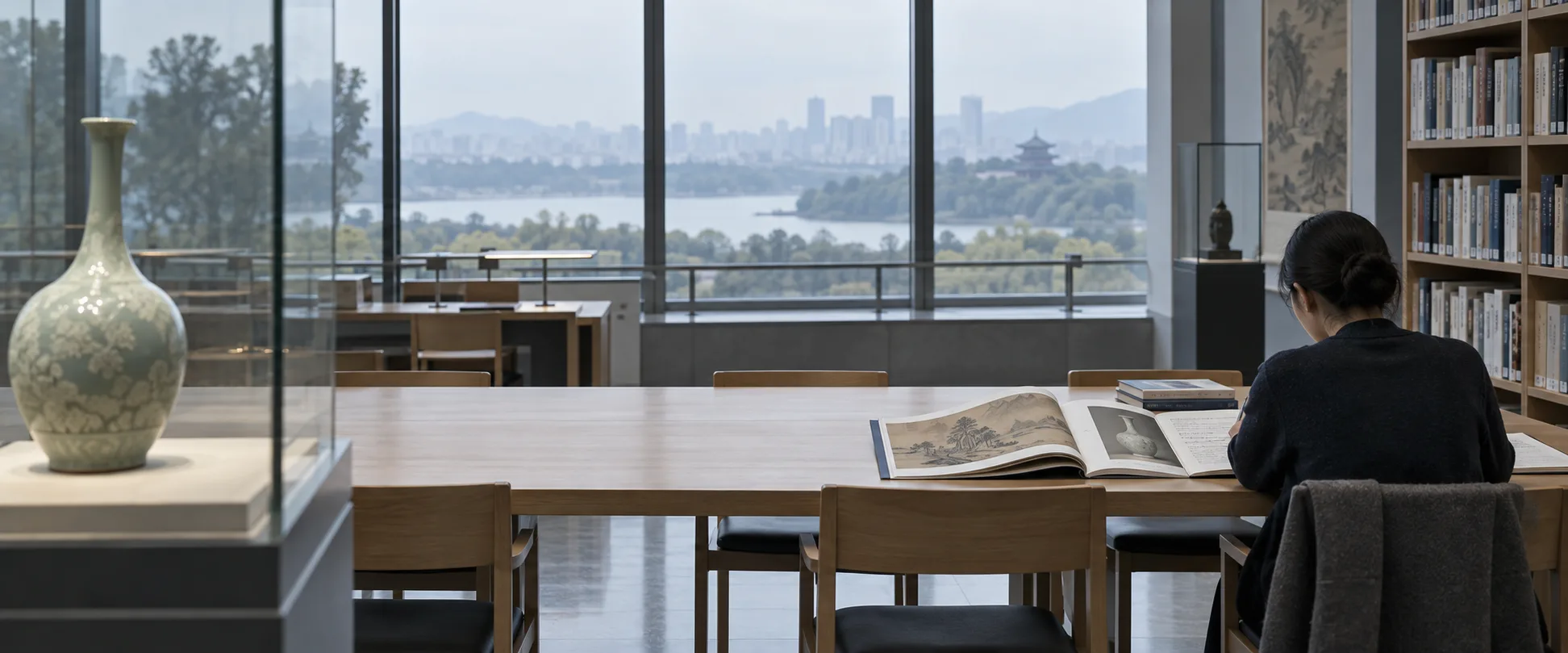
The aim is not to collect impressive quotations or purchase a prescribed kit. It is to learn how to ask where a claim comes from, what an image can actually show, and which part of an exercise is a contemporary choice. Reading and making then correct one another: sources limit invention, while practice reveals which questions a source leaves unanswered.
Build a source ladder
Begin with primary texts, not isolated maxims
Two Ming texts make a useful pair. Yuan Hongdao's 1600 Ping Shi (History of the Vase) speaks personally about keeping flowers at a desk, ranking materials and changing them with the season. The Ping Hua Pu (Manual of Vase Flowers), attributed to Zhang Qiande, organizes preferences for flowers, vessels, water and placement. Read each as a situated historical voice, not as a universal rulebook.
Record author, title, approximate date, edition or transcription, section and the words you actually used. Then separate description from prescription: “the writer preferred this” is not “all Chinese arrangers must do this.” Translation adds another layer, so keep the Chinese term beside any uncertain English or French rendering and mark your own paraphrase as a paraphrase.
Use objects and pictures with their catalogue records
The National Palace Museum's “Four Leisure Activities” exhibition brings together a fourteenth-century Longquan celadon bottle, Li Song's Southern Song Flower Basket and a printed manual that observes plum blossom through eight stages. These are different kinds of evidence: a vessel, a constructed picture and a book. Their dates, media, ownership histories and exhibition labels matter as much as their appearance.
A painting can show how an artist framed flowers, vessels and space, but it is not a photograph of ordinary practice. A surviving vessel does not tell us what every owner placed in it. Start with the catalogue entry, compare several dated records, and label any arrangement made “after” a picture as a reconstruction. Our history guide explains why no single object carries the whole tradition.
Choose modern guidance critically
Check editions, research and transmission
A useful modern book or article identifies its sources, distinguishes quotation from interpretation and gives readers enough information to find the evidence again. Library records help confirm editions and publication dates, but a title's existence does not verify every claim inside it. Prefer work that states what is uncertain and compare it with primary texts and museum records.
Transmission is rarely a straight line. The Tokyo National Research Institute for Cultural Properties reports that Ping Shi had reached Japan by at least 1629 and later influenced literati flower culture and schools of arrangement, while noting that its early reception remains unclear. That combination—documented movement and an admitted gap—is stronger than a seamless lineage invented after the fact.
Evaluate teachers, courses and demonstrations
A teacher can offer something a book cannot: live handling, correction and a sequence of exercises. Ask what tradition or studio method is being taught, which elements are historical, which are the teacher's adaptation, and whether supports, imported flowers or commercial vessels are treated as practical choices rather than tests of authenticity. Clear boundaries are a sign of care, not a lack of authority.
When watching a demonstration, note the initial condition of the material, the viewing direction, every cut, the support and the time that passes. Compare the stated principle with the visible result using our guide to line and balance. A beautiful final photograph cannot show failed trials, water care or what was removed, so do not confuse finish with evidence.
Practise for one month
Weeks one and two: vessel, water and line
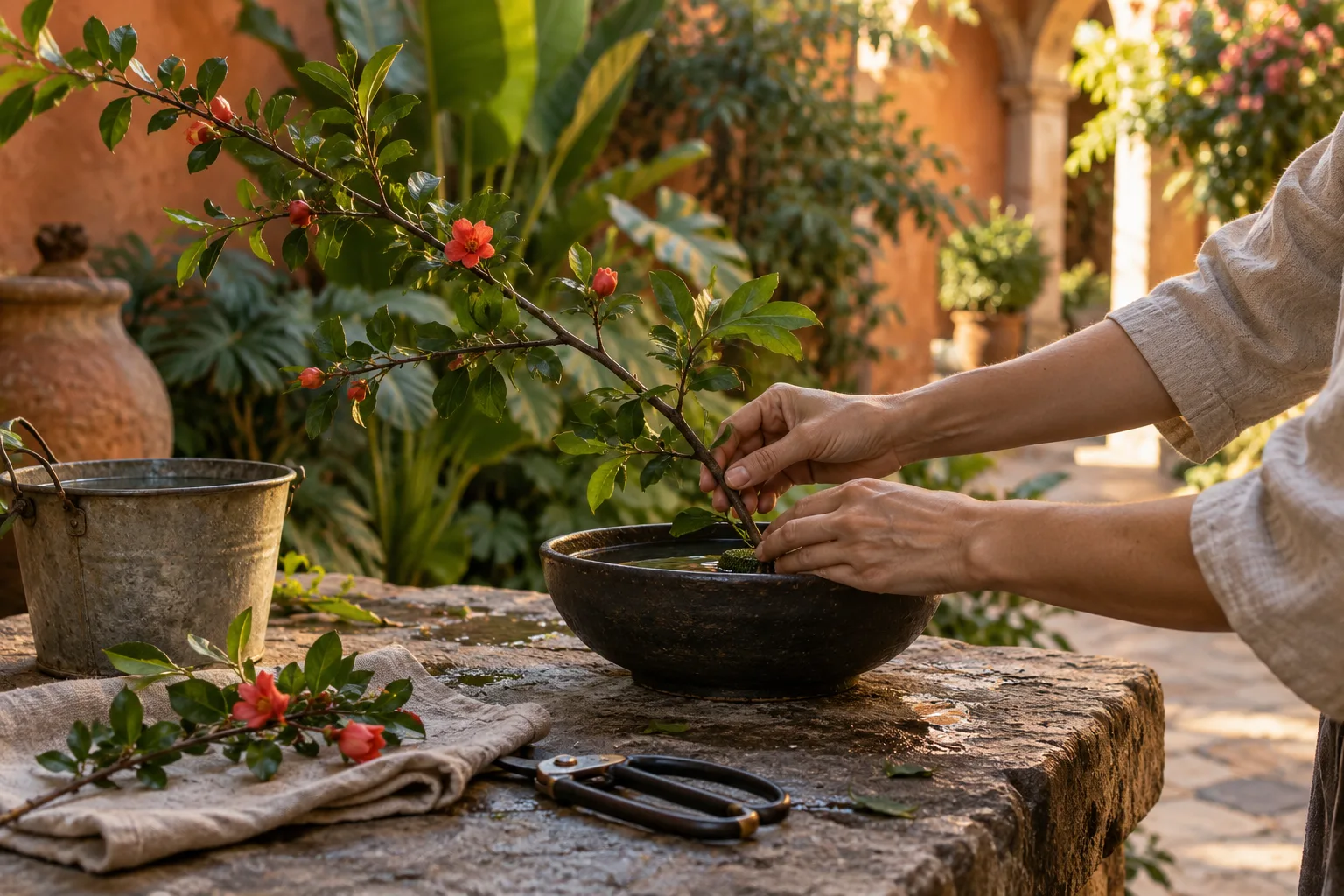
In week one, use one stable vessel and one legally obtained or purchased material. Record its source, photograph the uncut branch, test three orientations and make only the cuts needed for safety, water access and stability. The vessels and tools guide covers clean tools, supports and care. A support is a tool, not proof that an arrangement is less traditional.
In week two, repeat with the same vessel and a different line: upright, leaning or spreading. Change one variable at a time and view the work from the intended position, not only through a phone screen. Commercial, imported, found and pruned materials can all teach something when their provenance is known and collection is lawful; none is automatically superior.
Weeks three and four: season, revision and comparison
In week three, choose what is responsibly available in your place rather than copying a distant seasonal list. Use the season and symbolism guide to check a plant's identity, context and competing associations before attaching a meaning. Note weather, source and stage of growth. If identification is uncertain, describe the material instead of guessing.
In week four, remake one earlier study. Keep vessel and material type as similar as possible, change one decision, and compare results after an hour and the next day. Then try the twenty-minute observation exercise in our cultivation guide. There is no required silence, sacred stem count, photograph ban or promise of mastery.
Keep a record that can teach you
Let notes and photographs do different work
A short record needs only date, material and provenance, vessel, support, water, viewing direction, interventions and later changes. A photograph preserves one viewpoint and helps comparisons, but it can flatten depth and hide mechanics. Notes can capture scent, weight, uncertainty and time. Use both; neither is a neutral copy of the arrangement.
Add one source note to each study: a page, catalogue record, object number or teacher's explanation, followed by what it helped you notice. Mark quotations, paraphrases and reconstructions differently. After four weeks, review which claims became more precise, which remained uncertain and which exercises produced repeatable learning rather than a lucky image.
Choose the next path through the Wudang sequence
If the difficulty was historical context, return to the history guide. If it was empty space or visual weight, revisit line and balance. If the branch would not stand or remain hydrated, work through vessels and tools. If a flower's meaning seemed too obvious, go back to season and symbolism. Let a specific problem choose the next reading.
The sequence is therefore not a ladder toward a single “Chinese style.” It is a loop among evidence, material, looking, revision and responsibility. Begin with one branch and one accountable source. The goal of further study is not to make the work look ancient or spiritual, but to make each choice more observant, more traceable and more honest.