Principles of Flower Arrangement
插花的几条道理:线条、宾主、留白
The principles of Chinese floral arrangement are drawn from two short Ming treatises, from passages in other Ming and Qing writings, and from what can be inferred from painting. They are preferences and criticisms rather than a system, and this page presents them as such rather than converting them into rules.
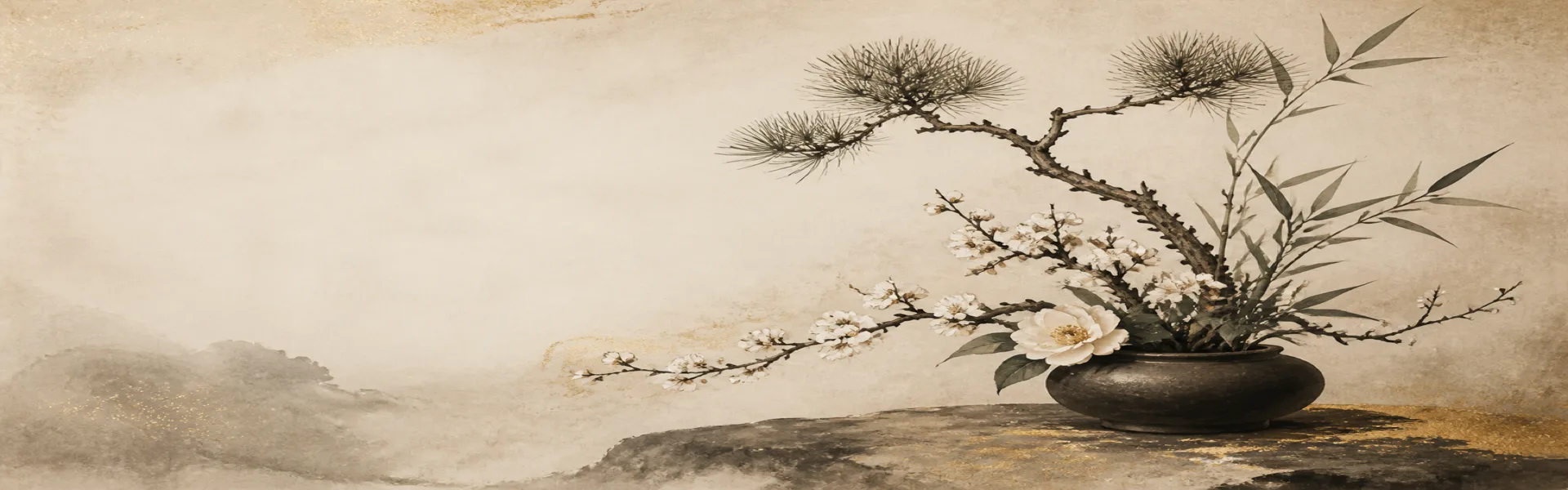
A caution first. Modern teaching often presents a structural system with named principal branches at specified angles and proportions. Some of this is a reasonable reading of the sources and some of it is imported from Japanese pedagogy. Where the distinction matters, it is noted below.
Few materials
This is the most emphatic principle in the literature and the one modern practice most often abandons. Yuan Hongdao states plainly that one or two kinds of flower are enough, that more than two or three stems of a kind is excessive, and that a crowded vase looks like a market stall.
The reasoning is partly aesthetic and partly about attention. Few elements can be looked at individually; many elements become a mass. The tradition wanted each branch to be visible as a particular branch with a particular line, and that is not possible in an abundant arrangement.
The practical test is to remove things. If an arrangement is not improved by removing one stem, it probably has too few rather than too many, which almost never happens to a beginner.
Host and guest
An arrangement is structured by relationships between unequal elements. The literature speaks of a host branch and a guest branch: the host sets the height and the principal direction, and the guest answers it from a different angle at a lesser height. A third low element may anchor the base and give the composition weight where it meets the vessel.
These terms come from the same vocabulary as painting, where a composition has a dominant mass and subordinate ones. The relationship is the point, not the count: two branches of equal height and opposite angle produce a symmetrical arrangement with no host, and the tradition regards that as a failure.
Modern teaching frequently specifies three principal branches with proportions and angles, sometimes given as ratios. The Ming texts do not do this. The three-branch structure is a reasonable inference and a useful teaching device, but it should not be presented as a Ming rule.
Asymmetry and unequal division
Nothing should be at the centre, nothing should be of equal length, and nothing should be at ninety degrees. Heights differ, angles differ, and the visual weight sits off to one side, balanced by the direction of a line rather than by a matching mass on the other side.
This is the same principle that governs Chinese painting composition and it is easier to see in painting than to execute in three dimensions. A useful check is to photograph an arrangement: the flattened image makes symmetry and equal division immediately obvious.
Empty space
The space around the material and the gaps within it are part of the composition. A branch that has a large gap between two clusters of leaves is more useful than an evenly foliated one. Space above the arrangement matters, and space between the material and the vessel's mouth matters.
The commonest fault in beginners' work is filling. The instinct is to add material where there is a gap, and the discipline is to leave it. It helps to think of the empty areas as shapes to be judged, exactly as calligraphers judge the white of the paper.
Looking as though it grew
The stated aim is that the arrangement should look as if the plant had grown that way in the vessel. Branches should not appear bent to a purpose, cut ends should not be conspicuous, and the whole should not show effort.
This is the same problem that appears in every art in this tradition: an unforced appearance cannot be achieved by aiming at it. The practical route is to work with the branch's existing shape rather than against it, to choose material for its line before cutting rather than trying to correct it afterwards, and to stop early. Most arrangements are ruined by continued adjustment.
Depth
Arrangements are three-dimensional and the literature assumes a principal viewing direction, usually because the vessel stands against a wall or on a table with a wall behind it. Material should be set at different depths, with some elements forward and some back, so that the arrangement has thickness rather than being flat.
This is difficult without mechanical support, which the tradition did not use, and it is one reason branch material is preferred: a branch that forks can hold another stem at a different depth.
Season
An arrangement should belong to the time of year. The Ming literature includes calendars of appropriate materials month by month, and the assumption throughout is that you use what is available.
Modern availability undermines this completely. Any flower can be bought at any time, and the result is arrangements that are technically competent and temporally meaningless. If you want to work in this tradition, restricting yourself to what is growing near you in the current month is the single most transformative constraint, and it is free.
The imperfect and the old
The vocabulary of praise in this tradition includes words that translate as old, thin, gnarled, awkward and plain. A branch with a bend, a scar, lichen, or an odd asymmetry is preferred to a straight healthy one. Buds and spent flowers are used with open ones so the arrangement shows a process.
This is not a taste for decay. It is a preference for material that has visible history and individuality, on the same grounds that a calligrapher prefers a line with irregularity to a mechanically even one. Perfect material is uninformative.
The vessel and the setting
The vessel is judged as part of the composition. Its material, colour, height and mouth diameter all constrain and complement the material. The Ming writers have strong preferences: old bronze and understated ceramics over bright new wares, and forms appropriate to the plant rather than to display.
Beyond the vessel, the setting matters. An arrangement sits on a particular table, in a particular room, in relation to a hanging scroll, perhaps near a censer. The four scholarly pursuits were practised together in a single interior, and an arrangement was composed with that whole in view. Modern practice, which photographs arrangements against neutral backgrounds, loses this entirely.
Yuan Hongdao's specific advice
His treatise contains practical instructions worth repeating. Change the water frequently, and use rainwater or river water rather than well water if available. Recut stems when changing water. Keep the arrangement away from smoke and lamp soot, which he says ruins flowers. Protect it from cats and rats. Keep it out of direct sun and away from heat.
He also lists things that spoil the experience rather than the flowers: unsuitable company, noise, drunkenness, and people who talk about the price of things. The inclusion of these alongside the technical advice is characteristic, and it indicates that the arrangement was understood as part of a situation rather than as an object.
Holding stems without mechanical aids
Because no pin holders or foam were used, the tradition solved the support problem with the vessel and with the material itself, and knowing the techniques makes a real difference to what you can achieve.
The narrow neck does most of the work: stems wedge against each other and against the rim. A forked twig cut to length and pushed into the mouth of the vessel creates a support across which other stems can be laid, and this is the most useful single trick. A short section of stem or a piece of charcoal can be split and used to grip a stem, which is the technique Shen Fu describes in the Qing. Bundling several stems and binding them low down, below the water line, allows a group to be positioned as one unit.
These methods leave stems slightly mobile, which is part of the character of the result. Arrangements shift a little, and a branch settles into a position over a day or two. Practitioners who have used mechanical supports often find this unsettling at first and then come to prefer it, because the final position is arrived at partly by the material rather than entirely by the arranger.
Common faults
Too much material, in too many kinds, of too even a length. Symmetry. Everything at the same depth. Filling gaps. Continuing to adjust past the point of improvement. Using out-of-season material without noticing. A vessel that competes with the material. Cut ends visible above the water line. And working to a diagram rather than to the branch in your hand.
An exercise
Take one flowering or leafing branch, whatever is available now. Look at it for a while before cutting anything. Decide which part of its line you want. Cut once. Put it in a narrow-necked vessel. Add nothing.
Live with it for a few days, and notice what you would change. Then do the same thing again next week with a different branch. This is a slow method and it is the one the sources actually describe.
Key points
- The sources give preferences and criticisms rather than a system, and the three-branch structures taught today are partly inferred and partly imported.
- Few materials is the most emphatic principle, on the grounds that few elements can be looked at individually while many become a mass.
- Structure comes from unequal relationships between a host branch and a guest branch, not from a count of stems.
- Empty space is part of the composition, and filling gaps is the commonest beginner's fault.
- Material with bends, scars and visible history is preferred to unblemished specimens, on the same grounds a calligrapher prefers an irregular line.
- Restricting yourself to what is growing near you this month is the single most transformative constraint available, and it costs nothing.