Origins & History of Chinese Floral Art
中国插花的源流与历史
The history of Chinese floral art is a history with a gap in it. The practice developed over roughly a thousand years, reached a high point, produced a small but excellent literature, and then declined and effectively stopped. This page follows that arc and includes one detail that makes the loss vivid: a Japanese school of flower arranging is named after a Chinese author whose book was largely forgotten in China.
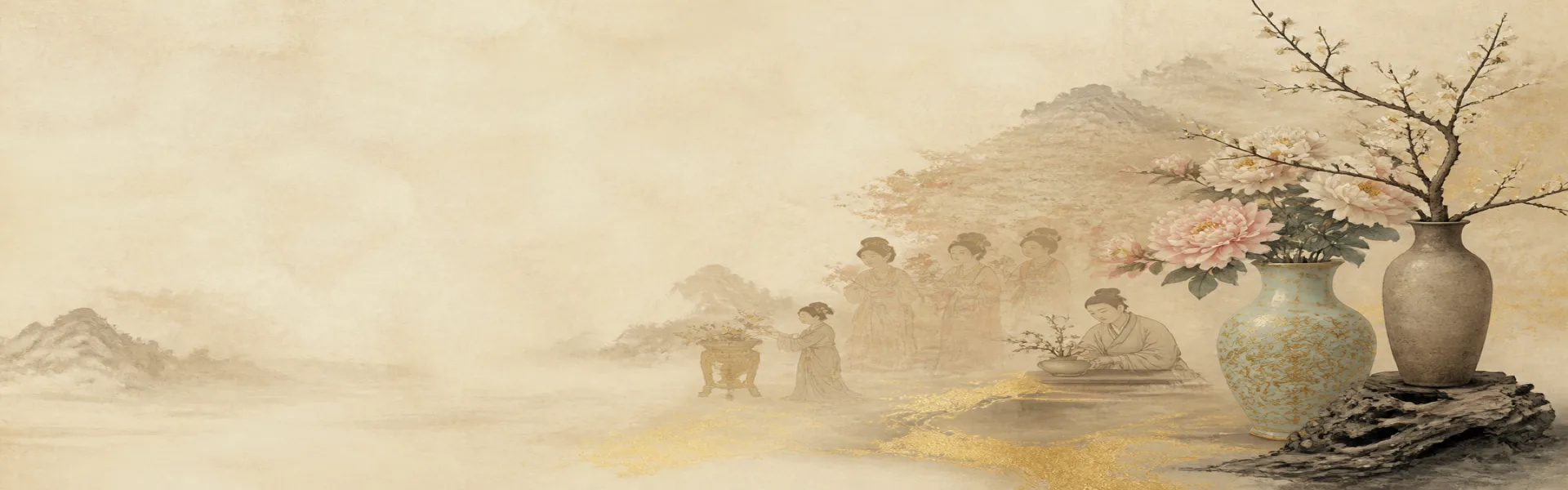
Flowers before arrangement
Early Chinese sources are full of flowers and fragrant plants, but not of arrangements. Plants were worn at the belt and in the hair, given as tokens, used in ritual, and written about extensively. The Chuci uses fragrant plants as emblems of integrity, and the Book of Songs mentions many species.
What is missing is the idea of cutting stems and composing them in a vessel for indoor display. That practice appears to have entered China from outside.
Buddhist offering
The earliest clear evidence of arranged cut flowers in China is religious. Buddhist practice requires flower offerings, and vases of flowers before images appear in cave paintings from the period of division onward and are described in texts of the same period. Paired vases flanking an altar is the standard form and remains so.
This origin matters for two reasons. It explains why the practice arrived with a religious purpose rather than an aesthetic one, and it explains the persistence of symmetrical paired arrangements alongside the asymmetric scholarly form, which developed later and never displaced them.
The Tang: flowers as a public enthusiasm
Tang China developed a large-scale secular culture of flowers. Peony mania in Chang'an is the most striking example: prices for rare cultivars reached extraordinary levels, viewing expeditions were social events, and poems complain about the expense and the crowds.
Flower markets were established, cultivation and forcing became commercial activities, and there was a festival dedicated to flowers. Flowers were given, worn and displayed. What is less clear is how much deliberate arrangement was happening as a distinct practice, as opposed to flowers simply being placed in vessels.
The Song: the practice takes its classical form
The Song is where Chinese floral art becomes the thing described in this section. Several conditions came together: a large urban educated class, a commercial horticulture industry supplying cut material, a highly developed ceramics industry producing suitable vessels, and an aesthetic of restraint that valued few elements and empty space.
The clearest evidence of the practice's status is a Song grouping of four pursuits considered the proper occupations of a cultivated interior: preparing tea, burning incense, arranging flowers and hanging paintings. The four are named together as a set. This is the single most useful fact about Chinese floral art, because it establishes that arrangement was understood as belonging with the other scholarly arts rather than as a decorative craft, and it explains why the four subjects in this section of the site sit together.
Song writing on flowers is extensive: monographs on peonies of Luoyang, on the herbaceous peonies of Yangzhou, and on cultivation generally. Song painting shows arrangements in studies, and the vessels survive in quantity.
The Ming: the treatises
The Ming produced the theoretical literature, and it is short and excellent. Zhang Qiande's manual on flowers in vases covers vessels, water, materials and care in practical terms. Yuan Hongdao's History of Vases, of about 1599, is the more famous: opinionated, funny, dismissive of excess, and as concerned with attitude as with method.
Other Ming works include a section on flowers in vases within Gao Lian's compendium on healthy living, a monthly calendar of suitable materials by Tu Benjun, and relevant passages in Wen Zhenheng's treatise on superfluous things, which is the standard guide to scholarly taste in objects.
Taken together these texts describe a mature practice with settled preferences and enough disagreement between authors to show it was a live subject.
The Qing: a slow decline
Scholarly arrangement continued into the Qing without producing much new theory. The best-known Qing passage on the subject is in Shen Fu's memoir, where he describes arranging flowers with his wife, including a technique for fixing stems using a pin pushed through a piece of charcoal or a section of stem. The passage is affectionate and domestic and is often quoted precisely because it shows the practice as an ordinary shared pleasure rather than as an art.
Through the Qing the scholarly form gradually lost ground. Related practices diverged and flourished independently: potted landscape, the cultivation of specimen plants, and the elaborate artificial flowers used in decoration. Religious offering continued unchanged.
The transmission to Japan
Here is the detail worth dwelling on. Chinese flower arranging influenced Japanese practice from early on, through Buddhist offering and later through the importation of Chinese vessels and Chinese aesthetic ideas.
Yuan Hongdao's History of Vases was translated into Japanese in the late seventeenth century, and it was influential enough that a Japanese school of flower arranging was established taking his name. Japanese practitioners were reading, teaching and building a lineage on a Chinese text at the same period during which the text was drifting out of circulation in China.
This is not an unusual pattern in East Asian cultural history, and the same thing happened with whisked tea and with certain guqin materials. But it is a useful corrective to the assumption that a Chinese origin implies Chinese continuity.
What the vessels and paintings tell us
Because the textual record is thin before the Ming, two other kinds of evidence carry much of the weight, and it is worth knowing what each can and cannot establish.
Vessels survive in large numbers. Song and Ming ceramics include many forms whose proportions and narrow necks make sense only as flower containers, and the existence of such forms in quantity is good evidence that arranging was widespread. What vessels cannot tell us is what was put in them or how it was disposed.
Paintings show arrangements, sometimes in considerable detail, in depictions of studies, gardens and gatherings. These are more informative but must be read with care. A painted arrangement is a painter's composition, subject to the conventions of painting, and may show an ideal rather than a record. Where several paintings from the same period agree, the evidence is stronger.
Taken together the two lines suggest that Song and Ming arrangement used few stems, favoured branch material, and placed the vessel as one element in a composed interior alongside a hanging scroll, a censer and a stand for tea. That is consistent with the texts, which is reassuring, but it is inference rather than description.
The twentieth century
The scholarly practice ended. The class that sustained it disappeared, war and upheaval made ornamental pursuits impossible for most people, and later political conditions were hostile to visibly elite traditional culture. Commercial floristry that developed in Chinese cities during the twentieth century followed Western models, because those were the models available.
The Ming texts survived in libraries and in collected editions, but the practice they described did not survive as a living transmission. This is a genuine break, and it distinguishes floral art from calligraphy, painting and tea, all of which retained some continuity.
The revival
Recovery began in Taiwan, where scholars and practitioners from the 1980s onward worked from the Ming treatises, from painting and from surviving religious practice to reconstruct a Chinese approach distinct from Japanese and Western models. This work was serious, and it produced teaching, publications and exhibitions.
On the mainland, interest developed from the 2000s alongside the broader revival of traditional arts, and it has grown quickly. There are now courses, associations, competitions and a commercial market.
The honest assessment is that this is a reconstruction of considerable quality and that its relationship to Ming practice is interpretative. The sources give principles and preferences; they do not give a curriculum, a set of exercises, or graded structural forms. Where modern teaching provides those things, they have been devised, often with reference to Japanese pedagogy. This is not a criticism of the result, but presenting it as unbroken transmission is inaccurate.
Key points
- Arranging cut flowers in vessels appears to have entered China with Buddhism, as offering rather than as aesthetic practice.
- The Tang developed a large public flower culture, including peony mania and commercial flower markets.
- The Song grouped arranging flowers with preparing tea, burning incense and hanging paintings as the four pursuits of a cultivated interior, which establishes its status as a scholarly art.
- Two short Ming treatises are the core theoretical documents, with Yuan Hongdao's the more famous and more opinionated.
- Yuan's book was translated into Japanese and a Japanese school was named after him, while the text itself drifted out of circulation in China.
- The practice broke in the twentieth century, and the current revival, begun in Taiwan in the 1980s, is an interpretative reconstruction rather than an unbroken transmission.