Flower Arrangement as Cultivation
插花与修养
Of the four arts in this section, floral arrangement has the weakest documented connection to Taoism, and it is worth saying so at the start rather than constructing a link. There is no Taoist doctrine of flowers, no scriptural treatment of arrangement, and no lineage of Taoist floral practice.
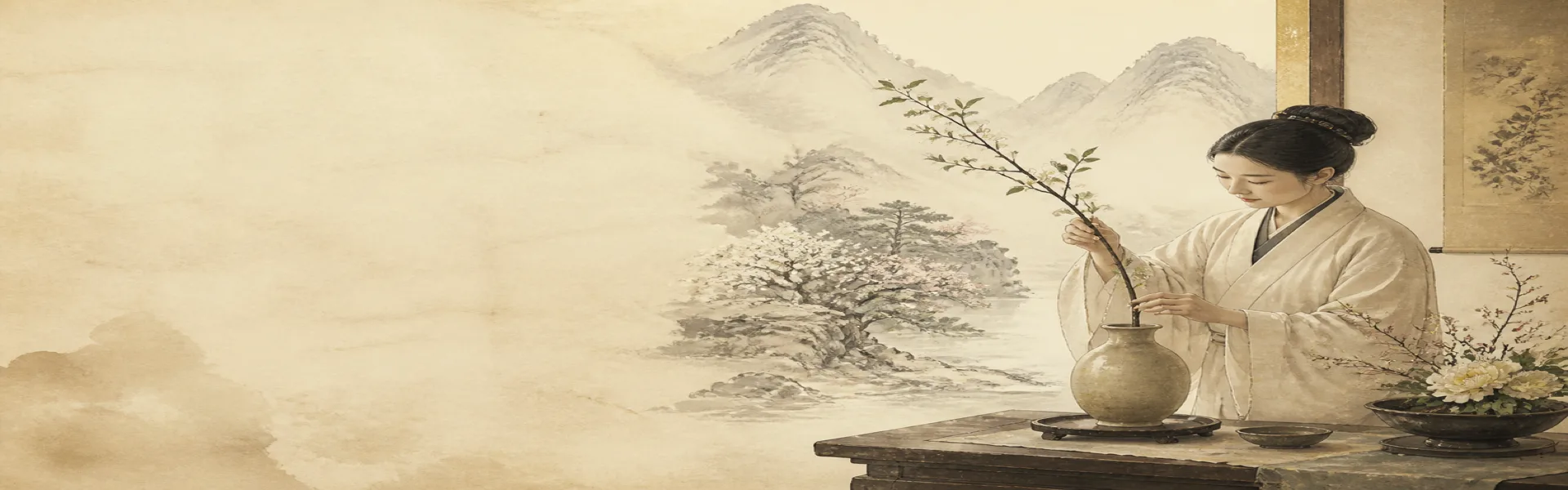
What exists is a set of shared aesthetic values, a genuine resonance with one particular passage in the Zhuangzi, a religious use of flowers as offerings, and a set of things the practice actually does to the person doing it. This page treats each honestly, including one difficulty the tradition does not resolve.
Religious use, and whose religion
Flowers are standard offerings in Taoist temples, placed in paired vases before images alongside incense, lamps, fruit and tea. This is real and universal, and a visitor to Wudang will see it.
But the practice of offering cut flowers came into China with Buddhism, and the Buddhist framework is much more developed: flower offering is prescribed in Buddhist texts, is discussed doctrinally, and carries a specific meaning about impermanence. Taoism adopted the practice as part of a shared repertoire of offerings without generating a distinctive theory of it.
So the honest statement is that flowers are offered in Taoist ritual, and that the ideas surrounding flower offering in Chinese religion are largely Buddhist in origin.
The shared aesthetic vocabulary
Here the connection is real, though it is a connection with a general Chinese literati aesthetic that draws heavily on Taoist texts rather than a specifically Taoist practice.
The words of praise are the same ones used for calligraphy, painting and the guqin: plain, unforced, natural, sparse, awkward in the sense of unpolished, and quiet. The words of criticism are the same too: contrived, showy, crowded, effortful. Anyone who has read the Laozi will recognise the whole set.
The principle that fewest elements is best, that empty space is active, and that the result should look as though it came about of itself are all continuous with the philosophical texts. This is not a coincidence; the people arranging flowers had read those texts and were consciously applying them.
The useless tree
One passage in the Zhuangzi has a specific and genuine relevance. It describes a tree so gnarled, knotted and crooked that no carpenter will touch it, and observes that this uselessness is precisely why it has survived to grow old while straight useful trees were felled.
This is directly relevant to the tradition's preference for bent, scarred and irregular branches. A Chinese arranger choosing a twisted branch over a straight one is doing something that has a text behind it, and the text is Taoist. The connection is not decorative.
It also connects to a broader position: that the qualities conventionally valued — usefulness, regularity, perfection — are not the only ones, and that what looks like a defect may be what allows something to persist and to be interesting. That idea genuinely informs the aesthetic.
Transformation rather than form
If there is a distinctively Taoist contribution, this is probably it. The Taoist texts are much concerned with change: things transform into other things, states are temporary, and fixing on a single state is an error.
Chinese arrangement builds this in structurally. Buds, open flowers and spent flowers are used together deliberately, so that the arrangement displays a process rather than a peak. The material continues to change over days and the arrangement is expected to change with it. Patching it to preserve a moment is regarded as a mistake.
This differs in emphasis from the Buddhist reading of the same fact. Buddhism treats the transience of flowers as an instruction about impermanence and attachment. The Taoist emphasis is less didactic: change is simply what things do, and an arrangement that shows it is more accurate than one that does not.
A difficulty the tradition does not resolve
Here is a genuine problem, and it is rarely raised. Arranging cut flowers requires cutting a living plant for no purpose except looking at it. Taoist thought contains a strong current against unnecessary interference with things, against forcing them out of their own course, and against valuing human satisfaction above the integrity of what exists.
The tradition's implicit answers are visible in its practices rather than stated as arguments. Take very little. Take what pruning would remove anyway. Work with the branch's existing shape rather than bending it to a design. Do not use mechanical supports that force material into positions it would not hold. Prefer material that has fallen or that is past its peak. Use what is in season and local rather than what has been forced, transported and refrigerated.
These are real mitigations and they are consistent with the philosophy. But the basic act remains an intervention, and a person who takes the non-interference strand seriously might reasonably decide not to cut anything at all. It is worth noting that the tradition's most admired arrangement — a single branch — is also its smallest intervention, and that the modern availability of industrially produced flowers makes the problem larger rather than smaller.
What Yuan Hongdao actually thought
Since the treatise is the tradition's central document, its author's position is relevant. Yuan Hongdao was associated with a late Ming literary movement emphasising individual sensibility and spontaneity over imitation, and his religious interests were substantially Buddhist, particularly Chan.
His treatise is not a religious text. It is the work of a man who liked flowers, disliked pretension, and wrote with humour about both. His insistence on few stems and on avoiding display is aesthetic and temperamental rather than doctrinal.
This matters because modern presentations sometimes frame the treatise as a work of Taoist philosophy. It is not. It is a good book about flowers by a man with views, and the philosophical resonances are the ordinary furniture of an educated Ming mind rather than a programme.
What the practice actually does
Setting aside the question of whether it is Taoist, arranging flowers in this manner does several checkable things, and they overlap with the other arts covered here.
It requires you to work with what exists. You cannot arrange the branch you imagined; you arrange the branch you have, with its actual bends and gaps. This is a specific and useful discipline, and it is more forceful here than in calligraphy or painting, where the material does not have a shape of its own.
It requires stopping. The dominant error is adding, and the practice consists largely of resisting that. Learning to stop before you feel finished is transferable and difficult.
It requires accepting change. Whatever you make will alter and end within days, and there is nothing to be done about it. Doing this weekly for a year is a practical education in producing something carefully and then letting it go, which is not a small thing.
Alternatives that avoid cutting
If the difficulty above bothers you, and it reasonably might, there are approaches within the same aesthetic that do not require cutting living material.
Fallen branches, storm debris and prunings that were going to be removed anyway supply excellent material, and weathered wood often has exactly the qualities the tradition prizes. Autumn foliage and seed heads can be collected after they have fallen. Dried material — reeds, grasses, pods, lotus stems and seed pods — is used in traditional arrangements and keeps indefinitely.
Potted plants and potted landscape are a related tradition that involves tending a living plant rather than cutting one, and they occupied Chinese attention at least as much. Stone appreciation, the display of a single found rock on a stand, applies the same compositional criteria to something that was never alive.
None of these is a lesser version of the practice. The tradition treated bare branches, dried material and stones as fully adequate subjects, and a winter arrangement of a dead branch and a piece of moss is completely orthodox.
Doing it as a practice
If you want to approach arrangement as a discipline rather than as decoration, a few adjustments follow from everything above.
Go and look before you cut. Spend more time selecting than arranging; the tradition's actual difficulty is in seeing which branch and which part of it, not in the placing. Take one thing. Work in silence and without music, since the point is attention. Do not photograph it, at least not at first, because the intention to photograph changes what you make.
Place it where you will see it repeatedly during the week, and look at it each time without adjusting it. When it is finished, dismantle it and put the material outside. Then do it again. The regularity is what makes it a practice rather than an occasional pleasure, and one branch a week for a year is a serious body of work.
An honest boundary
The defensible claims: the aesthetic vocabulary is continuous with Taoist writing; the preference for crooked and imperfect material has a specific Taoist text behind it; the structural inclusion of buds and spent flowers embodies a genuinely Taoist emphasis on change; and the practice trains working with given material, stopping early, and accepting impermanence.
The claims that do not survive: that there is a Taoist tradition of flower arrangement, that particular arrangements produce spiritual effects, that plant materials carry energies acting on the arranger, or that the Ming treatises are religious works. And the tension between cutting living plants and the non-interference strand of Taoist thought is real and unresolved, and should not be smoothed over.
Key points
- There is no Taoist doctrine of flowers and no lineage of Taoist floral practice, and the ideas around flower offering in Chinese religion are largely Buddhist in origin.
- The aesthetic vocabulary of plain, unforced, sparse and quiet is continuous with the Laozi and with the other scholarly arts.
- The Zhuangzi's useless crooked tree is a genuine text behind the preference for bent and scarred branches.
- Using buds, open and spent flowers together makes the arrangement display a process, which reflects the Taoist emphasis on change rather than the Buddhist lesson about impermanence.
- Cutting living plants for display sits in real tension with the non-interference strand of Taoist thought, and the tradition mitigates rather than resolves it.
- Yuan Hongdao's treatise is a good opinionated book about flowers, not a work of Taoist philosophy.