Seasonal Flowers & Symbolism
什么季节插什么,花又代表什么
Season is the organising principle of Chinese floral art, and symbolism is its second layer. This page sets out what is available and appropriate through the year, what the standard associations are, and how much weight the symbolism should carry.
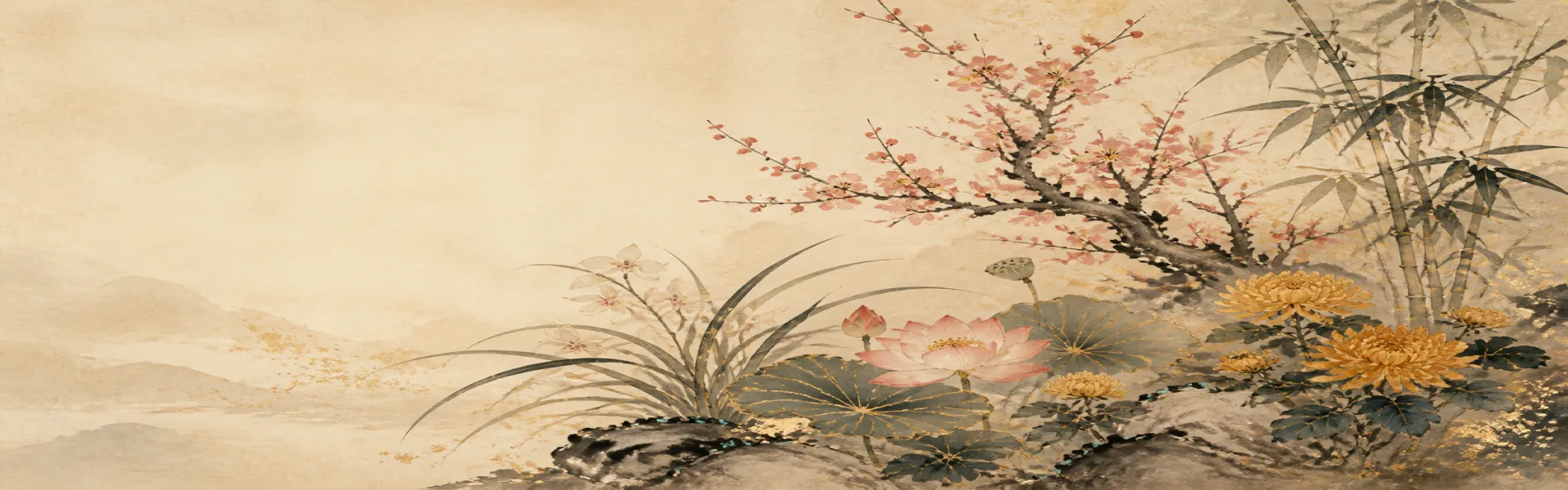
The seasonal information assumes a temperate climate broadly similar to central and eastern China. If you are elsewhere, the principle transfers even though the plants do not: use what is growing near you now.
Why season is not decoration
The Ming literature includes month-by-month tables of suitable materials, and the assumption is not that seasonal material is prettier but that it is the only honest option. An arrangement is supposed to record a particular moment, and a moment has particular plants in it.
Modern year-round availability removes this constraint and with it most of the meaning. An arrangement of imported roses in January is competent floristry and is not this tradition. The restriction to local seasonal material is the cheapest and most effective way to work authentically, and it also solves the problem of what to use, since the answer is whatever is out.
Late winter and early spring
Plum is the first and the most important. It flowers on bare branches in cold weather before other plants, and its associations — integrity under hardship, endurance, the promise of renewal — are the strongest in the whole repertoire. A single plum branch in a plain vessel is the classic arrangement of the tradition and needs nothing added.
Wintersweet, a different plant with small waxy yellow flowers and a powerful scent, also flowers in deep winter and is prized for its fragrance. Narcissus, forced indoors for the new year, is nearly universal in Chinese households at that season. Camellia flowers through winter and gives glossy foliage as well as blooms. Nandina, with red berries, supplies colour when little else does.
As spring advances: magnolia, with heavy white flowers on bare wood; forsythia; peach and crab apple; willow, valued for the line of its branches rather than for flowers; and orchid, which is a spring subject in Chinese usage and carries associations of unassuming cultivation.
Late spring
Peony arrives and dominates. The tree peony is the flower of wealth, rank and confident display, and it is the one Chinese subject where abundance and richness are entirely appropriate. It is also the flower most associated with Tang enthusiasm and with Luoyang.
Herbaceous peony, associated with Yangzhou, flowers slightly later. Wisteria, iris, and the flowering branches finishing their season all belong here. This is the most abundant period and therefore, by the tradition's logic, the one requiring most restraint.
Summer
Lotus is the summer subject and it is treated distinctively. Buds, open flowers, seed pods, leaves and even stems are all used, often together, so that a single arrangement shows the whole cycle. Its association, drawn from Buddhism, is purity maintained in a corrupt environment: it rises clean out of mud.
Gardenia and jasmine supply strong scent. Pomegranate flowers are brilliant red and the fruit follows. Hydrangea, day lily and various water plants are used. Bamboo is available year-round and is particularly suited to summer arrangements because it reads as cool.
Summer material wilts fast, which the Ming writers mention. Frequent water changes and cool positions matter more in this season than any other.
Autumn
Chrysanthemum is the autumn subject and, after plum, the most heavily freighted with meaning. It flowers when other plants have finished, which gives it associations of late endurance and of principled withdrawal, reinforced by its connection to Tao Yuanming, who is described picking chrysanthemums by his eastern fence.
Osmanthus is small, inconspicuous and intensely fragrant, and its scent in autumn is one of the most recognisable in Chinese cities. Cotton rose changes colour through the day. Maple and other coloured foliage are used as material in their own right. Reeds and grasses, persimmon branches with fruit still attached, and seed heads all belong to autumn and suit the tradition's preference for material past its flowering peak.
New Year arrangements
There is a named genre for the new year, an offering arrangement for the turn of the year, and it has a fairly settled repertoire: narcissus, nandina with red berries, pine, plum, and sometimes citrus fruit or a small potted plant.
These arrangements are often paired with a painting of the same subject, and the combination of narcissus, nandina, pine and a fruit appears constantly in Chinese painting under a title meaning pure offerings for the new year. Knowing this genre is useful because it is one of the few cases where a specific combination of materials is conventional and expected.
The standard symbolic sets
Two groupings recur everywhere. The four gentlemen are plum, orchid, bamboo and chrysanthemum, standing for integrity in hardship, unassuming cultivation, flexible strength and late endurance, and corresponding to the four seasons. The three friends of winter are pine, bamboo and plum, all of which survive cold.
Individual associations worth knowing: pine for longevity, lotus for purity, peony for wealth and rank, magnolia for nobility, willow for parting, osmanthus for honour and success in examinations, camellia for endurance.
Homophone symbolism
A large part of Chinese floral meaning works through puns, and this is more prevalent in popular and gift contexts than in scholarly arrangement.
Lily produces a phrase meaning a hundred years of harmonious union, which is why it appears at weddings. Persimmon sounds like affairs or matters and produces a wish that everything goes as you want. Osmanthus sounds like honour or rank. Bamboo sounds like to wish. Lotus sounds like continuous or successive. Tangerine sounds like auspicious. Apple sounds like peace.
These are not subtle and were not meant to be. They belong to a tradition of visual and verbal wordplay that runs through Chinese decorative art, and a gift arrangement is often assembled to say a specific sentence.
What to avoid giving
Some cautions are worth knowing, though several are more recent or more regional than they are usually presented as being.
White and yellow chrysanthemums are strongly associated with funerals and mourning in modern China and should not be given as ordinary gifts. White flowers generally carry funerary associations in some contexts. The number four is avoided because it sounds like death. Potted plants can imply rootedness in ways that may be unwelcome in some situations, though this is inconsistently observed.
Much popular advice on flower taboos is invented or borrowed. If in doubt, red and pink flowering material in odd numbers is safe almost everywhere, and asking is better than guessing.
Materials that are not flowers
A significant part of the repertoire is not flowers at all, and this is one of the clearest differences from Western practice. Bare branches are used for their line. Fruiting branches are used in autumn and winter, including persimmon, crab apple, citrus and pomegranate, and the fruit is often the point. Seed heads, dried pods and grasses are used deliberately rather than as filler.
Foliage is treated as primary material. Pine, bamboo, nandina, maple, and various evergreens are arranged on their own. Moss, small stones and pieces of weathered root appear in low arrangements in basins, and here the practice shades into potted landscape.
Water is also material. In a low basin arrangement the surface of the water is part of the composition, and the space it occupies is judged as space. Floating a single lotus flower or a few petals is an accepted form, and the Ming writers mention arrangements in which the water is the largest visible element.
The practical consequence for a beginner is liberating. If you cannot find flowers, you can still work. A bare winter branch, a few pine needles, a piece of moss and a shallow bowl are entirely adequate material, and in this tradition they are not a compromise.
How much to read into it
A caution to balance all of the above. Not every arrangement is a coded statement. The Ming writers chose plum because plum was flowering and because they liked the line of a plum branch, and the symbolism was available rather than compulsory.
Symbolic reading is most reliable when an arrangement was made for an occasion, when the combination is unusual or repeated, or when it accompanies a painting or inscription that confirms it. Otherwise, a branch of plum in February is a branch of plum in February, and reading a statement into every stem is a way of not looking at the arrangement.
Key points
- Seasonal material is not a preference but the tradition's basic honesty, and modern year-round availability removes most of the meaning.
- Plum is the central subject, flowering on bare branches in cold weather, and a single branch in a plain vessel is the classic arrangement.
- Lotus is used across its whole cycle, with buds, flowers, pods and leaves together showing a process rather than a peak.
- Chrysanthemum carries late endurance and principled withdrawal, reinforced by its association with Tao Yuanming.
- New Year offering arrangements have a settled repertoire of narcissus, nandina, pine and plum, and appear constantly in painting.
- Much symbolism works through puns, but not every arrangement is a coded statement, and over-reading is a way of not looking.