Chinese Incense Seals: Ash, Patterns and Fragrant Time
中国香篆:香灰、篆纹与芬芳计时
An incense seal begins as a line that can be smelled and watched. Fine aromatic powder is arranged as a continuous path on a prepared bed of ash; once one end smoulders, the glowing point advances and leaves a second line of spent material behind it. Pattern, fragrance and duration meet in the same small space.
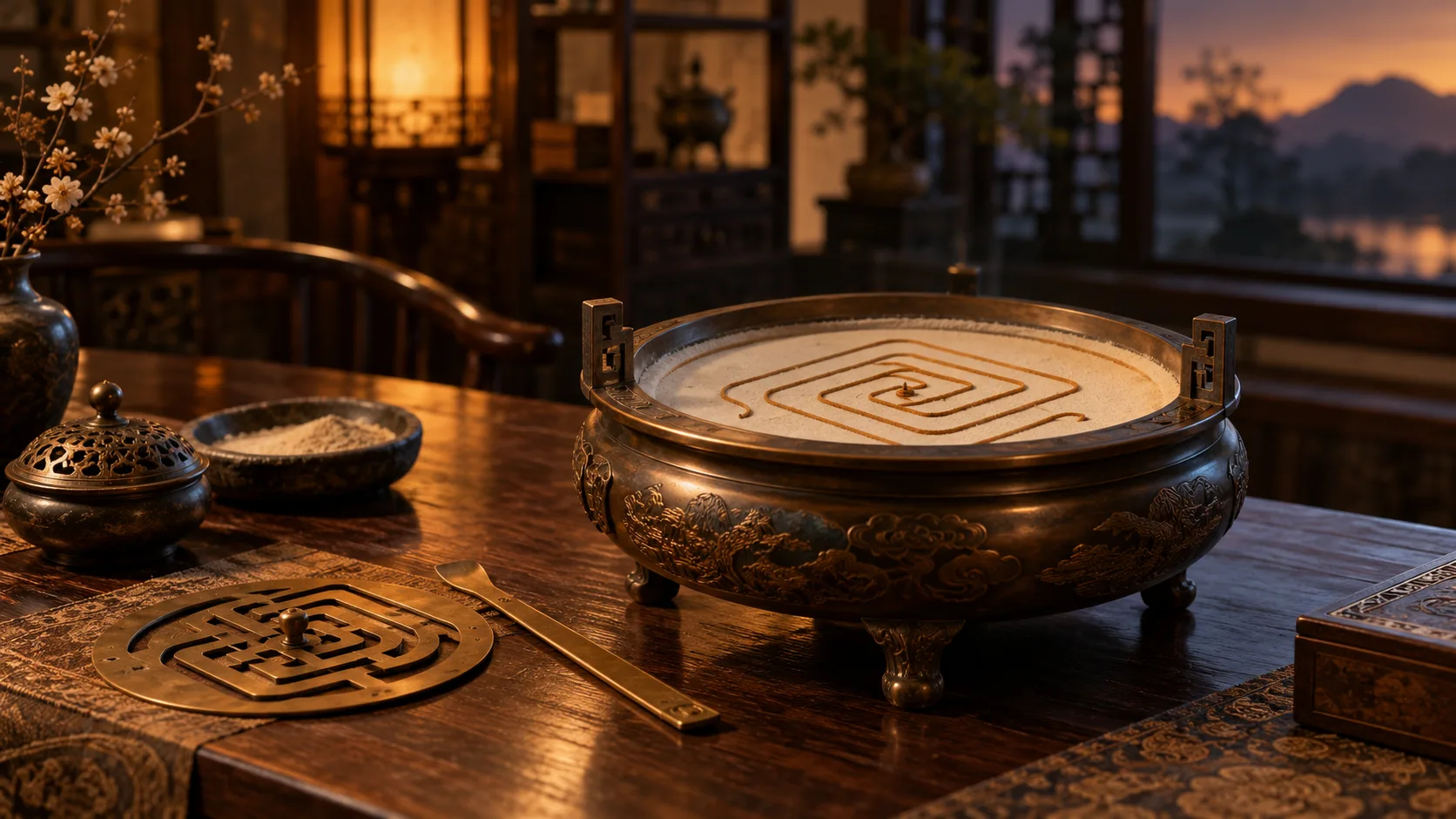
English labels can blur two related things: the patterned practice often called an incense seal, and an assemblage deliberately used as an incense clock. Some surviving instruments were made to measure time; not every decorative or contemplative trail was a precision timekeeper. This guide keeps that distinction visible while connecting the objects to Chinese Incense Culture, the history of incense in China and forms of incense appreciation.
Build the trail before reading the pattern
Ash is the working ground
The pale surface is not merely a background. The Horniman Museum’s ruyi-shaped powdered-incense clock has one tray for powder and another for a fine layer of white wood ash. A level, receptive bed supports the narrow line while separating it from the metal container. When studying an object, identify the ash tray, storage tray and outer case before treating the whole assembly as a single bowl.
The seal makes a continuous channel
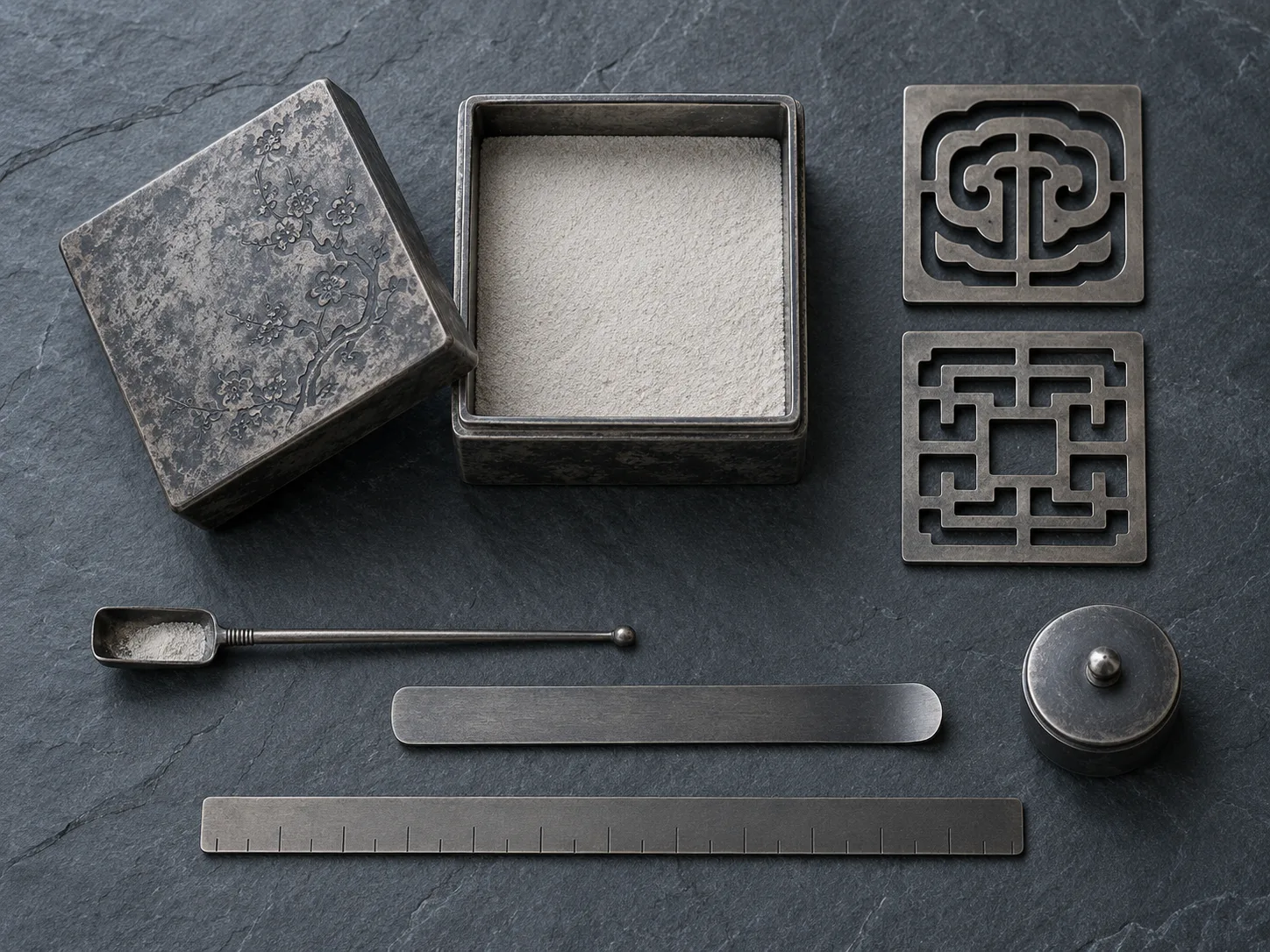
A stencil or seal is laid over the ash, powder is introduced into its channel, and a tamper or leveller helps form an even trail. The template is then removed without breaking the route. The Science Museum Group clock preserves three trays, two maze stencils, a latticework lid and a leveller. That inventory is valuable because it shows a system of cooperating parts rather than a freestanding ornament.
Lid, tools and storage complete the instrument
A pierced lid protects the trail while admitting air; a scraper, scoop or leveller prepares ash and powder; lower trays may store these accessories. Another Horniman incense clock retains a two-part seal, tamper plate, miniature shovel and bird-shaped scraper. A missing implement can make an incomplete object look deceptively simple, so catalogue each component before reconstructing how it worked.
When a pattern becomes a duration
The route turns distance into elapsed time
In a timekeeping assembly, the smouldering point travels along a pre-measured path. A longer route or a differently designed stencil can represent a different duration. The Science Museum Group record explicitly identifies two maze stencils representing different amounts of time. The evidence lies in the documented relationship among trail, stencil and use—not in a maze-like appearance by itself.
Steady burning depends on preparation and conditions
Powder composition, line width, compaction, ash, humidity and airflow can all affect progress. Museum descriptions note that pierced covers reduced disruptive breezes. This makes an incense clock a calibrated material process, not a mechanical clock hidden inside a censer. Without a tested recipe and documented scale, a beautiful pattern indicates sequence and duration more safely than exact minutes.
Fragrance can mark a passage without behaving like a stopwatch
Incense can structure a reading session, meditation or interval even when nobody needs minute-by-minute accuracy. Horniman’s catalogue notes a movement from timekeeping toward use by monks or scholars for meditation and aesthetic pleasure. That history cautions against a false choice: the same family of objects could organize practical time, sensory attention and cultivated appreciation in different settings. For a broader account of offerings and religious settings, see incense in ritual and temple life.
Place incense seals in history without forcing an origin story
Bedini assembled a documentary history of fragrant time
Silvio A. Bedini’s The Trail of Time brought Chinese and Japanese historical and literary records together in a major study of East Asian incense timekeeping. His earlier American Philosophical Society study includes a chapter specifically on the hsiang-yin, or “incense seal”. These works establish a long documentary field, but individual museum objects still require their own dating, provenance and condition records.
Song fragrance catalogues belong to a wider knowledge culture
Recent research by Qian Jia on Song-dynasty catalogues of incense shows scholar-officials organizing knowledge of aromatics, formulations and trade through a new textual genre, the xiangpu. This broadens the setting in which refined incense practices can be understood. It does not, by itself, date every surviving stencil or prove that all later customs took one unchanged form.
Names, symbols and shapes do not supply a complete biography
A longevity character, auspicious lattice or ruyi outline may help identify visual language, but it cannot alone establish workshop, owner, ritual or exact period. Separate what the pattern depicts from what the catalogue documents. The same caution applies to the container: compare the object-led guide to Chinese incense burners before turning a familiar form into a fixed historical claim.
Use a six-pass museum method
Read the complete record, not just the top view
- Assembly: Which pieces are case, powder store, ash tray, seal, tamper, tool and lid?
- Path: Is the channel continuous, and where would ignition and completion occur?
- Control: What features level the powder, shield airflow or distinguish one duration from another?
- Material: What does the catalogue identify—brass, copper, nickel silver, wood, ash or mixed materials?
- Evidence: Does the record document timekeeping, meditation, collecting or another use, and with what degree of certainty?
- Afterlife: Are components missing, associated later, repaired, polished or separated across catalogue entries?
Keep observation, reconstruction and interpretation separate
Write “the record identifies” when following a catalogue; “the construction suggests” when making a physical inference; and “the motif may evoke” when interpreting imagery. Do not convert an attractive reconstruction into evidence about a specific monastery, scholar or household. For aromatic materials themselves, continue with fragrant woods and other incense ingredients.
Study historic objects; use fire only in suitable modern equipment
Never fill, light, clean or test an antique or museum object. For personal practice, use a stable modern vessel intended for powdered incense, place it on a heatproof surface, ventilate the room and keep smouldering material away from textiles, children and animals. Do not leave it unattended. The cultural history of fragrant time is worth understanding without turning a surviving object—or a conceptual image—into an operating manual.