Origins & History of Chinese Incense Culture
中国香文化的源流与历史
Chinese incense culture has two distinct phases separated by an event: the arrival of foreign aromatics through maritime trade. Before it, incense meant native fragrant plants used mainly for purification and for keeping insects away. After it, incense meant expensive imported resins and woods, and a culture of connoisseurship became possible.
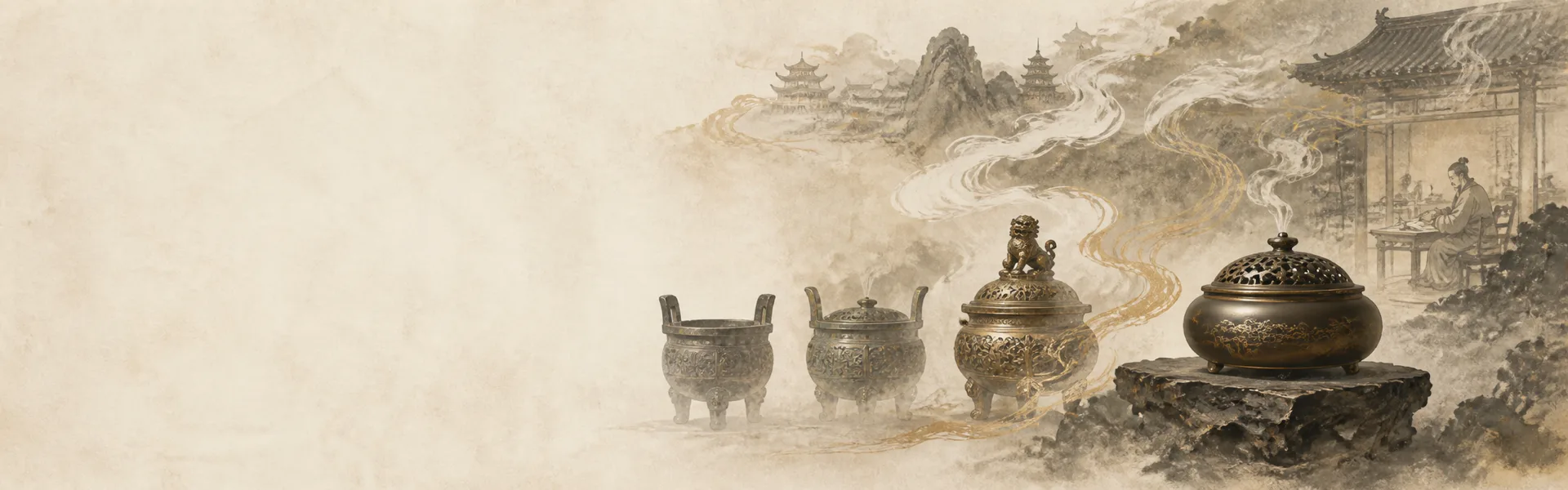
This page follows that development and the later history, including the collapse of the literati practice and the recent and rather peculiar revival.
Before imported aromatics
Early Chinese texts refer to fragrant plants in ritual and personal use well before the Han. Artemisia was burned for purification, and thoroughwort and other aromatic herbs were worn at the belt, hung in doorways, and steeped in wine.
The Chuci, the Songs of the South, is full of fragrant plants used as markers of moral purity: the speaker gathers and wears aromatic herbs to signal integrity in a corrupt court. This established a long-lasting association between scent and character that persisted after the materials themselves changed completely.
What is missing at this stage is anything like appreciation for its own sake. The plants were used because they purified, repelled insects, or symbolised something. Nobody was sitting down to smell them attentively.
The Han and the arrival of the trade
From the Han onward, resins and aromatic woods began arriving from Southeast Asia, India, Arabia and East Africa through maritime and overland routes. Frankincense, myrrh, agarwood, sandalwood and camphor entered Chinese use, and they were expensive, exotic and burned rather than worn.
The characteristic object of this period is the mountain censer, a bronze vessel whose pierced lid is modelled as a peak, sometimes with animals and figures on its slopes, so that smoke issues from the openings as mist around an immortal's mountain. These are among the finest Chinese bronzes and they show that incense had already acquired cosmological associations.
Han court use was lavish and is recorded in anecdotes about emperors and favourites. Incense also entered medicine, and the aromatic materials were classified in the pharmacological literature from early on.
Buddhism
The spread of Buddhism from the Han onward transformed incense use, and the scale of the change is easy to underestimate. Buddhist ritual requires incense, monasteries burned it continuously, and the religion arrived along the same routes as the materials.
Demand rose enormously, monastic institutions became major consumers and sometimes traders, and the offering of incense became a universally understood religious act. Much of what looks like generic Chinese incense practice today descends from Buddhist ritual rather than from literati appreciation or from Taoist rites.
The Tang
Tang China consumed aromatics on a large scale. The maritime trade was substantial, foreign merchants were established in Guangzhou and other ports, and aromatic imports were significant enough to be taxed and regulated.
Compounded incense recipes become elaborate in this period, mixing many ingredients with binders and honey and ageing the result. Incense was used to scent clothes, rooms, carriages and the person, and the practice was thoroughly integrated into elite domestic life.
A remarkable survival illustrates the period: a large piece of agarwood presented to a Japanese temple in the eighth century still exists in the Shōsōin repository at Nara, bearing notches where fragments were cut off by successive rulers over more than a thousand years. It is the oldest identifiable piece of incense material in the world.
The Song: the connoisseur's period
Song China is where incense culture reaches its most developed Chinese form. Several things came together: maritime trade was at a peak and administered through official trade offices, a large educated class had money and leisure, and the same sensibility that produced Song ceramics and tea connoisseurship applied itself to scent.
Written manuals on incense appear, collecting recipes, describing materials, grading them and discussing methods. These are the primary sources for the tradition and several survive.
Two technical developments belong to this period. The method of heating material on a plate above buried charcoal, rather than burning it, allowed the scent of fine agarwood to be appreciated without combustion products. And seal incense, using a stencil to lay powder in a continuous decorative line, became widespread, serving both as timekeeping and as an object of contemplation.
Song poets and officials wrote about incense as they wrote about tea and ink, and the practice sat comfortably alongside the other scholarly arts. This is the period that modern revivals look back to.
Ming and Qing
Incense remained important through the Ming, and the period produced the most famous censer type in Chinese history, associated with the Xuande reign. The literature on compounding continued, and the practice of appreciation persisted among the educated.
The stick form spread widely during these centuries. It is cheap, convenient and requires no equipment, and it made incense available to everyone. Its spread is associated with the growth of mass devotional practice, and it changed the balance of the tradition: by the Qing, most incense burned in China was cheap sticks offered in temples, not fine material appreciated by scholars.
Literati incense practice declined through the Qing without ever quite disappearing. It was never as institutionalised as calligraphy or as widespread as tea, and it depended on expensive imported material, which made it vulnerable.
The twentieth century
The scholarly practice effectively ended. War, the collapse of the class that sustained it, and later political hostility to religion and to traditional elite culture left incense as a purely devotional and commercial product. Mass-produced sticks, often with synthetic fragrance, supplied temples and households.
The knowledge did not entirely vanish, but the continuity of practice largely did. This matters for understanding the revival, because there was no unbroken lineage to revive from.
The revival and the market
From the 1990s, incense appreciation reappeared in China, and its sources are worth stating plainly. Taiwan and Hong Kong, where the agarwood trade had continued, were important. Japanese practice, which had preserved and codified appreciation continuously since the fifteenth century, provided a model for procedure and equipment. And Song written sources were studied and reconstructed from.
The result is a practice that is genuinely connected to Chinese tradition through its texts and materials, and that is new in its present ceremonial form. Practitioners vary in how openly they say this.
Simultaneously, agarwood became a speculative commodity. Prices for high-grade material rose to extraordinary levels through the 2000s and 2010s, driven by collecting and investment demand as much as by use. This has had two consequences: intense pressure on remaining wild trees, and a market flooded with misrepresented and artificially treated material. Anyone entering this field should understand that they are entering a market with strong incentives for misdescription.
Incense and Taoist history
Taoist ritual adopted incense early and the sources are reasonably clear. Celestial Master liturgy from the period of division specifies incense burning in rites of petition, and the burner became a fixed element of the ritual space. The image of a petition rising with the smoke is old and persistent, and some ritual texts describe the officiant visualising the smoke carrying a written document to specific celestial offices.
There is also a distinctive Taoist contribution in the language of internal practice. Alchemical writing uses incense imagery for internal processes, and the furnace and the censer are sometimes deliberately conflated. As with alchemical vocabulary generally, whether a passage means an actual censer or an internal process is often not decidable from the text alone.
At the institutional level, large Taoist establishments consumed and sometimes traded aromatics on a considerable scale, and mountain sites with pilgrimage traffic developed local production of cheap devotional incense. This is a less glamorous connection than the alchemical one and is better documented.
What the sources actually tell us
It is worth being clear about the evidence base, because incense history is often written with more confidence than the material supports.
The Song manuals are the best sources, and they are recipe collections and material descriptions rather than accounts of practice. They tell us what was compounded and how materials were graded; they say relatively little about what people actually did when appreciating incense, in what setting, or with what etiquette. The elaborate procedural detail supplied in modern presentations is largely inference or importation.
Archaeology helps with vessels and occasionally with residues, and poetry supplies incidental detail. But there is nothing in Chinese comparable to the Japanese school records that document procedure continuously. This gap is the honest reason for the caution about reconstructed ceremony expressed throughout this section.
Key points
- Before maritime trade, Chinese incense meant native herbs used for purification and insect control, with no culture of appreciation.
- The Han import of resins and aromatic woods made connoisseurship possible, and the mountain censer shows early cosmological associations.
- Buddhism transformed the scale of incense use, and much of today's ordinary practice descends from Buddhist ritual.
- The Song is the high point of Chinese incense connoisseurship, producing written manuals and the smokeless method of heating on a plate.
- The spread of cheap sticks shifted the balance toward mass devotional use, and literati practice declined through the Qing and ended in the twentieth century.
- The current revival dates from the 1990s, draws on Taiwan, Japan and Song texts, and coincides with agarwood becoming a speculative commodity.