Forms & the Art of Appreciation
线香、香篆与隔火熏香
How incense is prepared determines what you experience, more than most people expect. A stick and a fragment heated on mica can be the same material and produce almost unrecognisably different results. This page describes the forms, explains the appreciation method in practical detail, and sets out what to pay attention to.
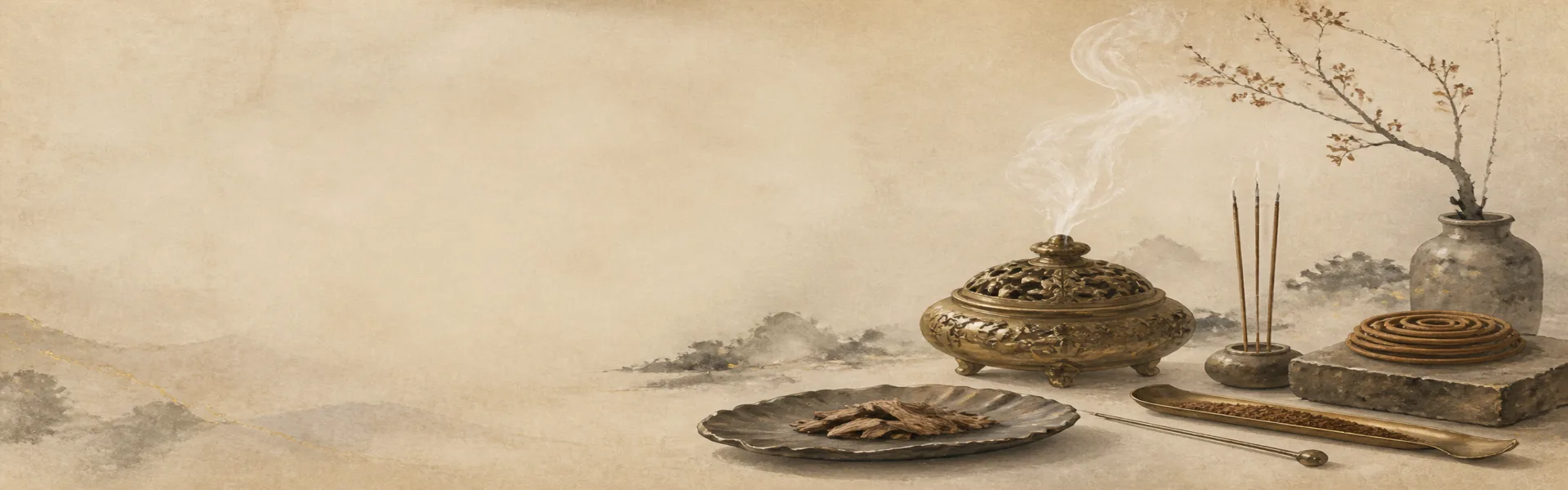
The forms and what each is for
Sticks are convenient, burn unattended, and produce a lot of smoke. They suit devotional use and general room scenting. Because they are combusted, the scent is partly the scent of burning, and fine material is largely wasted in this form.
Coils burn for hours and serve the same purposes at larger scale. Cones burn hot and fast. Loose powder can be burned in a trail or sprinkled on charcoal.
Pellets and small cakes are a traditional compounded form: aromatics bound with honey, rolled or pressed, and aged. They can be burned or, better, heated gently.
Seal incense uses a stencil placed on a bed of levelled ash. Powder is filled into the stencil's channels, the stencil lifted, and the resulting continuous line lit at one end. It burns slowly along its whole length, giving a low steady output and a visible measure of elapsed time. It is also simply pleasant to make.
Finally there is the method of heating without combustion, which is what the appreciation tradition uses and what the rest of this page mostly concerns.
Heating without burning: the equipment
You need a censer with a deep bowl, incense ash, a small piece of charcoal, tongs, a spatula or press for shaping ash, a pick, thin plates of mica or a small metal plate, and a fragment of material.
The ash matters more than it sounds. It must be dry, fine and loose so that air can pass through it, because the buried charcoal needs oxygen. Damp or compacted ash smothers the charcoal. Ash is reused indefinitely and improves with use, and preparing it is part of the practice rather than a chore.
The procedure
Level the ash in the censer. Light the charcoal until it is fully alight with no flame, then bury it in the ash, leaving it a few centimetres below the surface. Build the ash above it into a low mound and make a small hole at the top so that heat can escape in a controlled way.
Place the mica plate on the top of the mound over the vent, and put a small fragment of material on the plate. The material should warm gradually and release scent without smoking. If smoke appears, the plate is too hot: add ash beneath it or move the plate.
Then wait. The scent takes a minute or two to develop, and it will change over the following ten to twenty minutes as different components volatilise. When it fades, the fragment can be turned over or moved closer to the heat, and the same piece will often give two or three distinct phases before it is finished.
A fragment the size of a grain of rice is sufficient. This is the practical reason the appreciation method matters beyond aesthetics: it uses almost no material.
Electric heaters
Small electric heaters with temperature control are now widely available and they work well. They remove the charcoal management entirely, allow precise and repeatable temperatures, and produce no combustion products at all.
Traditionalists object that the charcoal preparation is part of the practice, and that argument has force in the same way it does for grinding ink. But for comparing materials, for learning, and for anyone without the patience or ventilation for charcoal, the electric approach is straightforwardly better. Many experienced people use both, charcoal for a session and electricity for evaluation.
What to attend to
Scent from gently heated material develops in stages, and following the stages is most of what appreciation consists of.
The first phase, as the material warms, is usually the lightest and sharpest: cool, sometimes citrus or camphor-like, sometimes sweet. The middle phase is the fullest and most characteristic, where the woody, resinous, honeyed or animalic qualities appear. The final phase, as the volatile components are exhausted, is often the deepest and quietest, and is where experienced people say the quality of a material shows most clearly.
Notice how long each phase lasts, how abruptly the transitions happen, and whether the scent is even or has distinct layers. Notice also where you feel it: some materials read as being at the front of the nose, others further back or in the throat, and these descriptions are consistent enough between people to be useful.
Describing what you smell
Here some honesty is useful. The elaborate vocabularies used in incense circles are largely modern, partly borrowed from tea and wine tasting, and partly translated from Japanese. Classical Chinese descriptions of scent are much sparser and more metaphorical than the modern ones.
The practical recommendation is to describe scents by comparison to things you have actually smelled: wet bark, honey, a hot iron, old paper, pepper, sea air. This is more informative than terms like elegant or refined, which record an evaluation rather than an observation, and it will develop your own reference set rather than someone else's.
Keep notes. Scent memory is poor and unreliable, and without a record you cannot tell whether your perception is developing.
Comparing materials
Comparison is the fastest way to learn, exactly as with tea. Heat two materials at the same temperature, in the same room, one after the other with a pause between, and the differences become obvious in a way they never do when materials are met separately weeks apart.
Keep the variables controlled: same size of fragment, same temperature, same censer or heater. Smell something neutral between samples if you need to reset, though the usefulness of coffee beans for this purpose is not well supported and plain air with a pause works as well.
Do not attempt more than three or four materials in a session. Olfactory fatigue is real and sets in faster than people expect.
Games and gatherings
The Japanese tradition developed formal games in which participants smell several materials, then identify them presented in a random order, often with results recorded on paper in poetic form. These are genuinely enjoyable and are a good training device.
They are Japanese in origin. Chinese sources do not describe anything equivalent, and versions offered in China today are adopted. That is not a reason to avoid them, but it is a reason not to describe them as a Song dynasty practice.
Setting and etiquette
Practical considerations mostly concern interference. Avoid strong competing smells: food, flowers, perfume, cleaning products. Do not wear scent. Ventilate the room before starting but avoid a draught during, since moving air disperses the scent unevenly. Keep the group small; incense from a single small fragment does not reach many people.
When passing a censer, it is handled with both hands and brought toward the face rather than the face down to it, and one breathes gently rather than inhaling sharply. Most etiquette in current use derives from Japanese practice or has been devised recently, and it is worth being relaxed about it.
Making your own
Compounding incense at home is entirely feasible and is the cheapest way into the subject. The basic requirements are a set of powdered aromatics, a binder, a mortar, and patience during ageing.
A simple starting formula is a majority of sandalwood powder, smaller quantities of two or three supporting aromatics such as clove, cassia or patchouli, a small amount of benzoin as a fixative, and around ten to fifteen per cent binder powder by weight. Mix dry, add water gradually until the mass just holds together, knead thoroughly, then form into small pellets or press into cakes.
Then leave it. Fresh incense smells harsh and raw. A month improves it noticeably and a year improves it more. This is the step beginners skip and it is the difference between something acceptable and something good. Keep a note of proportions, because you will not remember and you will want to adjust.
Two cautions. Do not add essential oils in the expectation of improving a compound; they behave differently under heat and usually produce a chemical note. And be conservative with camphor and borneol, which dominate a mixture at very small percentages.
Common mistakes
Too much heat is the dominant error, producing smoke and burning off the delicate components immediately. Too much material is the second: a large fragment does not give more scent, only a coarser and shorter experience. Damp or compacted ash smothering the charcoal is the third.
Other frequent problems include using a censer too shallow to bury charcoal safely, expecting a strong effect and therefore missing a subtle one, and trying to appreciate fine material in a room that smells of something else. The last is more damaging than any technical error.
Key points
- Sticks combust and partly produce the smell of burning, so fine material is largely wasted in that form.
- The appreciation method heats a rice-grain fragment on mica above buried charcoal, produces no smoke, and uses almost no material.
- Ash must be dry, fine and loose, since buried charcoal needs air, and preparing it is part of the practice.
- Scent develops in phases, and experienced people say the final quiet phase shows a material's quality most clearly.
- The elaborate descriptive vocabularies are modern and partly imported; comparison to things you have actually smelled is more useful.
- Too much heat is the dominant mistake, and a competing smell in the room does more damage than any technical error.