Aromatic Materials: Woods, Resins and Responsible Sourcing
香材指南:香木、树脂与负责任的来源
An incense label may name a wood, a place, a grade, a recipe or simply a scent impression. Those are different kinds of information. A material can also be raw, distilled, powdered, compounded or reconstructed, so the name on a packet does not by itself establish botanical identity, origin or quality.
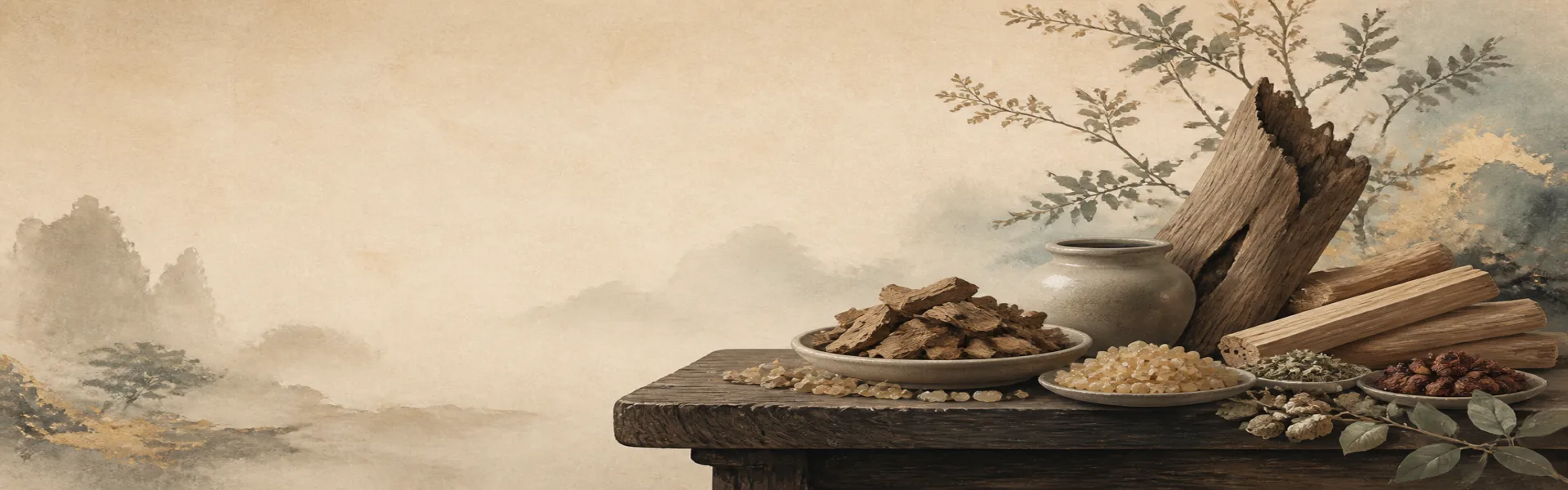
This guide separates the main material families used around Chinese incense culture. It does not provide a price hierarchy or a home test for authenticity. Instead, it shows what can be observed, what needs documentation, and why conservation and trade rules belong inside any serious discussion of rare aromatics.
Begin with names, forms and evidence
Common names travel across languages and markets. The same name may cover more than one species, while different names may describe the same material in another region or period. Historical terms are especially difficult: an old recipe records the vocabulary of its own time, not a modern laboratory identification.
Before comparing products, ask three separate questions: what organism or ingredient is claimed, what physical form is being sold, and what evidence supports the claim. A scientific name, documented source and clear processing description are more useful than superlatives such as imperial, ancient, medicinal or top grade.
Agarwood is resinous tissue, not an ordinary timber
Agarwood forms when certain trees, especially species of Aquilaria and Gyrinops, develop resin-rich tissue after stress or injury. Not every tree forms the same amount, and a dark piece is not automatically resin-rich. Agarwood is therefore a condition within wood as well as a traded material, not the ordinary heartwood of one single species.
Density, colour, geography and seller grades can describe a sample, but none is a complete quality test. Sinking in water may reflect density without proving identity, origin or aroma. Terms such as qinan or kyara belong to particular markets and appraisal traditions; without a disclosed standard and traceable lot, they should not be treated as universal scientific categories.
Sandalwood: species matters more than prestige labels
Sandalwood refers to fragrant heartwood from species of Santalum, but commercial names are applied more broadly. Santalum album is one important species; other sandalwoods and unrelated scented woods have different chemistry, cultivation histories and trade controls. A place-name such as Mysore or Timor is not enough to prove species, age or legal origin.
Good sandalwood can smell creamy, woody, dry, sweet or spicy depending on the sample and how it is heated. Those are observations, not rankings. Ask for the species, country of harvest, cultivated or wild status, processing form and any applicable documents. Powder is harder to authenticate visually than a clearly documented piece of wood.
Resins, balsams and traded plant exudates
Frankincense comes from Boswellia, myrrh from Commiphora, and benzoin from Styrax, but each genus contains multiple species and grades. These materials reached Chinese users through changing trade networks and could appear in ritual, household, medicinal or compounded-incense settings. Their presence in an old formula does not mean that every modern product bearing the same name is equivalent.
Resins respond strongly to heat. Too much heat can turn a clear or balsamic aroma into sharp smoke, while gentle warming can reveal changes over time. Appearance alone is limited because resins may be cleaned, blended, ground or sold under regional trade names. Botanical and supply information still matters.
Camphor, borneol, roots, bark and spices
Camphor and borneol are aromatic compounds, not self-explanatory statements of botanical origin. Commercial material may be plant-derived, isolated, refined or synthetic. Historical names can point to places, substances or qualities that do not map neatly onto a modern ingredient list, so an old term should not be converted into one exact species without evidence.
Clove, cassia, patchouli, citrus peel, roots and other plant materials can add lift, warmth, bitterness or sweetness to a blend. Their role depends on proportion and preparation. A material used historically in medicine is not automatically a medical treatment when burned, and incense smoke should not be presented as a therapeutic delivery method.
Historical animal materials and modern substitutes
Older recipes may mention musk, civet or ambergris. Those references are historically informative, but they do not instruct present-day buyers to seek wildlife-derived ingredients. Species protection, animal welfare, collection methods and national law differ, and a historical name may not reveal what a modern seller actually used.
Plant-based and synthetic substitutes can reproduce a functional effect such as diffusion, persistence or warmth without claiming to be the historical substance. A responsible label should say substitute, accord or fragrance rather than borrow a wildlife name ambiguously. When provenance is unclear, not buying the animal-derived claim is the safer choice.
Raw material, extract and compounded incense are different products
A wood chip warmed over indirect heat, an essential oil, an alcohol extract, a powdered mixture and a self-burning stick do not present the same material in the same way. Extraction selects some molecules and leaves others behind; combustion adds the smell and particles of burning fuel, binder and base material.
In compounded incense, binders and bases affect strength, texture and burn behaviour. Recipes vary, and aging is not a universal guarantee of improvement. Evaluate the product you have rather than assuming that one named ingredient dominates it. The wider Chinese Incense Culture guide explains vessels, heat methods and basic smoke safety.
Compare aroma without pretending to authenticate it
Use very small, similarly sized samples under the same heat and ventilation. Note the aroma before heating, at first release, during the middle phase and after the sample cools. Record intensity, clarity, bitterness, sweetness and how quickly the profile changes, but do not force every observation into a fixed vocabulary.
Blind or coded comparisons reduce the pull of price and prestige. They can teach sensory differences, but they cannot prove species, country, age or wild origin. Home tests, photographs and confident smelling are no substitute for traceable records or specialist analysis when those claims matter.
Buy documentation, not a story
For a rare material, request the scientific name where known, source country, wild or cultivated status, harvest or production information, batch identity, processing or added fragrance, and the paperwork required for the transaction. A responsible seller should also be able to state what remains uncertain.
Start with modest quantities and repeatable samples. Extremely low prices for rare wild material, absolute claims about a famous locality, and secret grades that cannot be defined are reasons to pause. Plantation origin may reduce pressure on wild populations, but it is not by itself proof of legality, ecological quality or honest labelling.
Conservation, permits and a careful learning path
CITES lists Aquilaria and Gyrinops species in Appendix II, so international trade in covered specimens is regulated rather than automatically prohibited. Permit requirements depend on the specimen, transaction and countries involved; national rules may be stricter. CITES documentation supports legal trade control, not sensory quality or authenticity beyond what the document actually identifies.
A useful path is to compare a documented sandalwood, one resin and a clearly labelled compound before approaching costly agarwood. Keep the samples small, record their sources and use heat sparingly with ventilation. For the changing historical contexts behind these materials, continue to the Origins and History guide.