Chinese Incense Sets: Burner, Box, Vase and Tools
中国香具三式:炉、盒、瓶与匙箸
A Chinese incense set can look like a group of unrelated small objects: a burner, a lidded box, a narrow vase, a spoon and a pair of tongs. Read together, however, they describe a sequence of actions. Aromatic material is stored, selected, moved, burned or warmed, and ash is tended. The set is therefore a compact working system as well as a display of craft.
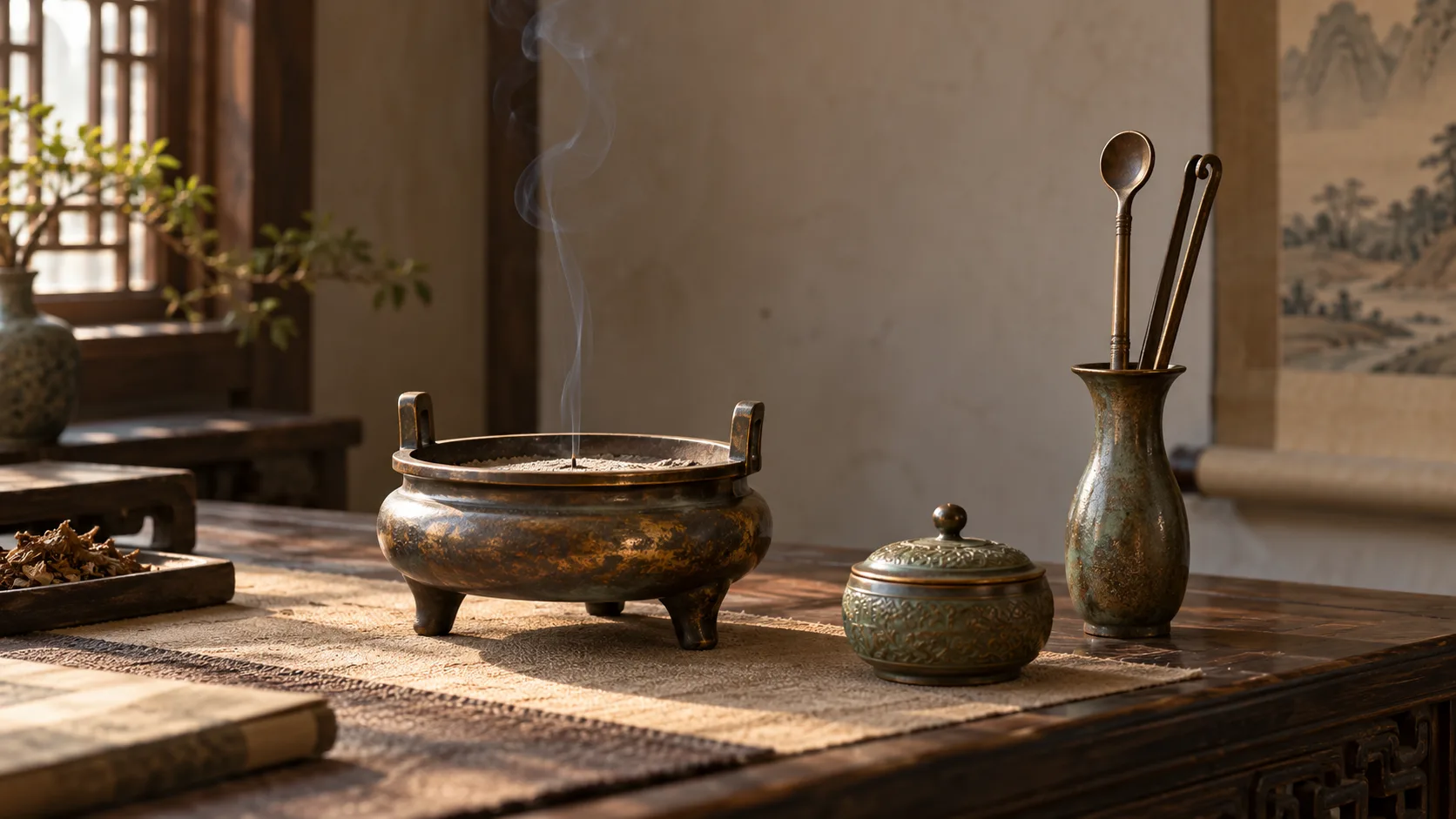
This guide builds on Chinese Incense Culture and the site’s separate guides to incense burners and incense seals. It focuses on the three-piece arrangement often called sanshi 三式 or sanshi 三事 in museum records: burner, tool vase and incense box. It does not claim that every household, temple, period or region used the same equipment.
A set records a chain of small actions
Burner, box and vase divide the work
The Palace Museum defines the three-piece set by function. The burner receives incense; the covered box stores aromatic material; the narrow vase holds implements used to handle incense and ash. That explanation is more useful than treating the three objects as a matching ornament. Each form answers a different movement, yet the pieces are coordinated on one table.
The box is usually low and accessible because its contents are taken out in small quantities. The vase is narrow enough to keep long tools upright and visible. The burner provides a contained working area. Size, opening, lid and stability all help reconstruct the set’s intended choreography.
Spoon and tongs make the quiet labour visible
The Metropolitan Museum describes a flat-bowled spoon and tongs among implements used with incense. A spoon can transfer fine material or work the ash surface; tongs can lift a fragment without putting fingers near heat. Museum terminology varies, and a particular tool may have served more than one action, so its exact use should be tied to shape, wear and documented context.
These implements matter because they shift attention from smoke to preparation. The fragrant moment depended on measuring, placing, adjusting and cleaning. A complete-looking vessel without tools may preserve only part of an original practice; a tool vase without its contents can still reveal what was expected to stand beside it.
“Three-piece set” is a category, not a universal rule
Palace Museum records use both 三式 and 三事 for burner–vase–box groups. English catalogues may say “incense set,” “incense implements” or name each object separately. These labels organize collections, but they do not prove that every surviving trio was made, sold and used together.
The Met notes that three seventeenth-century objects attributed to Hu Wenming share inscriptions and decoration, while also stating that it is unclear whether they originally formed a set. That careful qualification is a model: visual harmony is evidence worth recording, not a substitute for provenance.
Read form, material and arrangement together
Openings and lids reveal access
Begin with what hands must do. Does the box lid lift, hinge or fit inside a rim? Can the tool vase hold both spoon and tongs without crowding? Is the burner open, covered or fitted with an inner support? Do not assume that every cavity held incense. Look for scale, staining, ash, soot, liners and surviving accessories.
The site’s guide to incense forms and appreciation helps distinguish sticks, coils, powders and fragrant woods. Different materials require different handling. A set designed around wood chips is not automatically evidence for seal incense, and a decorative box need not have stored aromatics.
Matching material can unify unlike shapes
Palace Museum examples survive in jade, glass and cloisonné enamel, while the Met’s Hu Wenming group uses parcel-gilt copper alloy. Making the three pieces from one material or decorative language can turn a working ensemble into a visually coherent furnishing. Yet material alone does not establish date, maker, function or quality.
A white jade set and a bronze set may organize the same basic actions while producing very different weight, surface, colour and display. Compare the junctions between material and task: the box rim, the vase mouth, the burner wall and the grip of each tool. Preciousness and practicality can coexist without being identical.
Archaic-looking forms can be later acts of design
Later Chinese incense burners often borrow the silhouettes and motifs of ancient ritual bronzes. The quotation can connect a small domestic furnishing to ideas of antiquity, cultivated taste or courtly order, but it does not make the object ancient. A seventeenth- or eighteenth-century set may be deliberately retrospective.
Compare foot shape, handles, surface pattern and inscription with securely catalogued works. The burner guide explains why a bronze-like outline should not be confused with a bronze date. The same caution applies to copied marks and coordinated decoration.
Context changes what the objects mean
A scholar’s table, palace room and temple are not interchangeable
The Palace Museum describes three-piece sets as furnishings associated with literati desks and also records extensive Qing court production for palace interiors. That evidence does not turn every set into a Daoist ritual instrument. Temple offerings, domestic fragrance, court display and scholarly recreation can use related materials while following different purposes and authorities.
For specifically religious settings, consult incense in ritual and temple life. A museum object should be called ritual only when its record, inscription, find context or documented use supports that term. Form alone rarely settles the question.
Archives and object records preserve different kinds of evidence
A Palace Museum study of Qing court incense furnishings cites workshop orders that paired burners with boxes, tool vessels, spoons and tongs. The Met’s recent research on imperial glass likewise connects small tool bottles with archival commissions for burner–box–vase groups. Such records can link an object type to production and furnishing practices more securely than modern display alone.
Still, an archive records an order, not necessarily the whole later life of every object. Pieces can be separated, replaced, remounted in new stands or regrouped by collectors. Record the catalogue’s level of certainty and avoid rebuilding a “complete set” from visual resemblance alone.
Heat, residue and repair belong to the history
Burners may preserve soot, ash, corrosion, heat effects or later liners; boxes and tools may show rubbing at lids, rims and grips. These traces can indicate use, but they are not a safe do-it-yourself test. Polishing metal, washing ash, scraping residue or reheating an old vessel can remove evidence and cause damage.
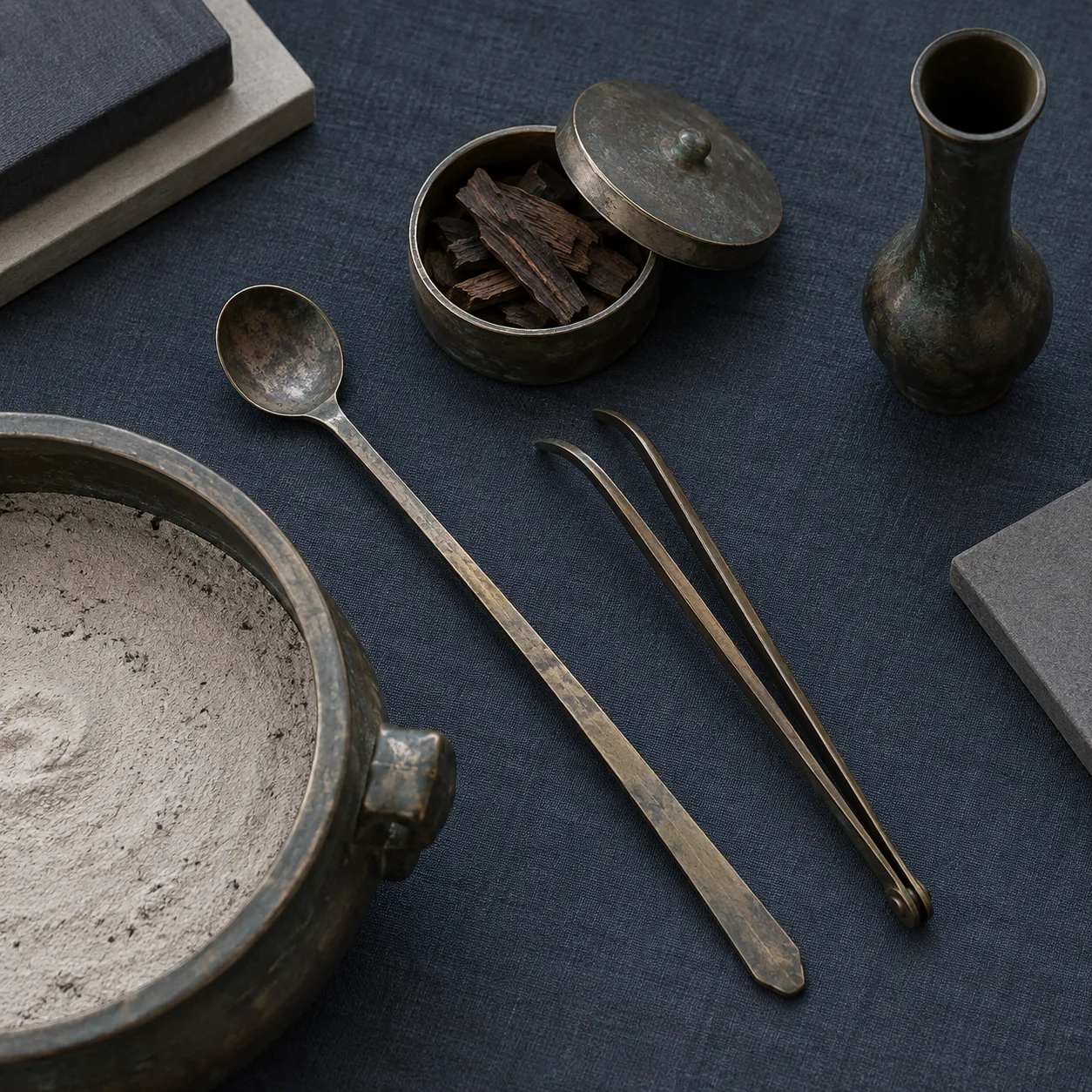
For modern practice, use stable, heat-safe equipment on a non-combustible surface with good ventilation; keep embers away from children, animals, textiles and old wooden furniture. Historic objects belong with qualified conservators, not in active burning experiments. Responsible sourcing also matters; see the guide to aromatic woods and resins.
A six-step method for reading an incense set
Move from inventory to action
- Inventory the parts. Record burner, box, vase, spoon, tongs, lids, stands, liners and any missing elements without assuming completeness.
- Test the scale visually. Compare openings, tool lengths and vessel stability; do not insert or operate museum objects.
- Reconstruct the sequence. Ask what could be stored, lifted, measured, placed and cleared, keeping alternatives open.
- Compare materials. Note metal, jade, glass, enamel, ceramic, wood and later replacements without using material as a date shortcut.
- Read documentation. Separate maker, mark, period, provenance, archival order and curator’s inference.
- State the limit. Say whether original grouping, exact incense form, setting or ritual use remains unknown.
Compare complete and incomplete groups
Place a catalogued trio beside a lone incense box or tool bottle. Which functions are obvious only because the other pieces survive? Then compare sets in different materials. Repetition can reveal a stable functional idea, while variation shows how workshops and patrons adapted it.
Also look beyond the central vessels. Stands, small tables, covers and storage cases can shape the ensemble. A painting may show a set in use, but pictorial detail must be dated and identified before it is used to explain a particular museum object.
Let the evidence keep the set open
A well-read incense set is neither just decoration nor a universal ritual kit. It is an arrangement of containers and tools whose meaning depends on actions, setting and documentation. The strongest interpretation keeps the practical sequence visible while leaving uncertain groupings uncertain.
Useful starting points include the Palace Museum’s definition of 三式, its jade burner–vase–box set and white-jade 三事 record, the Met’s records for a Hu Wenming incense box and tool bottle, and the Museum’s scholarly study of Qing imperial glass commissions. Together they support a method based on function, material, archival context and explicit uncertainty.