The Ten Heavenly Stems: Names, Five Phases and Meanings
十天干:名称、五行属性与含义
The ten Heavenly Stems—tiangan (天干)—form the first of the two counting series that make up the Ganzhi system. In fixed order they are jiǎ (甲), yǐ (乙), bǐng (丙), dīng (丁), wù (戊), jǐ (己), gēng (庚), xīn (辛), rén (壬), and guǐ (癸). Originally the Stems appear to have served simply as the names of the ten days of the Shang week, a plain sequence like the letters of an alphabet. Over time, and especially through the Han synthesis, they were given a systematic set of correspondences that turned them into a compact language of the cosmos. This page examines both faces of the Stems: their role as an ordered count and the layer of meaning later attached to them.
The Stems as a plain count
As a counting series the Stems are straightforward. They cycle in the order above, and when combined with the twelve Earthly Branches they generate the sixty-term jiazi cycle. In the traditional calendar the Stems mark years, months, days, and hours in combination with the Branches, and they are essential to the pillars of a BaZi chart, where each pillar consists of one Stem set over one Branch. Because the Stems number ten and the Branches twelve, the Stem attached to a given Branch shifts from cycle to cycle, and it is precisely this interplay that gives the sexagenary count its length and its variety.
The symbolic layer: Five Phases
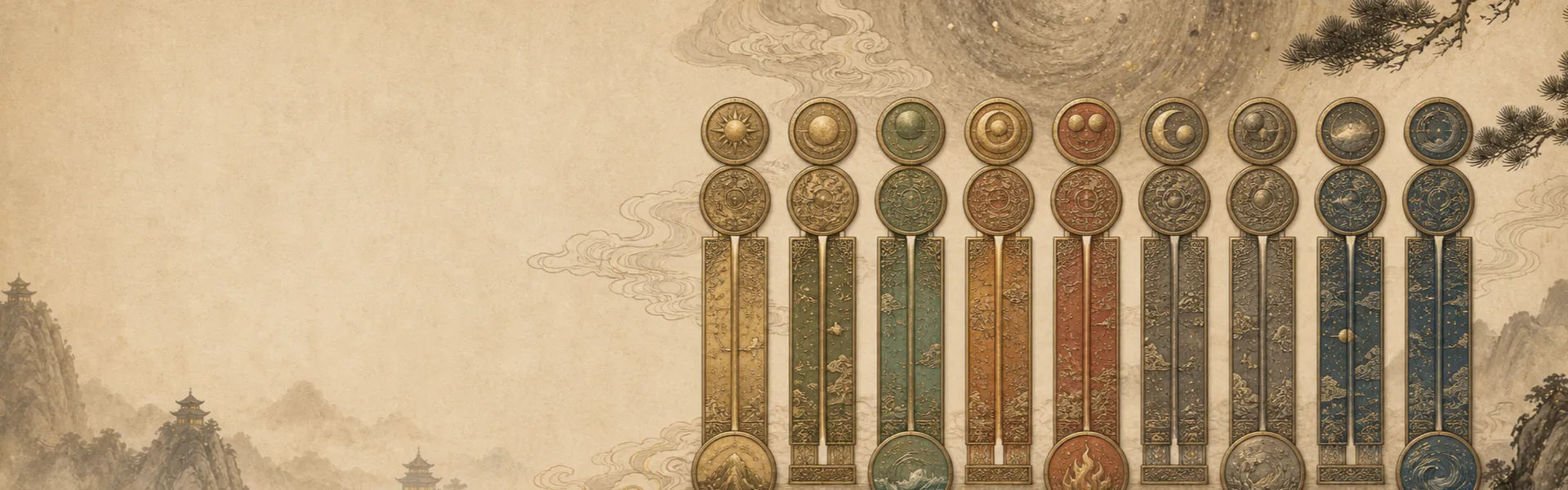
The symbolic layer begins with the Five Phases. The ten Stems are distributed across the five phases of wood, fire, earth, metal, and water, two Stems to each phase. Jiǎ and yǐ belong to wood; bǐng and dīng to fire; wù and jǐ to earth; gēng and xīn to metal; and rén and guǐ to water. Within each pair, the first Stem is yang and the second is yin. Thus jiǎ is yang wood and yǐ is yin wood; bǐng is yang fire and dīng is yin fire; and so on through the ten. This simple scheme—five phases, each in a yang and a yin form—accounts for the whole set and is the key to how the Stems are read in the metaphysical arts.
Yin and yang, and the traditional imagery
The traditional imagery attached to each Stem makes the yin-yang distinction vivid. Yang wood, jiǎ, is often likened to a great tree or standing timber—upright, growing, and firm. Yin wood, yǐ, is pictured as grass, vines, or flowers—flexible, spreading, and soft. Yang fire, bǐng, is the sun or a blazing fire, bright and outward. Yin fire, dīng, is lamplight or a candle flame, gentle and contained. Yang earth, wù, is a mountain or a wall—solid, high ground. Yin earth, jǐ, is garden soil or a field—receptive and nourishing. Yang metal, gēng, is an axe, a sword, or raw ore—hard and forceful. Yin metal, xīn, is a fine ornament or refined jewelry—delicate and precise. Yang water, rén, is a river, a sea, or a great flood—vast and moving. Yin water, guǐ, is dew, mist, or rain—soft, seeping, and quiet. These images are mnemonic and interpretive rather than doctrinal; they help a reader feel the character of each Stem, and different teachers phrase them in slightly different ways.
Direction and season
The Stems also carry directional and seasonal associations that follow from their phases. Wood, and so jiǎ and yǐ, is linked with the east and with spring. Fire, with bǐng and dīng, is linked with the south and summer. Metal, with gēng and xīn, is linked with the west and autumn. Water, with rén and guǐ, is linked with the north and winter. Earth, with wù and jǐ, occupies the center and is associated with the transitions between seasons. These correspondences are the same ones that govern the Five Phases generally, and they let the Stems slot directly into the wider correlative system.
The Day Stem in BaZi
In the Four Pillars of Destiny, the Stem of the day pillar holds a special place. This Day Stem, sometimes called the Day Master, represents the person whose chart is being read. All the other elements of the chart are interpreted in relation to it: whether they support it, drain it, control it, or are controlled by it. A chart's balance is judged by how the Day Master fares among the surrounding phases. This is why the character of each Stem matters so much in practice; a chart built on yang metal gēng is read very differently from one built on yin water guǐ, and the imagery of axe versus dew is a shorthand for those differences.
Relationships between Stems
The Stems enter into relationships with one another that practitioners watch closely. The best known are the five Stem combinations, in which particular yang and yin Stems five places apart are said to pair and, under the right conditions, to transform into a phase. Jiǎ combines with jǐ, yǐ with gēng, bǐng with xīn, dīng with rén, and wù with guǐ. Each pairing is traditionally associated with a resulting phase—for example, jiǎ and jǐ are said to combine and produce earth. Whether such a combination actually transforms depends, in the tradition's own logic, on the surrounding conditions of the chart. These combinations are interpretive devices within the arts and should be understood as part of the system's internal reasoning rather than as statements of natural fact.
The stems in medicine and ritual
The stems are not confined to fate calculation, and seeing them elsewhere helps you judge how much of their meaning is intrinsic. Chinese medicine uses them in a system that assigns times of day to particular channels, so that treatment at a matching hour is held to be more effective; the stem of the day enters that calculation. A related theory pairs the stems with annual phase influences to explain why certain illnesses are prevalent in certain years, a doctrine which was taken seriously enough that court physicians were expected to know it. Taoist ritual specifies stems when fixing the day for a rite, and certain observances are tied to particular stem days. What you should notice is that in each case the stem contributes a phase value and a polarity, and the reasoning proceeds from those rather than from anything about the character itself.
The stems used simply as numbers
Because the ten stems form an ordered list, they were also used as plain ordinals, in the way English uses the letters A to J. Legal and administrative documents number their clauses by stem. Examination candidates were placed in graded ranks named by stem. Traditional printers marked gatherings of pages this way, and modern Chinese still uses the first few stems for items in a list. This matters for reading: when you encounter a stem in a text, the first question is whether it is carrying cosmological content or merely counting, and in a great many cases it is merely counting. Readers who assume every stem is significant will find meaning where none was intended, which is one of the commonest faults in popular interpretation.
How much weight the imagery deserves
The traditional images attached to each stem, describing one as a great tree and another as a growing vine, one as the sun and another as a lamp flame, are vivid and are heavily used in modern popular teaching. It is worth being clear about their status. They are not part of the earliest layer of the system, they vary between sources, and they are best understood as mnemonic devices developed to make an abstract set of phase-and-polarity values easier to remember and to talk about with clients. Used that way they are genuinely helpful. Used as though they were the primary content, they encourage a kind of interpretation that reads personality directly from a poetic image, which no technical manual supports. The calculation is done with phases and polarities; the images are how the result gets explained.
Common errors with the stems
A few mistakes recur often enough to name. The first is treating a stem's phase as the whole story while ignoring its polarity, which loses half the information. The second is assuming that a yang form of a phase is stronger or better than the yin form; they are different in character, not in rank. The third is judging a stem's strength by counting how often its phase appears in a chart, when the traditional method assesses strength by season and position as well as by count. The fourth is confusing the stem of the day, which represents the person, with the stem of the year, which is what almanacs and popular articles usually discuss. Each of these errors will produce a confident reading built on a broken foundation.
Keeping the two layers apart
It is helpful to keep the two layers of the Stems distinct. At the base is a neutral count of ten, as old as the Shang week and as plain as any list. Layered over it is a scheme of correspondences—two Stems per phase, alternating yang and yin, with images, directions, and seasons attached—that was elaborated in the Han and refined by later writers on the metaphysical arts. The counting layer is a matter of documented history; the correspondence layer is a traditional system of interpretation, coherent within itself but not a claim about the physical world. Presenting the Stems honestly means holding both in view: a genuine ancient calendar device, and a rich symbolic language built upon it.
What a student should memorise
For the student approaching the metaphysical arts, memorizing the ten Stems in order, together with their phase and yin-yang polarity, is the essential first step. Everything in the Four Pillars, and much in date selection and classical astrology, is expressed through these ten characters and their relationships. The images of tree and grass, sun and candle, mountain and field, axe and ornament, river and dew are the traditional handholds by which practitioners remember and reason about them.
Key points
The ten Heavenly Stems are the first of the two series that make up the Ganzhi system.
As a plain count they simply cycle in order; combined with the twelve Branches they produce the sixty-term jiazi cycle.
The symbolic layer assigns two Stems to each of the Five Phases.
Within each phase one Stem is yang and the other yin, and traditional imagery makes the difference vivid.
Stems carry directional and seasonal associations that follow from their phase.
In BaZi the Day Stem, or Day Master, represents the person whose chart is being read.
Stems form relationships with one another, most notably the five Stem combinations.
The neutral count and the symbolic system are two separate layers and are worth keeping distinct.
A student should memorise the ten Stems in order with their phase and polarity.
Sources drawn on for this article include: Joseph Needham's Science and Civilisation in China (volume 2, on the theory of the Five Phases and correlative associations); Richard J. Smith's Fortune-tellers and Philosophers, on the calendar and the arts of prognostication; A.C. Graham's studies of yin-yang and correlative thinking; and standard reference treatments of the tiangan and their associations in the traditional almanac and Four Pillars literature.