The Twelve Earthly Branches: Animals, Hours, Months and Meanings
十二地支:生肖、时辰、月份与含义
The twelve Earthly Branches—dizhi (地支)—form the second counting series of the Ganzhi system. In fixed order they are zǐ (子), chǒu (丑), yín (寅), mǎo (卯), chén (辰), sì (巳), wǔ (午), wèi (未), shēn (申), yǒu (酉), xū (戌), and hài (亥). Where the ten Stems align with the ten-day week, the twelve Branches align with the twelvefold divisions of time: the twelve months of the year, the twelve double-hours of the day, and, by extension, the twelve stations of the sky. This page sets out the Branches as a count, the animals and hours attached to them, and the important idea of the Stems concealed within each Branch.
The Branches as a count
As a count the Branches are simple: they cycle in order and combine with the Stems to build the sixty-term jiazi. But the Branches carry an unusually dense set of associations, richer in some ways than the Stems, because they are tied to the calendar and to the passage of the seasons. Each Branch corresponds to a month, beginning traditionally with yín as the first month of spring in the agricultural calendar, and each corresponds to one of the twelve double-hours into which the day is divided. Zǐ, for instance, marks the hour around midnight, and wǔ marks the hour around noon—which is why noon in Chinese is still called wǔ.
The zodiac animals
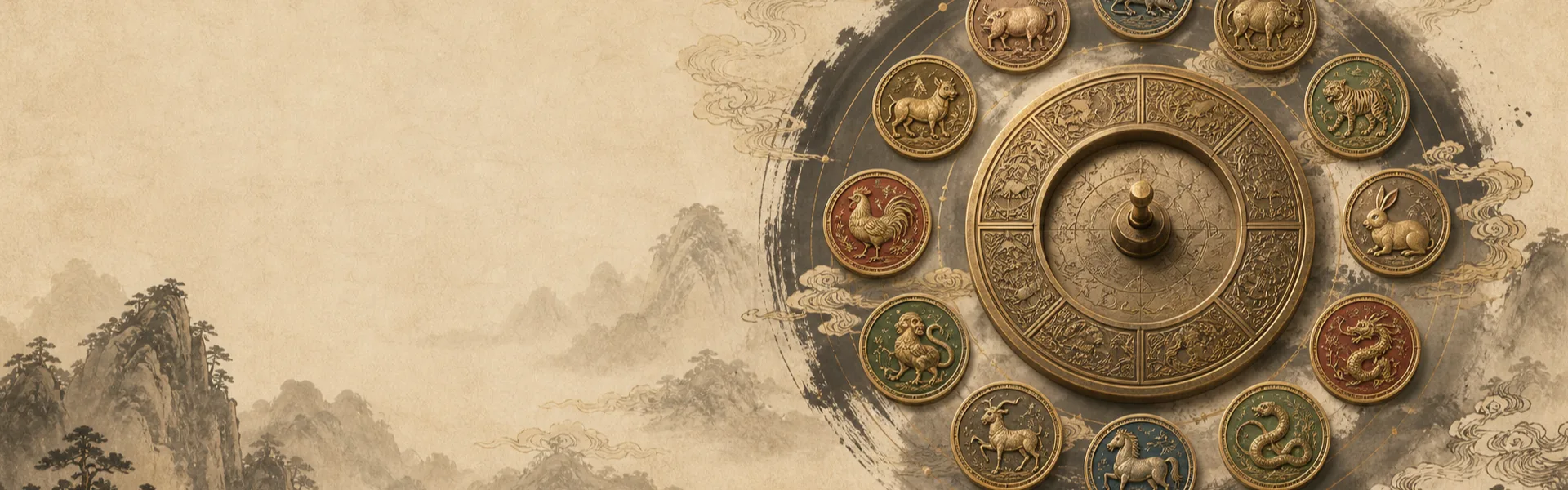
The most familiar face of the Branches is the zodiac. Each Branch is paired with one of the twelve animals: zǐ with the rat, chǒu with the ox, yín with the tiger, mǎo with the rabbit, chén with the dragon, sì with the snake, wǔ with the horse, wèi with the goat, shēn with the monkey, yǒu with the rooster, xū with the dog, and hài with the pig. A person's birth-year Branch, wearing its animal name, is their zodiac sign. This animal layer is a later addition to the older Branch system, but it has become so widespread that for most people the animals are the Branches in everyday life.
The Branches and the Five Phases
Like the Stems, the Branches are distributed across the Five Phases, though not as evenly. Yín and mǎo are wood; sì and wǔ are fire; shēn and yǒu are metal; hài and zǐ are water. The remaining four—chén, xū, chǒu, wèi—are all earth, and they hold a special place as the earth Branches that sit at the corners between the seasons. These four are sometimes called the four storehouses or graves, because in the tradition they are said to gather and store the qi of the season just ending. The Branches also carry yin-yang polarity, alternating as the Stems do: zǐ is yang, chǒu is yin, yín is yang, and so on around the twelve.
Hidden Stems — the key technical feature
The most technically important feature of the Branches, and the one that distinguishes them most sharply from the Stems, is the doctrine of hidden Stems. Each Earthly Branch is held to conceal within it one or more Heavenly Stems, which represent the qi active within that Branch. A simple Branch may hide a single Stem; a more complex one may hide two or three. For example, the Branch yín is said to contain hidden within it the Stems corresponding to yang wood, yang fire, and yang earth, reflecting the mixture of forces present in the first month of spring. This idea of concealed Stems is central to the Four Pillars, where the hidden Stems of the Branches supply much of the detailed information a reader draws from a chart. It is a purely interpretive construct of the metaphysical tradition, but within that tradition it is indispensable.
Relationships between Branches
The Branches also enter into a web of relationships with one another that practitioners study closely. Among the most important are the six harmonies, in which pairs of Branches are said to combine harmoniously; the three harmonies, in which three Branches spaced evenly around the circle form a phase-bureau or trine, said to reinforce a single phase; the six clashes, in which Branches opposite one another on the circle are said to oppose or destabilize each other; and further relations of harm, punishment, and destruction. For instance, zǐ and wǔ, sitting opposite each other, form one of the six clashes, while shēn, zǐ, and chén together form a water trine. These relationships are the grammar by which the Branches interact in a chart, and much of the art of reading the Four Pillars lies in weighing them. They are, again, interpretive rules internal to the tradition rather than descriptions of nature.
The seasonal logic behind them
The seasonal logic behind the Branches helps make sense of these relationships. Because each Branch marks a month, Branches close together in the year share a season and tend to cooperate, while Branches half a year apart—opposite on the circle—mark opposite seasons and are read as clashing. The three-harmony trines gather the Branches that lead into, peak at, and conclude a given phase's season: the water trine of shēn, zǐ, and chén, for example, gathers the approach to winter, its depth, and its close. Seen this way, the abstract-seeming rules of combination and clash are grounded in the plain movement of the seasons through the year.
How the Branches are used in practice
In practice the Branches do a great deal of the work in the metaphysical arts. In the Four Pillars, the Branches of the four pillars, together with their hidden Stems, describe the deep structure of a chart, while the interactions of harmony and clash among them are read as the tensions and supports in a life. In date selection, the Branch of a day and its relationship to the Branch of the person's birth year is a primary consideration. In classical astrology and in Feng Shui, the twelve Branches map onto the twelve directions of the compass and the twelve stations of the sky. The Branches are, in short, the richer and more heavily worked of the two Ganzhi series.
The branches as double-hours
Each branch names a period of two hours, so the twelve of them divide the day. This is where a great deal of practical error enters, because the hour pillar of a chart depends on getting the period right and several things can go wrong. The first branch straddles midnight rather than beginning at it, running from late in one day into the early part of the next, which means a birth in those hours can belong to a different day than the civil date suggests. Modern clock time is also standardised across a whole time zone, while the traditional divisions follow local solar time, so a birth well east or west of the meridian on which the zone is based needs correcting. Daylight saving, where it was in force, is a further trap. None of this is difficult, but a chart built on an uncorrected hour is simply the wrong chart.
The branches as directions
The twelve branches also mark directions, distributed evenly around the compass, with the first at north and the seventh at south. This gives a twelve-fold division of space alongside the eight-fold division supplied by the trigrams, and compass feng shui uses both, subdividing further into twenty-four sectors by combining branches with stems. Because the branches carry seasons as well as directions, a direction inherits a seasonal and phase character, which is how a compass bearing acquires a five-phase value that can then be reasoned about. The same twelve-fold scheme underlies the arrangement of the palaces in purple star astrology, where each palace is assigned a branch.
Combinations and clashes
The branches stand in a set of named relationships determined purely by their positions in the sequence, and these are among the most heavily used devices in the fate arts. Branches six positions apart are said to clash, being opposite on the twelve-fold circle. Branches four positions apart form groups of three which combine into a single reinforced phase, a device used to explain why an apparently weak phase in a chart may in fact be strong. Three consecutive branches belonging to the same season form another kind of group, stronger still. There are further named relations for harm, destruction and punishment, whose rationale is less clear and which the sources explain inconsistently. What matters is that every one of these relations is derived from arithmetic position, not from the animals.
Common errors with the branches
Four mistakes are worth naming. The first is working from the animal rather than the branch, which discards the phase and polarity that the calculation actually uses. The second is ignoring the hidden stems, which are not an advanced refinement but a standard part of every reading. The third is taking the lunar new year as the boundary of the branch year, when the fate arts change the year at the solar term beginning spring, so anyone born in the intervening weeks is routinely assigned the wrong animal by popular sources. The fourth is treating a clash as straightforwardly unfortunate; the traditional literature treats clashes as indicating movement, disruption and change, which may be needed or unwelcome depending on the rest of the chart.
Three layers to keep in mind
To hold the Branches clearly in mind, it helps to remember the three layers they carry. First, a plain count of twelve, tied to months and hours, as old as the calendar itself. Second, the popular overlay of the twelve zodiac animals, memorable and universally known. Third, the dense metaphysical layer—phases, polarities, hidden Stems, and the relationships of harmony and clash—assembled over the Han and later periods for use in the arts. The first is documented history; the second is folklore of great cultural depth; the third is a coherent interpretive system, powerful within its own logic but not a claim validated by modern science.
Key points
The twelve Earthly Branches are the second series of the Ganzhi system.
As a count they simply cycle and combine with the Stems to form the sixty-term jiazi.
Each Branch is paired with a zodiac animal, which is their most familiar face.
The Branches are distributed across the Five Phases unevenly, with four assigned to earth.
Their most important technical feature is the hidden Stems each Branch contains.
Branches form a web of relationships — combinations, clashes and related patterns — that practitioners watch closely.
Those relationships follow from the seasonal logic, since each Branch marks a month.
In the Four Pillars the Branches carry much of the analytical weight.
Hold three layers apart: a plain count of twelve, the popular overlay of the zodiac animals, and the metaphysical layer of phases, hidden Stems and relationships.
Sources drawn on for this article include: Joseph Needham's Science and Civilisation in China (volume 2, on Five-Phase correlations, and volume 3, on the calendar); Richard J. Smith's Fortune-tellers and Philosophers; standard scholarship on the origin and spread of the twelve-animal zodiac; and reference treatments of the dizhi, the hidden Stems, and the Branch relationships in the traditional Four Pillars literature.