How Heavenly Stems and Earthly Branches Encode Yin–Yang and the Five Phases
天干地支如何结合阴阳五行
The Stems and Branches would be a bare counting device were it not for the layer of cosmological meaning laid over them. That layer connects the sexagenary cycle to the two great frameworks of Chinese natural philosophy: the polarity of yin and yang, and the Five Phases of wood, fire, earth, metal, and water. This page explains how each Stem and each Branch carries a yin-yang polarity and a phase, and how those attributes turn a simple calendar into the working language of the metaphysical arts. It assumes familiarity with yin-yang and the Five Phases themselves, which are treated in their own subcategory; here the focus is on how the Ganzhi terms encode them.
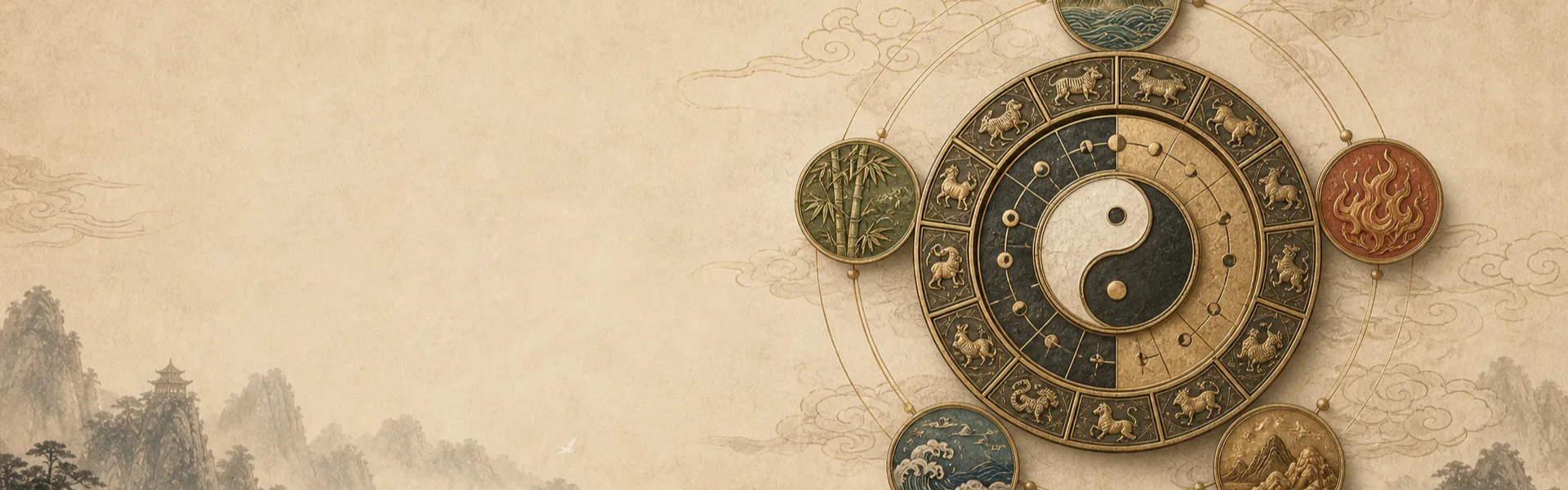
Yin and yang alternate strictly
Begin with yin and yang. Every Stem and every Branch is assigned one of the two polarities, and they alternate strictly along each series. Among the Stems, the first, jiǎ, is yang; the second, yǐ, is yin; the third, bǐng, is yang; and so on, so that the odd-positioned Stems are yang and the even-positioned are yin. The Branches alternate in the same way: zǐ, the first, is yang; chǒu, the second, is yin; and so on around the twelve. Because the sexagenary pairing joins only same-polarity terms—yang Stem with yang Branch, yin with yin—every one of the sixty combinations is internally consistent in polarity. There is no jiazi term that mixes a yang Stem with a yin Branch.
The Five Phases across the Stems
Next come the Five Phases. The ten Stems divide evenly, two to each phase, with the first of each pair yang and the second yin: jiǎ and yǐ are wood, bǐng and dīng are fire, wù and jǐ are earth, gēng and xīn are metal, and rén and guǐ are water. The twelve Branches divide less evenly. Yín and mǎo are wood; sì and wǔ are fire; shēn and yǒu are metal; hài and zǐ are water; and the remaining four—chén, xū, chǒu, wèi—are all earth. This gives earth four Branches while the other phases have two each, an asymmetry that reflects earth's traditional role as the pivot among the seasons, distributed at the corners of the year rather than gathered in one place.
Hidden Stems give the Branches extra depth
The Branches carry a further and subtler phase-attribute through their hidden Stems. Because each Branch conceals one or more Stems, it carries not only its own surface phase but also the phases of those hidden Stems, weighted by their prominence. The earth Branches especially are read as storehouses that hold, alongside their earth, the residual qi of a neighboring phase: chén, for instance, is an earth Branch that also stores water, while xū stores fire. This layered phase-content is what allows a single Branch to participate in several relationships at once, and it is one of the features that gives the Four Pillars its interpretive depth.
Generating and controlling between Stems and Branches
The interactions among Stems and Branches are read through the two cycles of the Five Phases: the generating cycle, in which each phase produces the next, and the controlling cycle, in which each phase restrains another. When two terms sit side by side in a chart, the reader asks whether their phases generate, control, or are neutral to one another, and whether they share or oppose polarity. A Stem that generates the Day Master is read as a source of support; one that controls it, as a source of pressure. These readings apply the general logic of the Five Phases, treated fully in the Yin-Yang and Five Elements subcategory, to the specific terms of the sexagenary cycle.
Why the seasons make this concrete
The seasonal grounding of the phases gives the Branch-phases a concrete meaning. Because the Branches mark the months, their phases follow the year: the wood Branches yín and mǎo fall in spring, when wood is strong; the fire Branches sì and wǔ fall in summer; the metal Branches shēn and yǒu fall in autumn; the water Branches hài and zǐ fall in winter; and the earth Branches sit at the seasonal corners. A phase is said to be at its strongest in its own season and weakest in the season of the phase that controls it. This idea of seasonal strength, or the state of the qi, is central to judging a chart: the same Stem is read as robust or feeble depending on whether the month-Branch supports its phase.
What the encoding lets a reader do
It is here that the practical power of the encoding becomes clear. A reader who knows the four Stem-Branch pairs of a birth moment can immediately extract, for each pair, a polarity and a phase, plus the hidden phases within the Branches, plus the seasonal strength given by the month. From these the whole web of generating and controlling relationships can be traced, and the balance of the chart assessed. Nothing in this requires any information beyond the date and time; the sexagenary terms carry the cosmological data within themselves. This is why the calendar and the interpretive art are inseparable in the Chinese tradition.
Relationships that combine both frameworks
Several relationships combine the two frameworks in ways worth noting. The Stem combinations, in which paired Stems are said to transform into a phase, and the Branch trines, in which three Branches reinforce a single phase, both work by concentrating a phase out of the yin-yang pairings. The Branch clashes, by contrast, set opposing phases and seasons against each other. In every case the reasoning runs through the same two frameworks: what polarity, what phase, and how do they generate or control. The sexagenary terms are, in effect, tokens that carry the cosmology in compressed form, and the arts are systematic ways of reading that compressed information.
How strength is actually judged
It is worth spelling out how a practitioner decides whether a phase in a chart is strong, because the popular method of counting occurrences is not the traditional one. Position matters: a phase sitting in the month branch is far more influential than the same phase elsewhere, because the month sets the season and the season determines which phase is currently dominant. The tradition names a series of conditions describing how a phase stands relative to the season, running from thriving through supported and resting to confined and extinct. A single phase in season may outweigh three occurrences out of season. Whether a phase is rooted in a branch, rather than appearing only as a stem with nothing beneath it, also counts heavily. This is why two charts containing the same eight characters in different positions are read quite differently, and why software that simply tallies phases produces conclusions no competent practitioner would endorse.
What the encoding cannot do
Being clear about the limits keeps the rest honest. The encoding converts a moment into values, and that conversion is arithmetic which is either right or wrong and can be checked. What the encoding cannot do is establish that the values mean anything about a person or an outcome. Nothing in the derivation of a phase from a stem, or a hidden stem from a branch, contains any information about character, marriage or livelihood; those associations were attached later, by correlation rather than by demonstration. A further limit is that the system is closed: because every chart yields a full set of relations, some configuration can always be found to account for whatever actually happened. The precision of the calculation is real and easy to mistake for evidence that the interpretation is precise too, and the two are entirely separate questions.
Two cautions
Two cautions belong here. First, the assignments of polarity and phase, though presented as fixed and natural, are conventions of the tradition, assembled over the Han and later periods and occasionally varying between schools, especially in the details of the hidden Stems. They are best understood as a coherent symbolic code rather than as descriptions of physical properties. Second, the readings drawn from these assignments—judgments about a person's fortune or character—are interpretations within the art, not findings that modern science endorses. Presented honestly, the encoding is an elegant and internally consistent symbolic system: it maps the neutral calendar onto the cosmology of yin-yang and the Five Phases, and the metaphysical arts read that map.
In summary
In sum, each Stem and Branch is stamped with a yin-yang polarity and a Five-Phase value; the Branches carry additional phases through their hidden Stems and gain strength or weakness from the season; and the arts read charts by tracing the generating and controlling relationships among these values. This encoding is what raises the jiazi from a calendar to a cosmological instrument, and it is the bridge that connects this subcategory on Ganzhi to the subcategory on Yin-Yang and the Five Elements.
Key points
Stems and Branches would be a bare counting device without the cosmological layer laid over them.
That layer connects the cycle to yin–yang polarity and to the Five Phases.
Polarity alternates strictly along each series, so odd positions are yang and even ones yin.
The ten Stems divide two to each phase, the first yang and the second yin.
Branches carry additional phase values through the Stems hidden inside them.
Interactions are read through the generating and controlling cycles of the phases.
Because Branches mark months, their phase values have a concrete seasonal meaning.
Four Stem–Branch pairs therefore encode a full set of phase relationships for a moment in time.
Stem combinations and Branch relationships link the two frameworks together.
The assignments are conventions within a traditional system, not natural facts.
Sources drawn on for this article include: Joseph Needham's Science and Civilisation in China (volume 2, on yin-yang and the theory of the Five Phases); A.C. Graham's Yin-Yang and the Nature of Correlative Thinking; Richard J. Smith's Fortune-tellers and Philosophers; and standard reference treatments of the Stem and Branch polarities, phases, hidden Stems, and seasonal strength in the traditional Four Pillars literature.