The Sixty-Part Jiazi Cycle: How Stems and Branches Combine
六十甲子:天干地支如何组合成六十循环
The heart of the Ganzhi system is the cycle of sixty, known as the jiazi (甲子) after its first term, or as the sexagenary cycle in English. It is produced by running the ten Heavenly Stems and the twelve Earthly Branches together, in step, until the two series return to their starting point. Understanding why the result is a cycle of exactly sixty—not ten, not twelve, not a hundred and twenty—is the key to understanding how the whole system works.
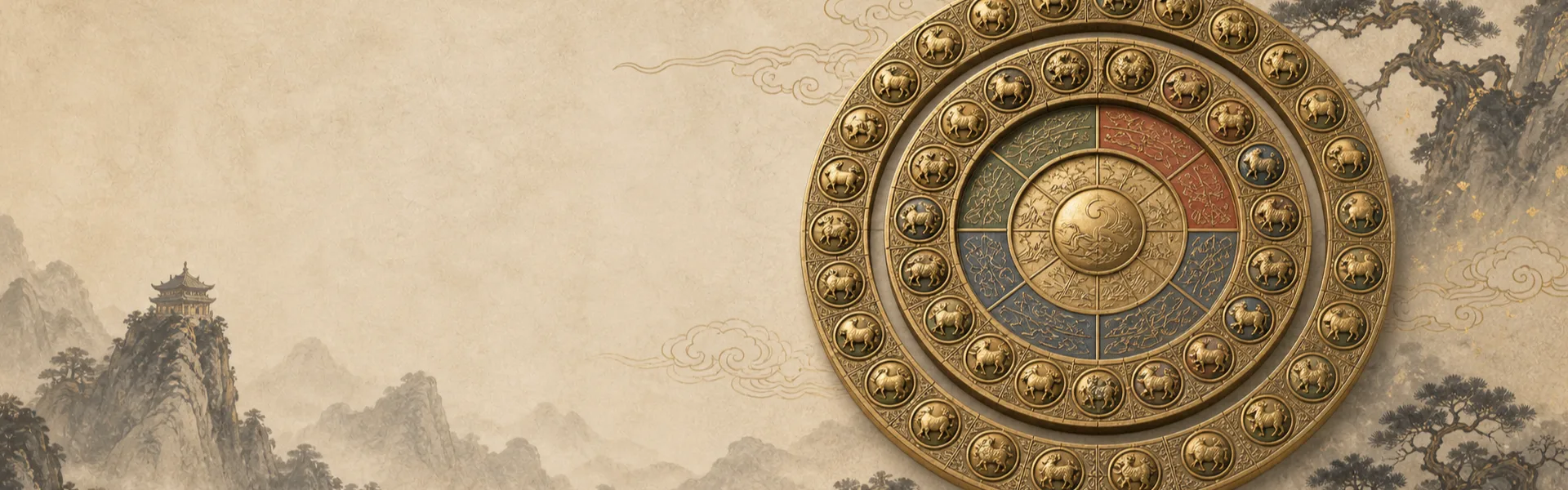
Two wheels turning together
The mechanism is a simple piece of arithmetic. Imagine the ten Stems written on one wheel and the twelve Branches on another, and imagine advancing both wheels by one step at a time. The first pairing is the first Stem with the first Branch: jiǎ-zǐ, which gives the cycle its name. The next is the second Stem with the second Branch, yǐ-chǒu, then bǐng-yín, and so on. After ten steps the Stems have completed one full turn and return to jiǎ, but the Branches, having twelve members, have only reached their eleventh. So the eleventh pairing is jiǎ again, now matched with the eleventh Branch, xū: jiǎ-xū. The two wheels are now out of phase, and they will not both return to their starting positions until enough steps have passed for ten and twelve to align again.
Why sixty and not one hundred and twenty
That alignment happens at the lowest common multiple of ten and twelve, which is sixty. After sixty steps, the Stems have completed six full turns and the Branches five full turns, and both arrive back at their first member simultaneously: the cycle returns to jiǎ-zǐ, and the whole sequence begins again. This is why the jiazi has sixty terms. A further consequence of the arithmetic is that odd-numbered Stems always meet odd-numbered Branches and even meet even; a yang Stem never pairs with a yin Branch. Half of the one hundred and twenty combinations that would be possible if any Stem could meet any Branch therefore never occur, and the cycle settles at sixty.
The jiazi table
The sixty terms have traditionally been memorized and tabulated in a fixed order, and this ordered list—the jiazi table—was already complete in the Shang oracle bones. Learning the cycle means learning this sequence, and traditional education often had students recite it much as one might recite a multiplication table. The terms are grouped by the tradition into six sets of ten, each set beginning with a Stem paired with zǐ, so that the cycle is sometimes visualized as six decades of Stems rolling against five dozens of Branches.
One cycle, four scales of time
The same sixty-cycle is applied at four different scales of time, and this is one of the most elegant features of the system. Years run through the jiazi, so that every sixtieth year the same Stem-Branch term returns. Months run through it as well, cycling through the twelve months of the year with their Stems advancing so that a full Stem-Branch month cycle also spans five years. Days run through the cycle continuously, as they have since the Shang, one sexagenary term per day without interruption. And the double-hours of the day run through it too, twelve Branches to a day with Stems attached. A fully specified traditional date therefore consists of four Stem-Branch pairs—for year, month, day, and hour—and these four pairs are exactly the four pillars of a BaZi chart.
The sixty-year round in the life course
The sixty-year round has a strong presence in the culture of the life course. Because the same year-term returns only after sixty years, a person who reaches their sixtieth year completes one full turn of the cycle and returns to the Stem-Branch under which they were born. This return is marked in the tradition as a milestone of longevity and renewal; the sixtieth birthday has long been celebrated as a significant occasion, the point at which a life has traveled a complete circuit of the cosmic count. The cycle thus lends a natural rhythm to the human lifespan, dividing it into turns of sixty years.
Working out the term for a year
Calculating the term for a given year is a matter of counting from a known reference point. Once the Stem-Branch of any one year is fixed, every other year can be found by counting forward or backward and taking the position within the sixty-cycle. In practice, traditional almanacs and modern reference tables simply list the term for each year, so a reader looks it up rather than computing it. The same is true for days: because the day-count runs continuously, the Stem-Branch of any date can be determined from tables or from a formula keyed to a reference date. The regularity of the cycle makes such calculation entirely deterministic.
The cycle and the solar year
It is worth being clear about the relationship between the sexagenary cycle and the ordinary solar year. The Stem-Branch year in the metaphysical arts is generally reckoned not from the lunar New Year but from the solar term that begins spring, so the boundary between one year-term and the next falls in early February by the common calendar. This matters greatly in the Four Pillars, where a birth just before or just after that boundary belongs to a different year-pillar. The month-pillars likewise turn on the solar terms rather than on the lunar months. This solar-term basis reflects the system's roots in tracking the agricultural seasons, and it is a common point of confusion for beginners who assume the year turns at the lunar New Year.
A universal coordinate for time
The elegance of the sixty-cycle is that a single, compact device serves as a universal coordinate for time. With four Stem-Branch pairs one can specify a moment to the level of a two-hour period within the whole span of recorded history, and the same four pairs simultaneously encode a wealth of phase and yin-yang information for the metaphysical arts to read. The calendar and the interpretive system share one skeleton. This double duty—precise timekeeping on one hand, symbolic reading on the other—is what has kept the jiazi at the center of Chinese life for three thousand years.
The ten empty positions
One technical feature of the sixty-term cycle is worth explaining because the fate arts use it constantly. Since the stems run out before the branches do, each block of ten consecutive terms leaves two branches unpaired with any stem in that block. Those two are called the empty or vacant branches for that decade, and every one of the six decades within the sixty has its own pair. Practitioners treat a position in a chart occupied by one of the empty branches for the relevant decade as weakened or hollowed out, so that whatever the position represents is held to be less substantial than it appears. Whether or not the interpretation persuades you, the arithmetic behind it is exact and easily checked: the vacancies follow mechanically from ten and twelve running side by side, and there is nothing arbitrary in their derivation.
The cycle and the sixty-term correlates
Later tradition attached further layers to each of the sixty terms rather than only to their component stems and branches. Each term was assigned a phase value of its own, derived by a rule and often differing from the phases of the stem and branch that make it up, and each acquired a poetic image and a short verse. Collections of these formed the basis of a distinct interpretive tradition, and some practitioners weight them heavily while others ignore them entirely. It is worth knowing that these correlates are a late accretion rather than part of the original counting system, and that the sources disagree about them, so a reading that depends on them is resting on the most contested layer of the material rather than on the calendrical foundation.
Naming years in modern usage
The cycle remains in everyday use for historical reference, and recognising this makes a great deal of Chinese writing clearer. Several well-known events of the nineteenth and twentieth centuries are habitually identified by their cycle year rather than by a Western date, and treaties, reforms, uprisings and disasters are commonly known by these names. Because the terms repeat every sixty years, such a name alone does not fix a century, and a reader has to supply that from context; scholars normally give both the cycle term and the Western year for this reason. Traditional almanacs, temple inscriptions, genealogies and land deeds are dated this way, which is why anyone working with such documents has to be able to convert between the systems.
Three points to remember
For the beginner, three points anchor the whole subject. The cycle is sixty because sixty is the lowest common multiple of the ten Stems and the twelve Branches. The same sixty-cycle counts years, months, days, and hours, and the four resulting pairs are the four pillars. And the metaphysical year turns not at the lunar New Year but at the start-of-spring solar term. Hold these three facts and the mechanics of Ganzhi fall into place.
Key points
The jiazi or sexagenary cycle is made by running the ten Stems and twelve Branches together.
Both series advance one step at a time, like two wheels turning.
The cycle is sixty because sixty is the lowest common multiple of ten and twelve.
Only half the possible Stem–Branch pairs occur, since polarity always matches.
The ordered sixty-term table was already complete in the Shang period.
The same cycle applies at four scales: year, month, day and hour.
A returning year-term after sixty years marks a full round of life, which is why the sixtieth birthday matters.
Any year’s term can be found by counting from a known reference year.
The Stem–Branch year in the metaphysical arts does not begin on the same date as the ordinary calendar year.
Four Stem–Branch pairs give a compact universal coordinate for any moment in time.
Sources drawn on for this article include: the Shang oracle-bone jiazi tables and their discussion in the scholarship on early Chinese chronology; Joseph Needham's Science and Civilisation in China (volume 3, on the calendar); standard works on the Chinese lunisolar calendar and the solar terms; and reference treatments of the four pillars and the sexagenary reckoning in the traditional almanac literature.