The I Ching as a Journal: A Month of Reflection
把《易经》当作日记来读:一个月的反思
Many people are drawn to the I Ching (Yijing, Book of Changes) and then hesitate, because they associate it with fortune-telling. There is another way to use it, and it is the one this site takes: treat a hexagram as a question to carry through your day, not as a forecast. This page shows how to keep a simple journal for a month, one hexagram a week, with a question for each.

A hexagram is a question, not a forecast
The I Ching is a very old divination text that became a Chinese classic, and the beginner's guide explains how a hexagram is built and read. Nothing on this site presents it as telling you what is going to happen. Each hexagram describes a kind of situation (a time to begin, a time to hold still, a time to be sincere) and asks how you might conduct yourself in it. The page on meaning, reflection and responsible practice says the same thing: the value lies in perspective, and a good consultation sends you back to your life with more clarity, not less.
That is why the questions matter more than the answers. The method page notes that it is more useful to ask questions about conduct ("how should I carry myself in this?") than questions about outcomes ("will this work?"). A journal fits that approach naturally, because it asks you to write down what you noticed rather than what you hoped.
A common mistake: opening the book hoping for a yes or a no. The text will not give you one, and you will end up forcing a line to say something it does not say.
Two ways to choose your hexagram
You do not need a ritual to begin. Either of these works.
- Cast it. Throw three coins six times, building the figure from the bottom up. The method page explains the coin method and what the numbers mean, so it is not repeated here. If you cast, ask your question first, write it down, and accept the result you get. Do not throw again because the answer was unwelcome; the Book of Changes itself warns against asking again and again (hexagram 4).
- Read in order. Simply take the next hexagram in a list you choose. This is the easier route for a first month, and it is the one the four weeks below use. It is a quiet way of reading, closer to studying a poem than consulting an oracle.
The Book of Changes hub lets you find a hexagram by its trigrams if you want to look one up.

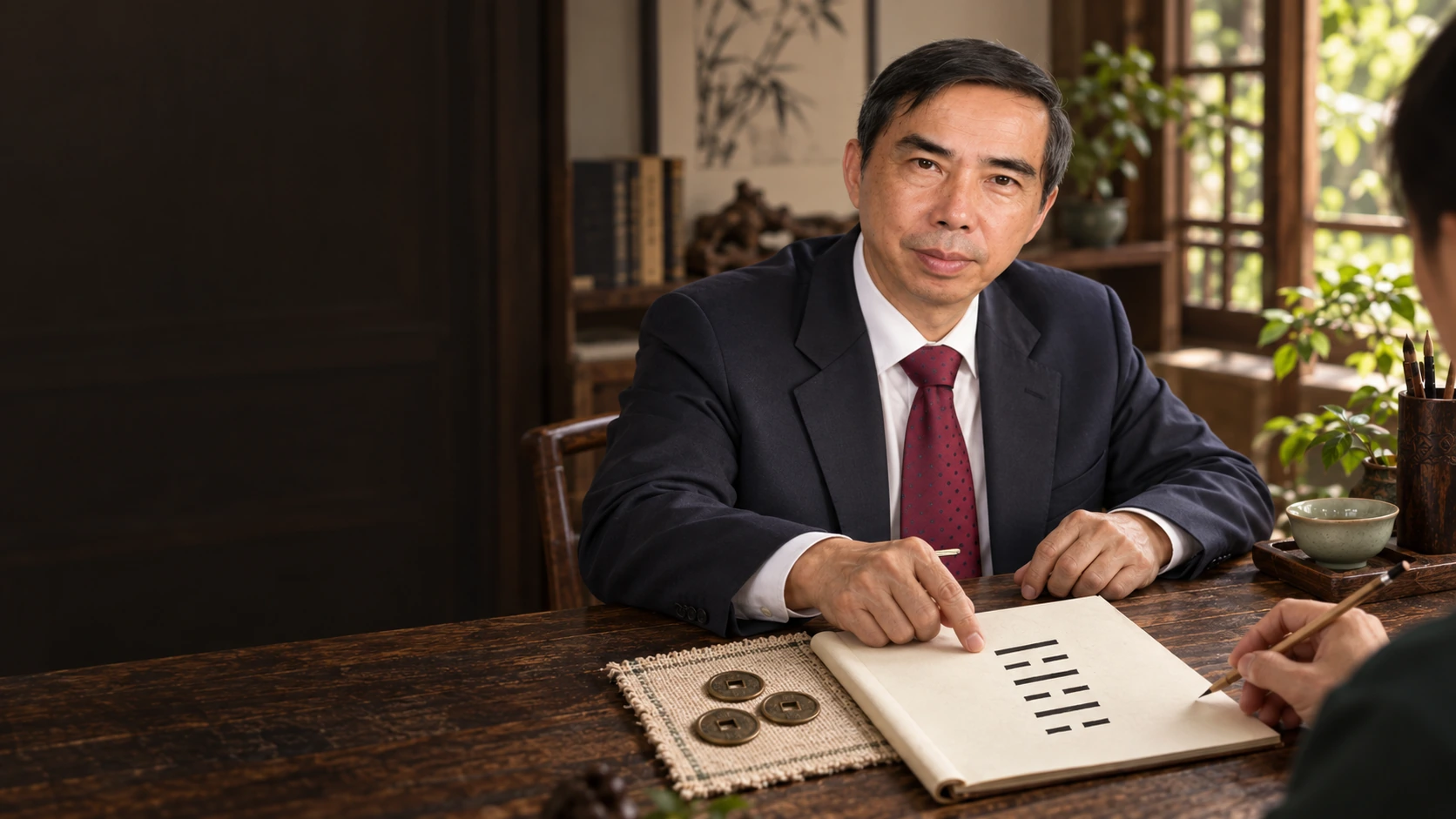
A notebook, three coins and a cup of tea: all the journal needs.
How to keep the journal
Keep it small enough that you will do it. Five lines a day, or even five lines a week, is plenty. Each entry has the same parts:
- The date.
- The hexagram, with its number and name.
- One line of its text, copied out by hand: the Judgment is the simplest place to start.
- The question it raises for you. Not what it means in general, but what it asks of you this week.
- What you noticed by evening. A moment when the question came up, or did not. If nothing happened, write that.
Writing the line out slowly is half the practice. It gives you a few quiet minutes with a text that you did not choose the words of.
Four weeks, four hexagrams
These four were picked because their themes suit reflection. Each name below is taken from the site's own page for that hexagram, where you will find the full text and the six lines; read that page once at the start of the week, then return to your one line each day.
Week 1: Return (Fu, hexagram 24)
The page for Hexagram 24, Return gives a line from the Judgment: "on the seventh day comes the return." Read it as a gentle start rather than a dramatic change. Question: what is the smallest honest step back toward something I already know is right for me?
Week 2: Keeping Still (Gen, hexagram 52)
The page for Hexagram 52, Keeping Still quotes the Judgment: "Keeping the back still, one no longer feels the body; walking through the courtyard, one does not see the people there. No blame." It does not ask you to stop living; it asks about attention. Question: which impulse keeps pulling at my attention, and where is the right place for me to stop?
Week 3: Modesty (Qian, hexagram 15)
This is Qian 谦, not Qian 乾, the first hexagram; the names are spelled alike in romanisation, so check the character. The page for Hexagram 15, Modesty gives the Judgment: "Success. The noble person carries things through to the end." It links modesty with seeing things through, not with looking humble. Question: where am I looking for recognition, and what would change if I simply finished the work?
Week 4: Inner Truth (Zhong Fu, hexagram 61)
The page for Hexagram 61, Inner Truth begins with a strange line: "Even pigs and fishes: good fortune." Notice who is named: pigs and fishes. The traditional commentary reads them as a sign of how far sincerity can reach. Do not read "good fortune" as a promise; the page itself says to look at what your sincerity actually reaches. Question: who is hardest for me to reach, and what would sincerity, rather than persuasion, look like toward them?
If you would like other hexagrams, the full set is on the 64 hexagrams page. Hexagram 1, Qian, and 2, Kun, also suit a first month, as a pair.
When a reading feels uncomfortable
Sooner or later a hexagram will seem to describe something you would rather not look at, or will sound like bad news. Three things help.
- It is a prompt, not a verdict. The text describes a kind of situation and a tendency; it is not a ruling on your life, and it cannot know your circumstances.
- Set it down. Close the notebook and do something ordinary: walk, tea, a meal. Come back the next day. If you notice yourself returning again and again out of worry, that is a sign to stop for now.
- Keep real decisions with real advice. The I Ching is not a substitute for medical, legal, financial, safety or mental-health advice. If a reading leaves you low, anxious or frightened, or if you are facing a decision of that kind, speak to a doctor, a qualified professional or someone you trust.
Something to try: when a line stings, write down what it says in your own words, then write one sentence about what you would do differently if you took it as a question rather than an answer.
Reviewing the month
At the end of the fourth week, read the whole journal in one sitting. Look for the questions that came back under different hexagrams, the weeks when nothing seemed to happen, and anything you wrote down by evening that surprised you. Then ask yourself: which question do I want to carry into next month? You may find that the habit of asking was more useful than any single hexagram.
When you want to go deeper, the guide has a responsible reading method, and the hub collects the references.