Taoist Immortals and the Celestial Bureaucracy: Shen and Xian
道教神明、仙真与天庭官府:神和仙有什么不同
Two categories of being fill most of the Taoist otherworld, and English tends to blur them. Shen are gods: figures holding office in a celestial administration. Xian are transcendents: individuals who achieved a changed condition through cultivation. The two overlap, and a transcendent can be given an office, but they are answers to different questions — one about how the cosmos is governed, the other about how far a human being can get.
“Immortal” is a misleading translation
The word xian is conventionally rendered “immortal,” which puts the emphasis in the wrong place. Endless duration is not really the claim. The claim is a change of condition: a body and mind refined to the point of no longer being subject to ordinary decay, with an accompanying freedom of movement and a different relationship to time.
“Transcendent” is closer, and even that is imperfect. What the sources actually describe is someone who has completed a process — closer to a metallurgical or medical outcome than to a religious reward. This matters because it explains the tradition's characteristic vocabulary of refining, smelting, sealing and circulating. Transcendence was conceived as achieved, not granted.
The early literature also grades the outcome, which tells you it was thought of technically. Ge Hong, writing in the fourth century, distinguishes celestial transcendents who rise, earthbound transcendents who remain in mountains and among people, and those who depart by leaving the body behind — a category invoked to explain empty coffins. The grading is not moral. It reflects how completely the process was carried out.
Two different projects
It is worth being blunt about the tension here, because most introductions smooth it over.
The bureaucratic model says the cosmos is governed by an administration you petition through correct channels. The transcendence model says an individual can, through sustained personal work, step outside the ordinary human condition altogether. One is about submitting to an order; the other is about escaping the terms on which that order operates. They come from different sources and were pursued by different kinds of people — priests serving communities on one side, hermits and alchemists on the other.
Taoism did not resolve this. It combined them, mostly by appointing transcendents to posts. A figure who attained through cultivation could then be given a jurisdiction, a title and a place in the hierarchy, which reconciles the two models at the level of institutions while leaving the underlying difference intact. Recognising that the seam is there makes the tradition much easier to read than pretending it is seamless.
How the celestial administration is arranged
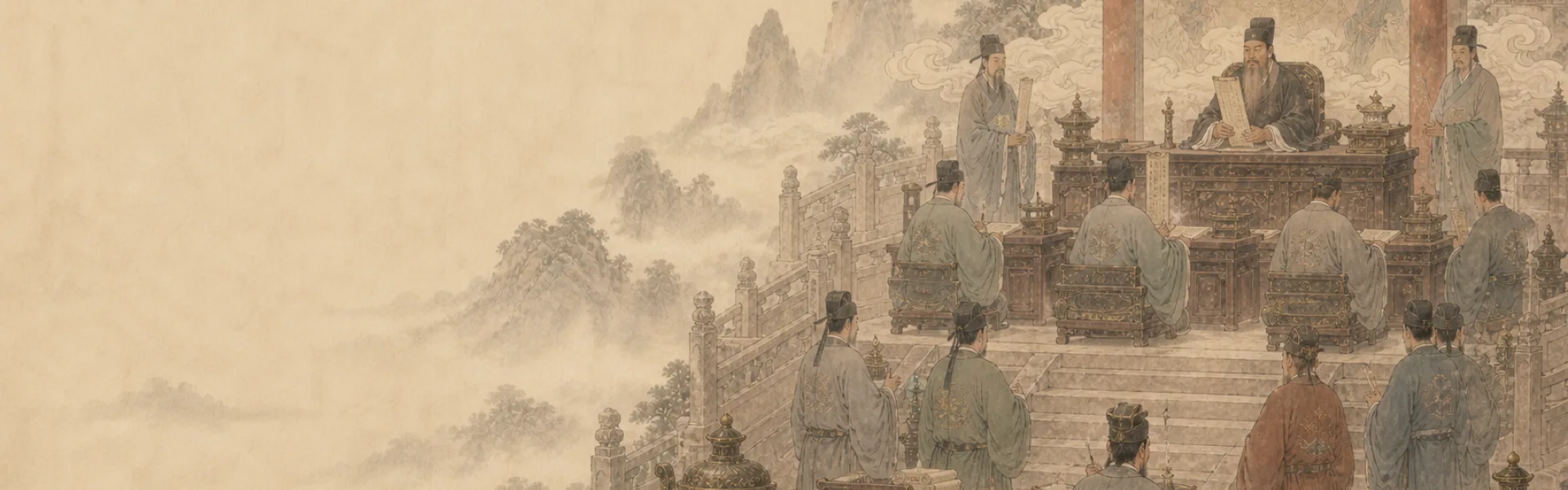
The structure mirrors an imperial government. The Jade Emperor holds executive authority. Below him are ministries with defined portfolios, officials of graded rank, and local officers with small jurisdictions. Authority is delegated downward, reports and petitions travel upward, and there are inspections.
Three features are worth noting because they shape everyday practice. Jurisdiction is territorial as well as functional, so the relevant god for a matter may be the one responsible for where you are. Rank determines what a deity can decide, so an unsatisfactory outcome can be appealed upward. And offices are filled by persons, so the individual holding a post in one town may be a different figure from the holder in the next town.
The offices you will actually meet
A handful of posts turn up almost everywhere and are worth knowing by function.
The city god administers a walled settlement and its dead, and is the closest thing to a local magistrate in the divine order. The earth god handles a much smaller area — a village, a field, sometimes a single street — and is the most numerous deity in China by a wide margin. The stove god sits inside the household itself and is understood to submit an annual report on the family's conduct.
Then there are functional ministries: gods of wealth, of literature and examinations, of medicine, of childbirth, of thunder and rain. And there are the Three Officials of Heaven, Earth and Water, who between them handle blessing, the examination of faults and the relief of distress. Their three festival dates divide the year into thirds, which is why the mid-year Zhongyuan observance for the dead sits where it does in the calendar.
Records, inspection and the moral ledger
The single most pervasive idea in this system is that everything is written down. Merit and fault are recorded, reports are filed, lifespans are entered in registers, and periodic review occurs. Northern and southern stellar offices are traditionally associated with the recording of death and of life respectively.
This has consequences for how morality feels in Chinese religious practice. Wrongdoing is less an offence against a loving god than an entry that will be read. Amendment is possible and procedural — confession, ritual petition, accumulated good works — which is a very old idea, going back to the second-century Celestial Masters who treated illness as a consequence of fault to be resolved by written confession.
It also explains a common feature of temple visits. People ask for their record to be looked at again, for an intercession, for a lifespan question to be reconsidered. Those requests make complete sense inside an administrative cosmos and very little sense outside one.
What the tradition claims about becoming a transcendent
The methods described are varied and the sources disagree, but the general shape is consistent: long, private, technical work, usually under a teacher, usually in seclusion, usually involving breath, diet, sexual continence or its careful management, meditation, and in some periods the ingestion of prepared substances.
The external alchemy of early centuries, which sought a transformative elixir from minerals, gave way over time to internal alchemy, which relocated the entire operation inside the body and reinterpreted the mineral vocabulary as metaphor. This shift is one of the most important in Taoist history and it is treated in detail elsewhere on this site.
What should be said plainly here is that these are traditional claims and this site presents them as such. Descriptions of what practitioners aimed at, and of what the texts assert, are not statements that the outcomes occurred. Where a story reports a departure, an empty coffin or a later sighting, that is hagiography, and it is labelled as hagiography.
The literature and what it is actually doing
A great deal of what we know about transcendents comes from collections of short biographies, and those collections are worth understanding as a genre, because reading them as history produces nothing but frustration.
The form is stable across many centuries. A named person appears, usually with a place of origin. Some peculiarity is noted: an unusual diet, an aversion to ordinary company, a refusal of office, a skill that cannot be accounted for. There is a method, described partially and often deliberately incompletely. There is a demonstration, witnessed by named people. Then there is a departure, and the departure is the point of the whole form: the figure leaves in a way that is not an ordinary death, or a coffin is opened later and found to contain something other than a body.
These accounts were not written to be believed in the way a modern reader means by belief. Several things are going on at once. They are advertisements for methods, which is why a technique is mentioned but not fully explained — the reader is being told that a complete instruction exists and is held by somebody. They are arguments about authority, since a lineage that can point to a transcendent has a stronger claim than one that cannot. They are also, quite often, social criticism. The figure who refuses an official post, eats what nobody else will eat and treats a magistrate with indifference is making a comment on the ordinary path of ambition, and the reader in a bureaucratic society would have caught it.
There is a further function that is easy to miss. The collections establish that the boundary is permeable. Their cumulative message is not that a few extraordinary beings exist elsewhere, but that the transition happened to people with names and home towns, within recorded history, sometimes recently. That is what makes the two projects described above — administrative and personal — parts of one system rather than two unrelated things. The bureaucracy has vacancies, and the biographies are the evidence that they get filled.
How should you read them now? Not as reports, and not as fiction either, since the writers were often serious people who believed they were recording. Read them as the tradition's way of saying what kind of life it valued and what kind of result it thought possible. The details of the departures are conventional. The values embedded in them — indifference to rank, patience over decades, willingness to look foolish, refusal of the ordinary reward structure — are consistent enough to be taken as a genuine statement of position.
One caution follows for anything you read about these figures today. Modern retellings tend to keep the marvels and drop the social criticism, because the marvels travel and the criticism requires knowing what an official career meant. The result reads like folklore. The originals read more like argument.
Where the two models meet
In practice you will constantly encounter figures who belong to both categories at once. Lü Dongbin is a transcendent, a patriarch of internal alchemy and the object of formal worship with his own temples. Zhenwu attained on the mountain by the standard cultivation narrative and holds one of the highest military commands in the celestial order.
The pattern to notice is that the cultivation story tends to be added later, once a cult has become important. An office comes first, then a biography explaining how the holder qualified. That direction of travel — office, then life story — is the opposite of what most visitors assume, and it is worth carrying around as a general expectation.
Key points
- Shen are gods holding office; xian are transcendents who achieved a changed condition through cultivation. English blurs the two.
- “Immortal” misplaces the emphasis. The claim is refinement and a changed condition, not merely endless duration.
- Ge Hong graded transcendents technically — celestial, earthbound, and those departing by leaving the body — reflecting how completely the process was carried out.
- The bureaucratic and transcendence models pull in different directions; Taoism combined them by appointing transcendents to celestial posts.
- The celestial administration has territorial and functional jurisdictions, graded ranks that allow appeal upward, and posts filled by different individuals in different places.
- Common offices: the city god, the earth god, the stove god, and ministries for wealth, examinations, medicine, childbirth and weather.
- The Three Officials of Heaven, Earth and Water divide the year into thirds, which is why the Zhongyuan rites for the dead fall mid-year.
- Everything is recorded: merit, fault and lifespan. Amendment is procedural, through confession, petition and good works.
- Cultivation methods were long, private and technical; external alchemy gave way to internal alchemy, which reread the mineral vocabulary as metaphor.
- These are traditional claims, presented here as claims. Departures, empty coffins and later sightings are hagiography and labelled as such.
- Many figures are both transcendent and office-holder, and the cultivation biography is usually added after the cult becomes important.