Deities of Wudang Mountain: Zhenwu and His Sacred Court
武当山神明:真武大帝与他的神圣侍从
Most sacred mountains in China house many deities without belonging to any of them. Wudang is different. It is a single-deity mountain, and once you know who that deity is and what he means, almost everything on the site — the route, the sequence of halls, the scale of the building work, even the names of individual sites — becomes readable.
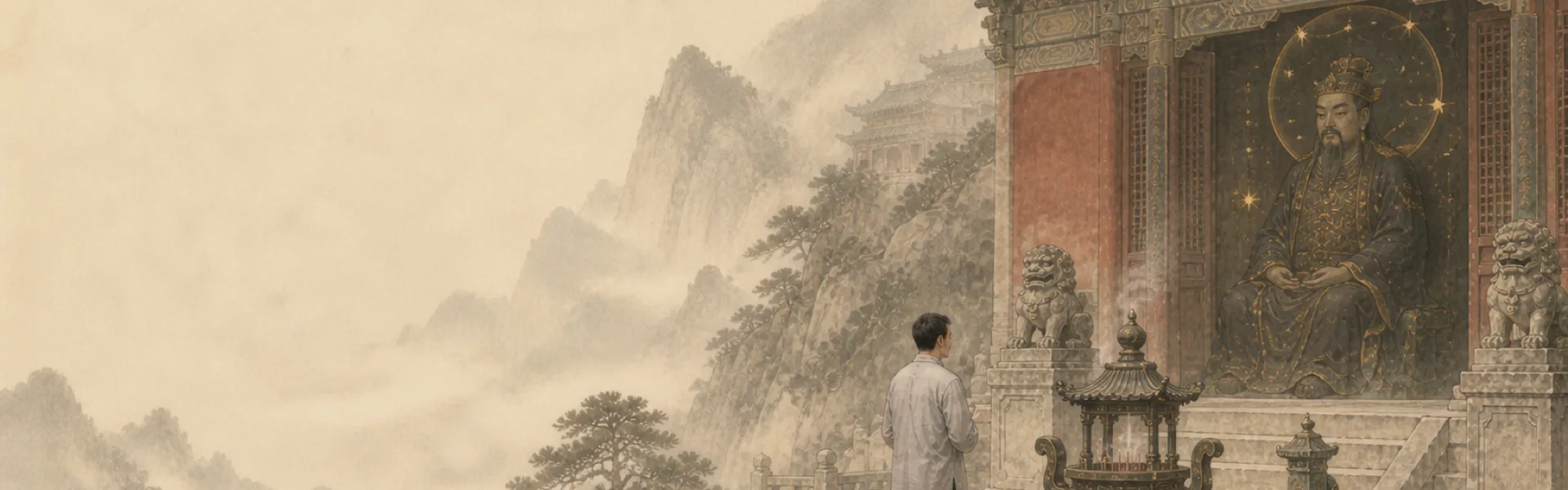
Zhenwu is the mountain
The principal deity of Wudang is Zhenwu, the Perfected Warrior, also widely called the Supreme Emperor of the Dark Heaven. He is a martial deity of the north with authority over exorcism and the subduing of malign forces, and the mountain is his in a strong sense: it is understood as the place where he cultivated and attained, and the whole built landscape is organised around that story.
One clarification is worth making early. His martial character is cosmological before it is athletic. He subdues demons, not opponents. The association between Wudang and specific fighting traditions is much later than either the deity or the mountain's religious importance, and Wudang is best understood as a religious site with a martial arts scene attached rather than the reverse.
From Xuanwu to Zhenwu
He did not begin as a person. He began as Xuanwu, the Dark Warrior, the emblem of the northern quarter of the sky — one of the four directional and astral animals, alongside the eastern dragon, the western tiger and the southern bird. That is why the decisive marker in his images is a tortoise entwined with a snake at his feet. Those animals are not symbolic decoration added later; they are what he originally was.
The change of name happened in the Song dynasty, and the reason is bureaucratic rather than theological: the character xuan became taboo through an imperial ancestor's name, so the deity was renamed. Small administrative facts of this kind explain a surprising amount in Chinese religion.
His biography as a prince — a royal son who renounced the succession, cultivated on this mountain for decades, and attained transcendence on a cliff terrace — is far later than the emblem, and it grew in detail as the cult grew in political importance. The direction of travel is therefore the opposite of what visitors usually assume. He is not a person who became a symbol. He is a symbol that acquired a life story.
Recognising him
His iconography is consistent enough to be genuinely useful. He is normally shown in dark robes, seated and frontal, frequently barefoot and with the hair loose rather than bound — a deliberate signal of a cultivator rather than an official. He often has a sword, sometimes held and sometimes standing before him.
The tortoise and snake at his feet are the reliable identifier. Other dark-robed martial deities exist; the entwined pair does not. Where the statue is heavily gilded or the feet are hidden by cloth offerings, look instead for the general and the guardsman figures described below, and for the hall name.
Youthful images are also common, showing him as the prince before attainment. The Prince's Slope site on the ascent is dedicated to that stage of the story, and the shift in appearance between a youthful and a mature image is a change of chapter, not a different god.
The attendants
Zhenwu is rarely alone, and the surrounding figures carry information.
Immediately flanking him you will usually find a boy and a girl, one holding a seal and the other a banner — the standard attendants of a deity with authority to issue orders, since a seal is what makes a document valid. Beyond them stand armoured marshals, martial officers of his command. The tortoise and the snake also appear in some halls as two separate generals in human form, which is the same pair promoted from attributes into personnel.
At the entrance to many temples on the mountain you will meet a fierce red-faced guardian deity, whose job is to stop what should not enter. He belongs to the threshold rather than to the main hall, and his ferocity is functional.
The Yongle programme and why it happened
Zhenwu's rank rose steadily through the Song and Yuan, but the decisive event was the Ming building programme begun in 1412 under the Yongle emperor. It ran for roughly a decade. Contemporary accounts describe some three hundred thousand soldiers, artisans and conscripted labourers, and it produced what tradition summarises as nine palaces and eight temples. The court ordered that the terrain not be altered, so buildings were fitted to the ground as found. The mountain was given a title ranking it above the traditional five marchmounts.
The reason is political and worth stating plainly. Yongle had seized the throne from his nephew. A ruler in that position needs more than military success; he needs a public argument that heaven approves. Building the mountain of the northern deity — the direction from which he had launched his campaign — was that argument, made in stone and at enormous expense. The mountain is a political document, and the imperial stelae are that argument set in stone with dates attached.
The other deities on the mountain
Wudang is Zhenwu's, but it is not only Zhenwu's, and a complete temple needs the full hierarchy.
The Three Pure Ones have their hall in the major complexes, as the highest manifestations of the Tao, and the Jade Emperor is present as the holder of executive authority. Zhenwu's parents have their own hall, which is unusual and tells you how thoroughly his princely biography was absorbed — the family of a god with a life story needs housing too.
Beyond these you will find the deities any large temple carries: wealth, medicine, literature, the thunder department, and the Taoist form of the compassionate deity that popular practice often does not distinguish from her Buddhist counterpart. The needle-grinding well on the ascent commemorates an encounter from Zhenwu's own story, in which a woman patiently grinding an iron needle taught the discouraged prince about persistence — a site attached to a narrative moment rather than to a deity's office.
Zhang Sanfeng is enshrined here as well, and the honest position is that his historicity is uncertain. He is treated within the tradition as a perfected being, Yongle sought him without finding him, and a temple was built in his honour. What is documented is the imperial interest and the building. What is not documented is the man.
Why this particular mountain was chosen
Zhenwu's association with Wudang looks inevitable once it is established, but it needed explaining at the time, and the explanations that were produced tell you a good deal about how sacred geography works in China.
The starting point is directional. Zhenwu governs the north, and the north in this system is not simply a compass bearing. It carries water, winter, darkness, the colour black and the beginning of cycles. A god of the north therefore needs a northern connection, and Wudang is not in the north of China — it is in the middle, in northwestern Hubei. This is a genuine difficulty, and the tradition solved it in the way such difficulties are usually solved: by relocating the emphasis. Wudang was described as the place where the god cultivated himself and ascended, not as his administrative seat, and a place of cultivation can be anywhere that suits cultivation.
The second argument was topographic. Wudang has the features a mountain needs in order to be read as a site of practice: a defined summit, cliffs with caves, water that does not fail, and enough vertical distance to make the ascent itself a process. Chinese religious geography treats such features as meaningful rather than incidental. A cave is not just a hole in rock, it is the interior of the mountain, and the interior of a mountain is where transformation is expected to happen. Wudang has caves in places that are difficult to reach, which is exactly what the story required.
The third argument was the name, and here the tradition and the evidence part company. A widely repeated explanation reads the characters of the mountain's name as meaning that no weapon other than Zhenwu's own could match this place. It is a satisfying gloss and it is almost certainly a later reading of an older name whose original sense is not recoverable. This is normal. Place names in China are frequently reinterpreted to fit what the place has become, and the reinterpretation is then repeated until it looks like etymology.
The fourth reason is political, and it is probably the decisive one. A dynasty that needed a northern god had reasons to want that god's principal site somewhere it could control and somewhere that was not already occupied by an older and independently powerful institution. Wudang had a real existing tradition of practice, which gave the choice credibility, but it was not one of the five canonical marchmounts with their own imperial protocols. It could be developed on a new scale without inheriting anyone else's arrangements, and the Yongle programme did exactly that.
The result is a site where god and place are unusually tightly fused. At most sacred mountains the deities are various and the mountain is the frame. Here the mountain is the biography of one figure: the ascent passes places associated with his training, his failures of resolve and his eventual success, and the summit is the completion of that sequence. Whether or not you find the story historically persuasive, the mountain has been built to be walked as an argument, and it still reads that way.
Legend and record
The two registers are easy to separate on this mountain, which makes it a good place to practise.
Documented: the Ming programme and its dates, the imperial titles, the stelae with their inscriptions and years, the administrative history, the twentieth-century relocation of Yuzhen Palace above the rising reservoir, and the 1994 inscription of the Ancient Building Complex on the World Heritage list. Dated stone is the most reliable evidence on the mountain — better than the buildings, which have burned and been rebuilt, and considerably better than interpretation boards.
Legend: the prince, the renunciation, the years of cultivation, the needle, the attainment on the cliff. These are hagiography, they are labelled as such here, and they are worth taking seriously as evidence of what the tradition valued — persistence above talent, and withdrawal above succession.
Key points
- Wudang is a single-deity mountain. Its principal deity is Zhenwu, also called the Supreme Emperor of the Dark Heaven.
- His martial character is cosmological, not athletic: he subdues demons, not opponents. The martial arts link is much later.
- He began as Xuanwu, the northern directional emblem. The tortoise and snake at his feet are what he originally was.
- The renaming happened in the Song because the character xuan became taboo through an imperial ancestor's name.
- His princely biography is far later than the emblem — a symbol that acquired a life story, not a person who became a symbol.
- Recognise him by dark robes, bare feet, loose hair, sometimes a sword, and decisively the entwined tortoise and snake.
- Attendants are a boy and girl with seal and banner, plus armoured marshals; the tortoise and snake sometimes appear as human generals.
- The Ming programme began in 1412, ran about a decade, involved some three hundred thousand workers, and left nine palaces and eight temples. The terrain was not to be altered.
- Yongle had seized the throne, so building the northern deity's mountain was a public argument for divine endorsement.
- The mountain also houses the Three Pure Ones, the Jade Emperor, Zhenwu's parents, and the usual functional deities.
- Zhang Sanfeng is enshrined here but his historicity is uncertain; the imperial interest and the building are documented, the man is not.
- Dated stelae are the best evidence on the mountain. The prince, the needle and the attainment are hagiography.