How the Taoist Pantheon Developed: Origins of Its Gods
道教神明体系如何形成:诸神的不同来源
The Taoist pantheon is often presented as a finished chart, with the Three Pure Ones at the top and everything else arranged neatly below. That chart is a modern convenience. What actually happened is that gods arrived from several different directions over about two thousand years, and were fitted into a structure that kept being extended to accommodate them. Knowing where a deity came from tells you more about it than knowing its position on any chart.
Four sources, not one
It helps to separate four distinct origins, because they behave differently and are recognisable once you know what to look for.
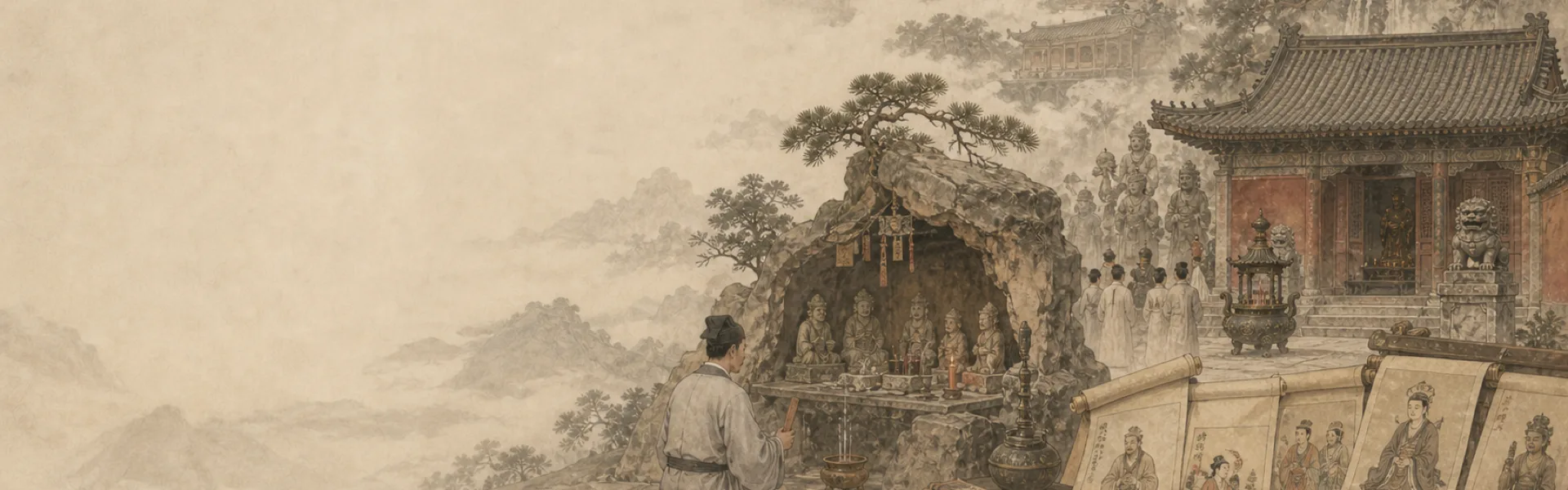
Some deities were inherited from the pre-Taoist state cult. Some were generated by the cosmological system itself, as personifications of principles. Some were local cults absorbed as Taoism spread across a very large and varied country. And some were human beings, promoted after death. A fifth factor, long exchange with Buddhism, complicates all four.
No single one of these is the “real” origin of Taoist religion. The mixture is the thing itself.
Inherited from the state cult
The oldest layer predates organised Taoism by many centuries. Before there were Taoist priests there was already an official religion of the Chinese state, and it dealt with Heaven, Earth, the directions, the great mountains and rivers, the stars, the soil and the harvest. Sacrifice at designated peaks was an imperial responsibility. The emperor reported to Heaven.
Taoism did not abolish this material and could not have. It absorbed it, gave it more elaborate form, and in some cases supplied it with a personality. The clearest single example is the Jade Emperor, who is essentially the impersonal Heaven of the state cult provided with a court, a face and a biography.
Zhenwu of Wudang belongs to this layer too, and is worth citing because the evidence is so visible. He began as Xuanwu, the directional emblem of the north — one of the four astral and directional animals — which is why the decisive marker in his images is still a tortoise entwined with a snake at his feet. The tortoise and snake are not decoration. They are the fossil of the earlier stage.
Generated by the system
The second source is unusual and easy to miss. Chinese cosmology is highly systematic — yin and yang, the five phases, the eight trigrams, the sixty-year cycle, the twenty-eight lunar mansions, the nine palaces. A system of that kind produces slots, and slots tend to get filled with named beings.
So there are deities of the five directions, of the planets, of individual stars and constellations, of each of the sixty year-signs, of the phases and their correspondences. These figures usually have thin biographies, because they were not remembered from anywhere. They were derived. Their names frequently describe their function rather than identifying a person.
This is why Taoism can appear to have an unmanageable number of gods. Many are positions in a scheme rather than characters in a story, and a scheme with several interacting cycles can generate hundreds of positions without difficulty.
Local cults absorbed
The third source is the largest by sheer count. China is enormous and its regional religious life was extremely diverse. As Taoism spread it encountered local gods everywhere — of a particular river, a particular hill, a founding settler, a dead official, a spring, a plague averted.
Rather than suppress these, Taoism did something closer to registration. A local god could be recognised, given a place in the hierarchy, assigned a rank and jurisdiction, and served by a Taoist priest using standard liturgy. Everyone gained: the local community kept its god and acquired ritual competence, and Taoism acquired reach.
The consequences are still obvious. Many deities are important in one province and unknown two provinces away. Some have several incompatible biographies, because separate local traditions were joined under one name. And the city god, found in essentially every walled town, is the same office held by different individuals in each place — usually a locally remembered figure appointed to the post.
Human beings promoted after death
The fourth source is the most distinctive feature of Chinese religion from an outside perspective, and it follows directly from the administrative model. If the divine order is a government, a person of exceptional merit can be appointed to it.
Guan Yu is the clearest case: a general who died in the third century, elevated gradually over more than a thousand years, eventually holding imperial titles, temples across the country and a portfolio covering war, loyalty, commerce and sworn brotherhood. Mazu is the other standard example, a woman from a Fujian coastal community who became the protector of seafarers.
What drove these promotions was efficacy rather than doctrine. A deity credited with answering requests attracted worshippers; worshippers funded buildings; a successful local cult could eventually attract official recognition and imperial titles, which in turn spread it further. The state was an active participant, since recognising a popular god was cheap and politically useful. Canonisation in this tradition is bottom-up, with the state arriving late to confirm what has already happened.
The Buddhist factor
Buddhism arrived in China in the early centuries of the common era and the two traditions have been in contact ever since — competing, borrowing, and at the popular level often merging. Iconographic conventions, vocabulary, cosmological furniture such as elaborate hells, and even individual figures moved between them in both directions.
The result is that ordinary worshippers frequently do not distinguish, and see no reason to. Clergy on both sides distinguish carefully. For a visitor this produces a few practical rules of thumb: palms pressed together is a Buddhist gesture, while the Taoist salute is a closed hand with the left over the right at the chest; circumambulating an image is Buddhist practice, not Taoist; and a priest at a Taoist temple is addressed as daozhang, never as the Buddhist fashi.
How a new god actually became established
The four sources describe where gods came from. They do not describe the process by which a new figure moved from obscurity to a place in the structure, and that process is worth setting out, because it is repetitive enough to be recognisable.
It usually began with an event. Someone died in a way that was remembered — unjustly, heroically, or in circumstances that struck the people who witnessed it. Or a place produced something inexplicable: a spring that did not fail in drought, a strange light, a survival that should not have happened. The event generated a local reputation for efficacy, and efficacy is the operative concept throughout. Chinese religious practice has always been more interested in whether something works than in whether it is theologically correct.
If the reputation held, a shrine appeared. This stage is informal: no clergy, no text, no title, often no image at first, just a place and a name and people bringing things. Most cults stop here and eventually fade. A minority grow, because they acquire a constituency — a village, a guild, a family that prospered, a group of soldiers.
Growth attracted attention from institutions, and here the process becomes political. A local official might report a cult upward, either to have it suppressed as unauthorised or to have it recognised. Recognition mattered enormously: it brought a title, sometimes land, and legitimacy that protected the cult from being demolished in the next campaign against illicit worship. The state's interest was not devotional. A recognised cult was a cult inside the system, and one whose god could be held responsible in the way an official could.
Taoist clergy entered at a similar point, and for a related reason. A god with a growing following needed ritual competence — correct texts, correct forms of address, correct handling of festivals. Providing that competence brought the cult into the Taoist framework, which meant fitting the god into the celestial administration: giving it a rank, a jurisdiction, a place in the sequence of petitions. Sometimes this was straightforward. Sometimes it required visible improvisation, and you can still see the seams in the resulting texts.
The final stage was standardisation: an image type that became conventional, a birthday fixed in the calendar, a story written down in a form that could travel, and a set of things the god was understood to be good for. Once a cult reached this stage it could spread far beyond its origin, carried by merchants, migrants and soldiers, and it became very difficult to remove.
Zhenwu passed through a version of this sequence, though at an unusual speed and with unusual sponsorship. The important point is general: the pantheon was not designed and then populated. It grew from below and was organised from above, repeatedly, and the tension between those two directions is visible in almost every part of it.
Why the list is still moving
There has never been a body with the authority to close the pantheon, and the sources above are all still capable of operating. Local cults still form. Efficacy still matters. Older gods still fade when the trades or dangers they governed disappear.
So a definitive list of Taoist deities does not exist, and any book presenting one is presenting an editorial selection. This is not untidiness to be apologised for. It is the direct consequence of a tradition that organises the divine as an administration — and administrations, unlike revelations, are never finished.
Key points
- The pantheon came from four main sources: inherited state cult, deities generated by the cosmological system, absorbed local cults, and deified human beings.
- Long exchange with Buddhism is a fifth factor affecting all of them.
- The oldest layer is pre-Taoist state religion: Heaven, Earth, directions, mountains, rivers and stars. The Jade Emperor personalises the impersonal Heaven of that cult.
- Zhenwu of Wudang began as Xuanwu, emblem of the north; the tortoise and snake at his feet are the trace of that origin.
- Many deities are positions in a cosmological scheme rather than remembered characters, which is why they have thin biographies and functional names.
- Absorbing local cults gave Taoism reach and gave communities ritual competence — a process closer to registration than to conquest.
- This is why deities can be major in one province and unknown elsewhere, and why some have several incompatible life stories.
- Humans could be promoted into the pantheon; Guan Yu and Mazu are the standard examples, driven by efficacy rather than doctrine.
- Recognition worked bottom-up, with the state confirming successful cults rather than creating them.
- Practical distinctions from Buddhism: the Taoist salute is left hand over right at the chest, there is no circumambulation, and clergy are addressed as daozhang.
- No authority can close the list, so no definitive catalogue of Taoist deities exists.