The Northern Dipper in Daoist Culture: Stars, Images and Ritual Maps
道教文化中的北斗:星象、图像与仪式图式
Look north on a clear night and seven bright stars form the shape commonly called the Big Dipper in English. In Chinese sources the pattern is Beidou, the Northern Dipper. The same seven points can appear in an astronomical atlas, a deity image, a ritual diagram, a scripture or a festival account—but those appearances do not all mean the same thing.

This guide extends Wudang.Org’s structural introduction to the Daoist pantheon. It moves from sky observation to historical maps and then to Daoist images and rites. The method is deliberately cautious: a cluster of seven dots is evidence of a pattern, not by itself proof of a date, deity, lineage or ritual.
Begin with the sky, not the symbol
Seven stars form an asterism
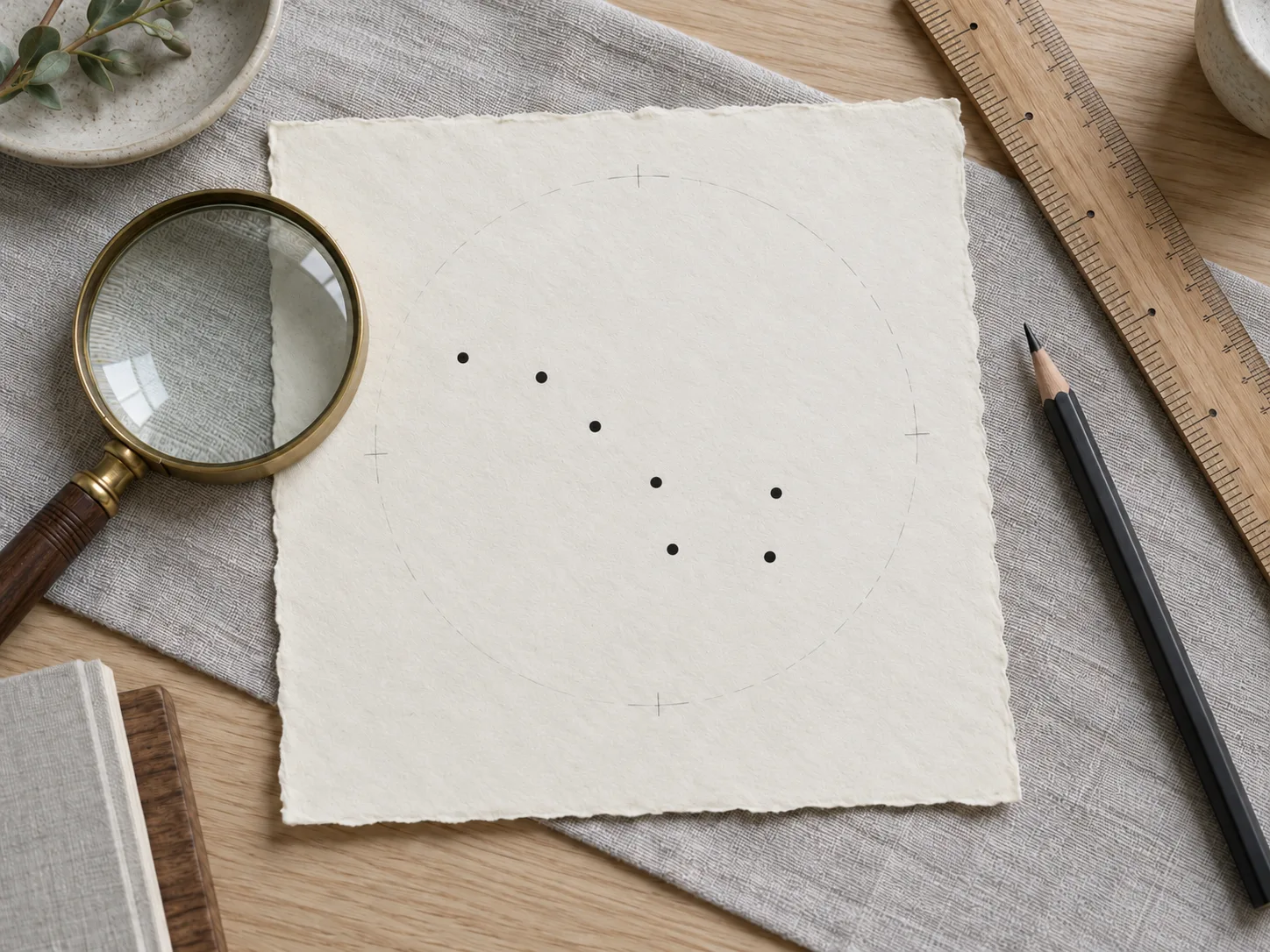
The Northern Dipper is an asterism: a recognizable pattern made from stars that modern astronomy places within Ursa Major. Its bowl and curved handle are convenient visual descriptions, not physical connections between neighbouring stars. Start by counting and locating the points before asking what a historical viewer called them.
Position also changes with hour and season as Earth turns and orbits the Sun. Historical Chinese observers used the northern sky within systems of direction, calendrical order and celestial administration, but a present-day snapshot cannot recover every older interpretation. Observation and cultural explanation are separate steps.
A sky pattern is not yet a star chart
A chart selects a viewpoint, projection, labels and boundaries. The early Tang manuscript Or.8210/S.3326, now in the British Library, contains twelve sky maps and a circumpolar map. The scholarly study by Bonnet-Bidaud, Praderie, Whitfield and colleagues identifies 1,339 stars and 257 asterisms and proposes a date of 649–684. Read the published study of the Dunhuang Chinese sky and the International Dunhuang Programme object introduction.
That atlas is important evidence for astronomical mapping, not a universal template for every Daoist image. Its dots, lines, captions and projections organize observed heavens. A ritual diagram may instead arrange stars as divine offices or a path of action. Similar geometry does not erase the difference in purpose.
Names belong to sources and periods
Beidou can refer to the seven visible stars as a group, while later religious sources also speak of nine stars, adding two assistants or hidden members within particular systems. Individual star names and divine titles vary across texts. Record the exact wording rather than combining several lists into one supposedly timeless roster.
This source discipline matters across Chinese cosmology. The guide to the Nine Palaces likewise distinguishes mathematical arrangement, historical commentary and later application. Seven, eight and nine can each be meaningful without being interchangeable.
Follow the change from chart to divine image
Stars can become offices, figures and courts
Daoist texts and images can personify stellar powers as lords, officials or a celestial court. This does not mean that astronomy was abandoned. Rather, observed patterns, calendrical knowledge, bureaucratic language and ritual theology could coexist and reshape one another. Ask whether a source depicts points, names, human figures, palaces or written commands.
The wider celestial bureaucracy offers a useful comparison. Administrative titles explain relationships and responsibilities inside a religious system; they should not be mistaken for a modern scientific claim about what stars physically are.
Doumu and the Nine Emperors have layered histories
Doumu, the Dipper Mother, and the Nine Emperors appear in overlapping but changing traditions. A recent open-access historical study traces how Daoist sources connected the Nine Emperors with the Northern Dipper by the Tang and how later texts expanded Doumu’s roles. It also shows that no single identity list governed every source or region. See the Cambridge study of the Nine Emperor Gods and diasporic religious ecology.
A 2026 textual study of Qing editions of the Northern and Southern Dipper scriptures likewise treats scriptural compilation and commentary as historical processes. Its evidence warns against presenting a currently printed scripture as a transparent survival from remote antiquity. Read the study of the Nanbei dou jing editions.
Zhenwu connects the northern sky to Wudang
Wudang is centred on Zhenwu, a northern deity whose visual and textual worlds can include the Northern Dipper. An Art Institute of Chicago hanging scroll titled Zhenwu with the Eight Trigrams, the Northern Dipper, and Talismans, dated to the seventeenth or early eighteenth century, places these elements in one composed image.
One object demonstrates association, not a rule for every period or Wudang hall. Compare it with the site’s focused introductions to Zhenwu at Wudang Mountain and the deities of Wudang’s sacred court. Only a dated object, inscription, ritual manual or site record can establish a specific historical use.
Ritual maps do more than represent the sky
The Dipper can organize ritual movement and authority
In some Daoist ritual traditions the Dipper is not merely pictured; it structures movement, command and the rectification of disorder. Mark Meulenbeld’s peer-reviewed study of celestial script describes the Northern Dipper as a locus of exorcistic power within the particular manuals he examines. The full text is available through the Hong Kong Polytechnic University repository.
That finding must remain attached to its sources. It does not license a visitor to reconstruct a rite from dots on a floor or to label every star pattern “exorcistic.” Ritual knowledge includes spoken formulas, authorized roles, sequence, gesture and context that a surviving image may not preserve.
Talismans, seals and lamps use related visual languages
Lines, dots, unusual scripts, seals and stellar arrangements may share a surface while doing different work. Begin by identifying the object and medium. A hanging scroll, printed scripture, altar paper, robe, seal impression and architectural painting each enters ritual life differently.
Use the companion guides to Daoist talismans, ritual seals and lamp rituals to compare how writing, authorization, light and spatial pattern operate. Resemblance is a question to investigate, not a shortcut to identity.
A festival is not a fossilized scripture
Nine Emperor Gods festivals in Singapore, Malaysia, Thailand and elsewhere are living regional traditions. The Cambridge study shows how migration, local institutions, oral histories and religious networks reshaped both ritual structure and divine identities. It explicitly cautions against treating every Southeast Asian form as a simple transplant from one fixed Chinese original.
This matters when reading the broader Taoist festivals and rituals cluster. A temple’s current explanation, a community’s oral history, a Qing stele and a medieval scripture are all evidence, but they answer different questions. Respect begins with naming whose tradition, where and when.
Use a six-step method for responsible reading
Move from visible form to documented context
When you meet a Dipper image in a temple, book, museum or festival, use the same sequence each time:
- Identify the medium. Is it sky observation, chart, painting, printed text, talisman, altar object, costume or festival display?
- Count and map. Record seven, nine or another number of points; note bowl, handle, labels, lines and orientation.
- Describe the neighbours. List figures, trigrams, seals, palaces, text, colours and other constellations without interpreting them yet.
- Read the caption or source. Record title, date, place, collection, scripture, edition and named ritual tradition.
- Compare cautiously. Use dated parallels, but do not turn resemblance into common authorship or function.
- State confidence. Separate visible fact, source-based identification, plausible comparison and unresolved question.
Do not copy sacred graphics as decoration
Photography may be restricted in working temples, and ritual papers or diagrams may not be offered for reproduction. Follow local instruction, avoid interrupting ceremonies and do not trace, stage, rotate or touch objects to make a clearer picture. The practical guide to identifying figures in Wudang halls begins from the same principle: look carefully without manufacturing certainty.
A seven-star tattoo, logo or decorative print may borrow the pattern without carrying the authority of a liturgical object. Conversely, a plain diagram in a manual may have a highly specific function. Respect comes from context, not from making everything look more mysterious.
Keep astronomy, religion and regional history in conversation
The Northern Dipper is simultaneously observable and culturally interpreted. The Dunhuang atlas shows a technical tradition of mapping the heavens; Daoist scriptures and images turn stellar order into divine and ritual relationships; Wudang’s Zhenwu traditions bring the northern sky into a specific sacred landscape; diasporic festivals create further local histories.
These layers enrich one another when they remain distinguishable. End any interpretation by saying which layer your evidence actually supports. That small discipline keeps the Northern Dipper visible as stars, historical record, religious image and living cultural form—without forcing them into a single timeless explanation.