The Jade Emperor in Taoism: Ruler of the Celestial Bureaucracy
道教玉皇大帝:天庭官府的治理者
The Jade Emperor is the god most people mean when they say “the Chinese god of heaven.” He is not the highest-ranking figure in Taoism — the Three Pure Ones are above him — but he is the one who actually governs, and that distinction is the key to understanding him. Rank and executive authority are separate things in this system, exactly as they were in the imperial administration the pantheon is modelled on.
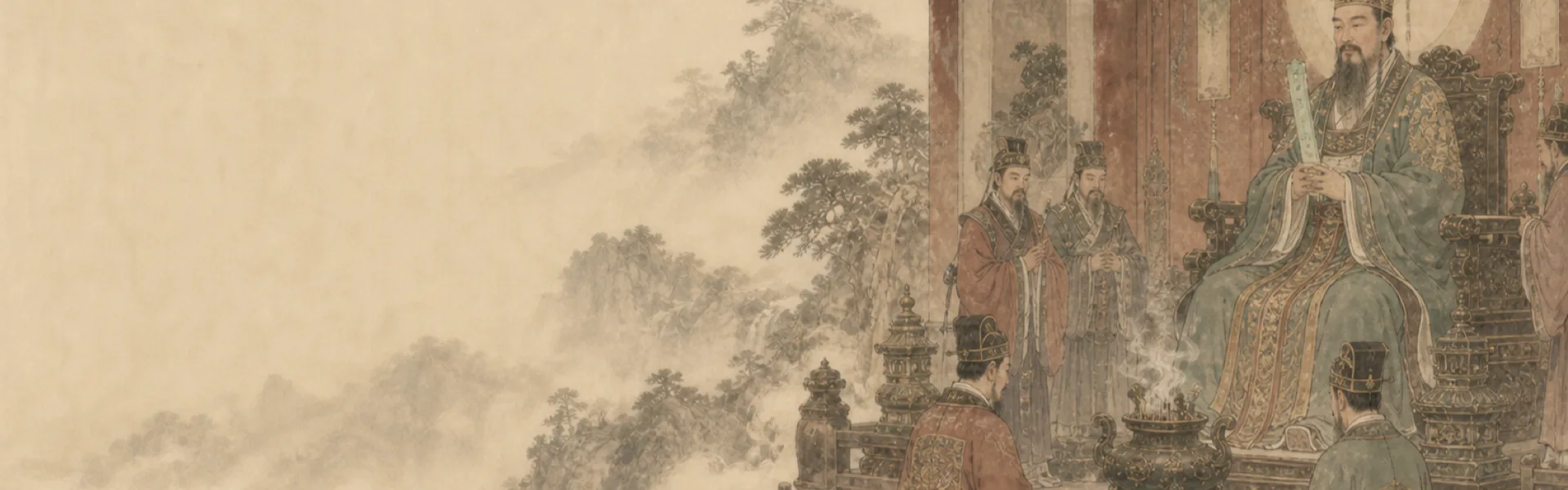
Not the highest, but the one in charge
The Three Pure Ones are the highest manifestations of the Tao, and they do not run anything. The Jade Emperor holds the mandate to administer the visible cosmos: heaven, earth, the human world, and the departments dealing with weather, water, disease, longevity, wealth and moral accounting.
If that sounds like an odd arrangement, compare it with the empire itself, where a retired emperor or a revered ancestor could outrank a reigning one without holding power. Seniority and function were routinely separated. The pantheon reproduces the same arrangement, which is why the busiest halls in a temple are rarely the highest-ranking ones.
In practice the Jade Emperor is the addressee of an enormous proportion of ordinary Chinese religious activity, and in southern China and Taiwan he is often known simply as the Duke of Heaven, a name that carries much more warmth than his formal titles.
The court is modelled on a real government
The resemblance to an earthly imperial court is not a loose metaphor. It is detailed and deliberate. There is a palace, an audience hall, ministries with defined portfolios, officials of graded rank, memorials submitted upward, edicts issued downward, seals, registers, inspections and personnel decisions.
Once you see this, features of Chinese religion that look strange become obvious consequences. Why is so much ritual documentary — petitions written, read aloud and burned? Because that is how one addresses a government. Why can a god be promoted, demoted, transferred or quietly retired? Because posts are administrative. Why does the stove god report annually on a household? Because inspection and reporting are what a bureaucracy does. Why does it matter that a priest is ordained? Because a submission needs a person with standing to make it.
The moral dimension follows too. In this model, wrongdoing is not primarily an offence against a loving god but an entry in a record that will be reviewed. Merit and fault accumulate, are reported, and are taken into account. That is an administrative conception of morality, and it runs deep in Chinese religious practice.
How he reached the top
He is not an ancient figure, and this is worth knowing because he is often assumed to be primordial.
Behind him lies a very old idea — Heaven as the ultimate authority, which predates Taoism as an organised religion by many centuries and belonged to the state cult. Heaven in that sense was impersonal, and emperors reported to it. The Jade Emperor is, in effect, that abstraction given a court and a face.
His decisive elevation came in the Song dynasty, in the early eleventh century, when the emperor Zhenzong conferred grand titles on him and promoted his cult with state backing. There were political reasons, as there usually are: a ruler under pressure benefits from a visible alignment between the heavenly court and his own. After that the Jade Emperor was firmly established at the head of the working pantheon and stayed there.
The pattern is the same one visible at Wudang four centuries later, when the Yongle emperor invested enormously in Zhenwu. Imperial need and divine promotion tend to arrive together.
Recognising him
His iconography is straightforwardly imperial and easy to read. He is seated, frontal and symmetrical, in the robes of an emperor rather than the gown of a priest or immortal. He usually wears a flat-topped ceremonial crown with hanging pendants, and often holds a tablet of office in both hands at chest height.
He is normally attended, and the attendants matter: officials with brushes, tablets and registers, standing in ranked positions. The presence of clerical staff is one of the clearest signals that you are looking at a governing deity rather than a transcendent one. Where the Three Pure Ones sit alone in near-abstract stillness, the Jade Emperor is depicted in the middle of running an administration.
His birthday and how it is kept
His birthday falls on the ninth day of the first lunar month, shortly after the New Year, and it is one of the most widely observed dates in the entire Chinese religious calendar — in some regions more consistently kept than the birthdays of local deities. Because the calendar is lunar, the Gregorian date moves every year, so no fixed date can usefully be given here.
Observance ranges from the household to the temple. In parts of southern China and Taiwan families set out offerings in the open, facing the sky rather than an image, since the addressee is heaven itself. In temples there is scripture recitation, formal offering and often a larger ceremony. The date also opens the year's ritual cycle in practice, coming as it does at the point when New Year observances shade into the ordinary calendar.
The officials who work for him
A god who administers has to have staff, and the Jade Emperor's court is populated in detail. Understanding the staff is more useful than understanding him, because it is the staff that ordinary religious practice actually deals with. You petition the emperor only for matters large enough to warrant it. Everything else goes through an office.
The pattern follows real bureaucratic practice closely. There are departments with defined portfolios: one deals with thunder and by extension with the punishment of wrongdoing, one with rain and water, one with epidemics, one with wealth, one with literary examinations, one with the records of human lives and deaths. There are inspectors who report upward on human conduct, including one who is said to observe a household from inside the house itself. There are guardians at the gate who stop what should not enter. There are couriers who carry documents between levels. The system assumes, as the imperial system did, that authority is exercised through paperwork moving between offices rather than through direct intervention from the top.
Several consequences follow, and they explain a lot of what you will see in a temple. Petitions are addressed to whoever has jurisdiction, which is why a worshipper may move between halls rather than concentrating on the largest figure. Written documents are burned rather than spoken, because burning transmits a document upward. Timing matters, because offices have reporting dates. Formality of language matters, because a badly worded petition is a badly drafted submission. What can look like superstition from outside is often the internal logic of an administration being followed carefully.
The subordinate officers also include figures who began as human beings and were appointed. This is the mechanism described elsewhere on this site: a person of exceptional conduct or exceptional local importance is given a post, sometimes with imperial ratification. The result is a court whose middle ranks are continuously refreshed from below, which is one reason the pantheon never settled into a fixed list.
At Wudang the arrangement is visible in the architecture. Zhenwu is a high officer with a specific commission, and the halls dedicated to him are flanked by figures who belong to his own retinue: attendants, generals, a marshal who guards the gate. The mountain is not organised as a display of the whole celestial administration. It is organised as the seat of one office within it, which is why the same handful of figures recurs from the lower gates to the summit.
If you want a single question to ask in front of an unfamiliar figure in a hall of this kind, ask what this one is responsible for. The answer is usually encoded in the objects held, the colour of the dress and the name on the plaque, and it will place the figure in the structure faster than trying to remember a hierarchy.
What people ask him for
Broad matters rather than narrow ones. A specific problem usually goes to the god whose portfolio covers it — wealth, childbirth, examinations, medicine, safe travel. The Jade Emperor receives the general requests: the wellbeing of a family over the coming year, protection of a household, thanks for a year survived, the settling of something that has no obvious departmental home.
He is also the correct addressee when the matter is essentially one of justice — a wrong that has not been righted, a situation where the person feels the record needs correcting. That fits the model precisely. You are appealing to the authority above the office that failed you.
Why an imperial god outlived the empire
China has had no emperor since 1912, and the Jade Emperor's cult is entirely undiminished. That is worth a moment's thought, because it tells you what the imperial framing was actually doing.
The court model was never primarily a political endorsement. It was a way of describing how a very large, impersonal order deals with individual cases: through channels, according to procedure, with records kept, where the correct approach matters and where an appeal can go over the head of an unhelpful official. That description of how power works has not become less recognisable since 1912. If anything the analogy has become easier for most people to grasp, since almost everyone now deals with bureaucracies and almost nobody deals with emperors.
Key points
- The Jade Emperor holds executive authority over the cosmos but not the highest rank; the Three Pure Ones outrank him without governing.
- Rank and function are separate in the pantheon, exactly as they often were in imperial administration.
- His court is modelled in detail on a real government: ministries, graded officials, memorials, edicts, seals and registers.
- This explains documentary ritual, the promotion and demotion of gods, household reporting deities, and why ordination confers standing.
- Morality in this model is an accounting matter: merit and fault are recorded, reported and reviewed.
- He is a relatively late figure, giving a court and a face to the far older, impersonal Heaven of the state cult.
- His decisive elevation came under the Song emperor Zhenzong in the early eleventh century, with political motives, as at Wudang under Yongle later.
- Iconography is imperial: seated and frontal, flat-topped crown with pendants, tablet of office, attended by officials with registers.
- His birthday is the ninth day of the first lunar month, very widely observed, sometimes with offerings made in the open facing the sky.
- He receives broad requests and matters of justice; specific problems go to deities with the relevant portfolio.
- The cult outlived the empire because the court model describes how impersonal power handles individual cases — still recognisable today.