Taoist Temple Worship: Incense, Offerings, Vows and Donations
道教宫观祭祀:上香、供养、许愿与捐献
Everything a worshipper does in a Chinese temple makes sense once you accept the administrative premise: you are approaching an office, respectfully and in the correct form, to lodge a request or acknowledge an outcome. This page explains the standard actions — incense, offerings, vows, divination and donation — and what each is understood to accomplish.
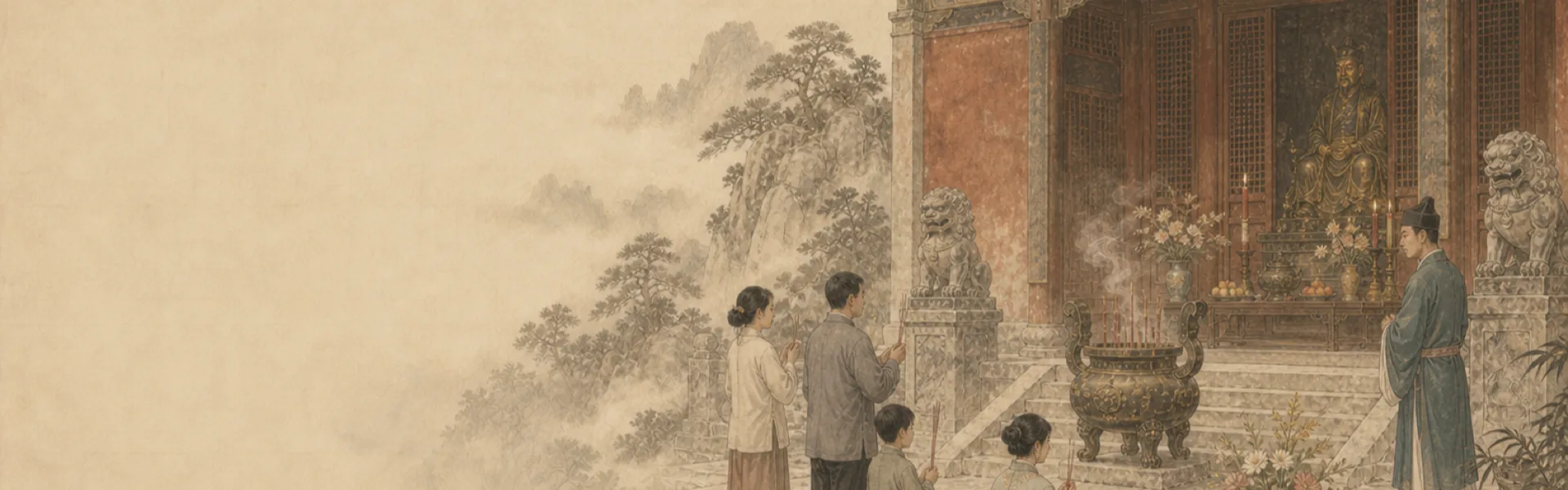
What an offering is actually for
The common assumption is that an offering buys a favour. That is not quite the model, and getting it right removes a lot of awkwardness.
An offering establishes a relationship of the correct kind. It marks the encounter as formal, demonstrates that the petitioner is serious enough to have prepared, and provides the material context in which a request can properly be made. The closer analogy is not a bribe but the courtesies attached to approaching an official: you arrive properly, you present yourself properly, and only then do you state your business.
This is why quantity matters much less than form. Three sticks of incense correctly offered accomplish what an armful does not, and clergy will say so. Excess is generally understood as a misunderstanding rather than as extra piety, and on a working mountain it is also a fire and smoke problem.
Incense: the standard procedure
Incense is the ordinary medium of contact and the one action almost every visitor performs. The procedure is simple and consistent enough to learn in a minute.
Take three sticks. Light them, and if there is flame, extinguish it by waving rather than blowing — breath is not used on offerings. Hold them at chest height with both hands, face the image, and bow. Then insert them into the burner using the left hand. The left hand is used because it is the honoured side in this context, which is the same reason the Taoist salute places the left hand over the right.
Note where the burner is. In Taoist practice it normally stands outside in the courtyard, in front of the hall rather than inside it. So the whole sequence moves outward from the image rather than towards it, which is the reverse of what many visitors expect. Do not insert incense into anything that is not a burner, and do not use another worshipper's sticks.
Three is the standard number and carries the usual cosmological weight. If you are unsure about anything else, three sticks, a bow, and the courtyard burner will be correct almost everywhere.
What else is offered
Beyond incense, the usual offerings are fruit, flowers, tea, lamp oil and cooked food. At a Taoist temple these should be vegetarian. Meat offerings belong to other registers of Chinese religious practice — ancestral rites and some local cults — and are not appropriate on a Taoist altar, particularly in a Quanzhen monastery where the clergy are vegetarian by rule.
Candles and lamp oil are a distinct category, since keeping a lamp burning is a continuing act rather than a single one. Paper money, widely burned in Chinese practice, belongs primarily to rites for the dead and ancestors rather than to petitions to high deities, and many temples restrict or prohibit burning it on the premises.
Offerings placed on a table are not abandoned. Fruit and food are normally removed later and consumed or distributed, which is entirely ordinary and not a lapse. Do not take anything from an altar table yourself.
Vows and their fulfilment
A great deal of Chinese religious practice consists of a two-part transaction, and this is where the administrative model shows most clearly.
First a vow: a request accompanied by an undertaking — to return, to make a specific offering, to fund a repair, to perform some act of merit, if the matter turns out well. Then, if it does, fulfilment. The second half is taken seriously, and the obligation is felt as real. Unfulfilled vows are a recognised source of unease.
The logic is consistent with everything else in the system. If outcomes are recorded, then an acknowledgement should also be entered in the record. This is not superstition about accounts; it is the same conception of morality as bookkeeping that produces confession, petition and the merit ledgers popular in later imperial China.
Asking a question
Temples also provide ways of getting an answer rather than making a request, and the two commonest methods are worth recognising even if you do not use them.
Divination sticks: a cylinder of numbered bamboo slips is shaken until one works loose. The number corresponds to a printed verse, usually obscure, and the verse is then interpreted — often with the help of someone at the temple. Paired lots, more common in southern practice, are two curved pieces cast on the floor to give yes, no or unclear answers to a series of narrowing questions.
Neither is fortune-telling in the sense of a paid personal reading. They are procedures the temple provides, and the interpretation is expected to be modest. Which brings up the necessary warning: paid religious services offered by people operating outside the temple's own framework — fortune-telling, blessings, consecration, or a remedy for a misfortune you were told about a minute earlier — are the largest and most avoidable loss a visitor can incur. Anyone selling religious services outside the registered framework of the site has no standing to do so.
Money and what is not for sale
This deserves plain treatment because it is where visitors most often feel uncertain.
The temples themselves charge nothing for worship. Donation boxes are voluntary and unattended, which is deliberate: nobody watches, nobody records, and no amount is expected. Buying incense, candles or lamp oil at a temple stall is a normal transaction and not a donation. On a managed scenic site there may be a separate entrance charge collected by the secular administration, which is payment for access and infrastructure, not for religious services — two different bodies with two different functions.
What is not for sale is anything presented as guaranteed divine outcome. If a specific sum is named for a specific result, or if urgency and a personal misfortune are introduced together, that is a commercial approach and not a religious one. Selling concentrates in leased commercial concessions, which carry revenue targets without monastic accountability — the structural reason it tends to appear exactly where religious authority does not. This is not unique to Wudang and not even especially bad there.
Who does the work, and what a service looks like
Most descriptions of Taoist worship concentrate on what a visitor does. The larger part of the activity in a working temple is done by the resident clergy, on a schedule that has nothing to do with visitors, and knowing roughly what it consists of makes the building intelligible.
The daily core is a service performed morning and evening. It is not a sermon and there is no congregation in the sense of an audience. A small number of clergy assemble in the main hall, and the service consists of chanted text, performed to a fixed melody with percussion marking the structure — a hand-struck bell, a wooden block, sometimes a drum. The texts are recited rather than explained. The purpose is not instruction of the participants but the correct performance of an obligation, and correctness includes pronunciation, tempo and the physical arrangement of the people involved.
Above this daily layer sit larger rites, performed on calendar occasions or when commissioned. These are more elaborate: more participants, vestments rather than everyday robes, written documents that are read aloud and then burned, offerings laid out in a prescribed arrangement, and movement around the hall following set paths. A major rite can run for hours or across several days. If you happen to be present for one, you are watching the thing the building was designed for, and the ordinary rules apply with extra force: stand at the back or outside, do not walk through the space between the officiants and the altar, and do not photograph.
Two things about this are worth taking in. The first is that the emphasis on correct performance is not empty formalism. In a tradition that understands ritual as the submission of documents to an administration, a rite performed wrongly has failed in the way a wrongly filed application fails. This is why training for clergy involves a great deal of memorisation and why an experienced officiant is valued for precision rather than for expressiveness.
The second is that this layer is largely invisible to the daytime visitor, which distorts the impression most people take away. Arriving at eleven in the morning you see a place that appears to consist of shrines, incense and other tourists. Arriving early enough to hear the morning service you see a religious institution doing its work, with the visiting public entirely incidental to it. The same building, read two completely different ways, and the earlier reading is the more accurate one.
You cannot arrange to take part, and you should not try. But you can arrange to be there when it happens, and at a mountain site that mainly means staying overnight rather than arriving with the day's transport. It is the single change that most alters what you understand about the place.
The minimum before you enter
If you remember nothing else, this is enough to behave correctly in almost any Taoist hall.
Enter by a side door, since the central axis belongs to the deity and the central door is often shut. Step over raised timber thresholds rather than on them. Keep to the sides of the hall, do not linger directly in front of the offering table, and leave the exact-centre cushion alone — it is for the officiant. There is no circumambulation in Taoist practice; that is Buddhist. During liturgy, no flash, no video with sound, and nothing photographed from the front along the axis past the officiant: stand at the side or outside.
The governing test resolves most remaining questions: would you do this in a stranger's home? A working temple is a home and a workplace. And the one thing genuinely expected of you is quiet — not silence, and not solemnity, since Chinese temple courtyards are sociable places. You are not being asked to keep the rule. You are being asked not to interrupt people who are.
Key points
- An offering establishes a formal relationship rather than purchasing a favour. Form matters far more than quantity.
- Standard incense procedure: three sticks, extinguish flame by waving not blowing, bow holding them at chest height, insert with the left hand.
- In Taoist practice the burner normally stands outside in the courtyard, so the sequence moves outward from the image.
- Offerings at Taoist temples should be vegetarian; meat belongs to ancestral rites and some local cults, not a Taoist altar.
- Paper money belongs mainly to rites for the dead, and many temples restrict burning it.
- Vows come in two parts, request and fulfilment, and the second half is treated as a real obligation.
- Divination sticks and paired lots are procedures the temple provides, not paid personal readings.
- Paid religious services from people outside the temple's framework are the largest avoidable loss for a visitor, and such sellers have no standing.
- Temples charge nothing for worship; donation boxes are voluntary and unattended. A scenic-area entrance charge is for access, collected by a different body.
- Selling concentrates in leased concessions, which have revenue targets without monastic accountability.
- Hall basics: side door, step over thresholds, keep to the sides, no circumambulation, no flash or frontal photography during liturgy.
- The test is whether you would do it in a stranger's home. The one real expectation is not to interrupt.