The Three Pure Ones: Highest Deities of the Taoist Pantheon
道教三清:神明体系中的最高尊神
The Three Pure Ones occupy the highest position in the Taoist pantheon and are, for most worshippers, the least involved in daily life. That combination confuses people, but in a hierarchy it is exactly what you would expect: the most senior offices do not handle routine business. If you visit a large temple, their hall is usually the most architecturally important building on the site and often the quietest room in it.
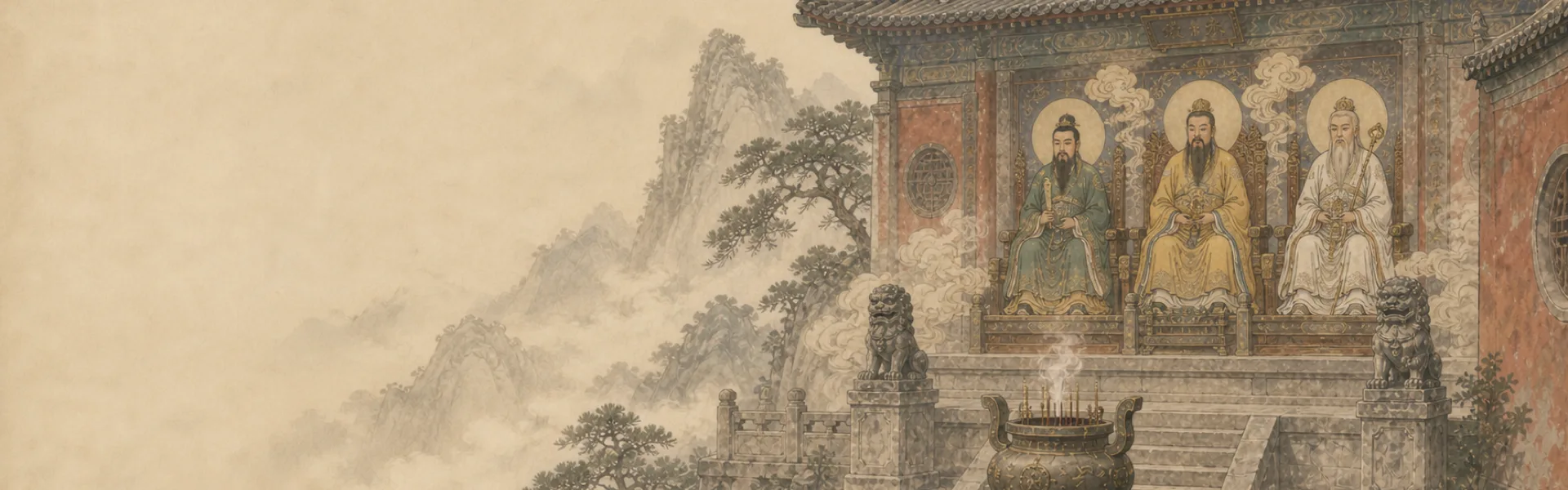
The problem they exist to solve
Start with the difficulty rather than the answer, because otherwise the Three Pure Ones look like an arbitrary invention.
The philosophical texts are emphatic that the Tao is not a being. It has no name, no form, no intentions and no preferences. It cannot be petitioned, thanked or bargained with, and the Laozi says so repeatedly. That is coherent as philosophy. It is unworkable as religion. A liturgy has to address something. An offering has to be made to someone. A written petition needs an addressee.
The Three Pure Ones are the religion's solution. They give the ultimate a form that ritual can approach, without collapsing it into an ordinary god with a personality and a temper. They are best described as the highest manifestations of the Tao rather than as three individuals — a way of making the formless addressable.
This is why they can feel abstract even to people who worship at their hall regularly. They are supposed to. A deity with a vivid biography and a specific portfolio is a different kind of thing, lower in the structure and closer to daily need.
The three, named
Each is a Celestial Worthy, and each is associated with one of the three highest heavens.
The Celestial Worthy of Primordial Beginning, Yuanshi Tianzun, is associated with the Jade Clarity heaven and with the undifferentiated origin — the state before distinction. He normally occupies the centre and is generally treated as the most senior.
The Celestial Worthy of Numinous Treasure, Lingbao Tianzun, is associated with the Upper Clarity heaven, with the ordering of the cosmos into pattern, and with the transmission of scripture. Where the first is origin, the second is structure and revelation.
The Celestial Worthy of the Way and its Virtue, Daode Tianzun, is associated with the Great Clarity heaven and with teaching in the human world. He is identified with Laozi in deified form, and is also very widely called the Most High Lord Lao. This is the figure who links the religion to the philosophical texts: the author of the Laozi, elevated into the highest tier of the pantheon.
Read as a sequence, the three describe a progression from origin, through the ordering of things, to instruction — which is also, not by accident, a description of how scripture is understood to reach the human world.
Telling them apart in a hall
Three near-identical seated figures are genuinely hard to distinguish, and guidebooks often get it wrong. A few reliable habits help.
Position is the most dependable indicator. The centre figure is normally Yuanshi Tianzun. Attributes are the next resort: Yuanshi is often shown with a pearl or with empty hands, Lingbao commonly holds a sceptre, and Daode Tianzun typically holds a fan and is the one shown as a visibly old man with a long white beard. Age is often the quickest cue, since the other two are usually depicted without obvious age.
Be aware that these conventions vary by region and period, and that restoration work has sometimes standardised or muddled them. If the attributes are ambiguous, the arrangement of the hall and any accompanying inscription are better evidence than the statues.
They are not a trinity, and not a family
The comparison to the Christian Trinity is made constantly and is worth resisting, because it imports assumptions that do not apply.
They are not three persons of one substance in the technical Christian sense, and no council ever defined their relationship. They are not father, son and grandson, though popular explanation sometimes talks that way. And the tradition has never spoken with one voice about how they relate to each other, because there was no authority capable of settling the question — a recurring feature of Taoism rather than an oversight here.
The usable formulation is the vaguer one: three manifestations of a single source, distinguished by function rather than by personality or descent. If that feels imprecise, the imprecision is in the tradition, not in the description of it.
How they entered the pantheon
The grouping is not original to early Taoism. The deified Laozi comes first, and by the Han dynasty the Most High Lord Lao was already a major figure. The other two emerge later, in the context of the great scriptural revelations of the fourth to sixth centuries, when the Shangqing and Lingbao traditions were producing new texts that needed divine sources of authority.
The three were then arranged as a set, with three matching heavens, and were placed above everything else. The names of the second and third heavens preserve the trace: Shangqing and Taiqing are the same terms as the scriptural traditions. In other words, the summit of the Taoist pantheon is partly a record of which textual lineages mattered when the hierarchy was being assembled.
This is a good illustration of a general point. The pantheon was not revealed complete. It was built up, and the order of construction is still legible if you know where to look.
What happens in the hall
Less than in busier parts of a temple, and that is not neglect. Major liturgy is conducted there, particularly the largest ceremonies, and the hall is the ritual anchor of the whole compound. But individual worshippers with specific requests generally go elsewhere, to the deity whose portfolio covers the matter.
If you do offer incense there, the ordinary procedure applies: three sticks, inserted with the left hand, into the burner that normally stands outside in the courtyard, so the sequence moves outward from the image rather than towards it. Enter by a side door, since the central axis belongs to the deity. Keep to the sides of the hall, do not linger directly in front of the offering table, and leave the exact-centre cushion alone — it is for the officiant. There is no circumambulation in Taoist practice; that is Buddhist.
The vocabulary that comes with them
The Three Pure Ones bring a set of technical words with them, and those words appear on plaques, in ritual texts and in explanatory signs at temples. Knowing roughly what they point at makes a great deal of Taoist material readable instead of opaque.
The word usually translated "heaven" in their titles is not a sky and not an afterlife destination in the Christian sense. It names a level of reality, and the system describes several such levels stacked above the ordinary world. Each of the three is associated with one of the highest of these. This is why the titles sound like addresses: they are addresses, of a kind. The structure is spatial because the people who built it thought in terms of ascent, and because the temple you are standing in is itself arranged as an ascent.
The word usually translated "primordial" or "original" marks something as belonging to the beginning rather than to the sequence of events that followed. It is a claim about priority, not about age in years. When a text says a figure is prior to heaven and earth, it is placing that figure outside the chain of cause and effect that the rest of the system describes, which is the same move being made by the arrangement of the three.
The word for the teaching or transmission that each of the three is said to have given out is the same word used for an ordinary lesson. This is deliberate and worth noticing. The system does not say that the highest reality acts; it says that it teaches, and that what descends from it is instruction. That is why the middle figure holds a scroll and the third figure is a teacher of doctrine. Revelation in this tradition takes the form of text, which explains why the Taoist canon became enormous and why possessing and transmitting texts mattered so much institutionally.
Finally, the character rendered "pure" in their collective name carries a sense closer to unmixed or unclouded than to morally clean. It describes a state without the turbidity that characterises the ordinary world. The same character appears in the name of one of the two great Taoist orders and in a large number of temple names, always with this sense. When you see it on a gate, it is making a claim about the condition of what is inside rather than about hygiene or virtue.
None of this vocabulary needs to be memorised to visit a hall. But it does explain why the explanatory boards read strangely in English translation. The translators are working with terms that have no close equivalents, and the usual English choices — heaven, primordial, pure, treasure — carry associations from an entirely different religion.
Recognising the pattern elsewhere
Once you have understood what the Three Pure Ones are doing, the same logic shows up throughout Chinese religion. Sets of three, five, nine and other structurally significant numbers appear repeatedly, and they generally encode relationships rather than recording history.
The practical benefit is diagnostic. When you meet an unfamiliar group of deities in a hall, the useful questions are how many there are, who is in the centre, and what each one is responsible for. Those three questions will usually get you further than trying to identify names from a list.
Key points
- The Three Pure Ones hold the highest rank in the pantheon and are the least involved in everyday requests, which is normal for a hierarchy.
- They exist because the Tao of the philosophical texts has no form and cannot be addressed, while liturgy requires an addressee.
- Yuanshi Tianzun is origin, Lingbao Tianzun is cosmic order and the transmission of scripture, Daode Tianzun is teaching in the human world.
- Daode Tianzun is the deified Laozi, also called the Most High Lord Lao — the point where the religion joins the philosophical texts.
- In a hall, position is the most reliable identifier; the centre is normally Yuanshi. Daode Tianzun is usually the visibly aged figure with a fan.
- They are not a trinity in the Christian sense and not a family. No authority ever fixed their relationship, and the tradition varies.
- Historically the deified Laozi came first; the other two emerged with the scriptural revelations of the fourth to sixth centuries.
- The names of the three heavens, Shangqing and Taiqing among them, preserve the textual traditions that shaped the hierarchy.
- Their hall anchors major liturgy but sees fewer individual petitions, which go to deities with relevant portfolios.
- Standard hall etiquette applies: side door, three sticks of incense inserted with the left hand into the courtyard burner, keep to the sides, no circumambulation.