Zhengyi Taoism and the Celestial Masters: Householder Priests and Ritual Authority
正一道与天师道:在家道士和科仪权威
The Celestial Masters tradition, known since the Tang dynasty as Zhengyi or Orthodox Unity, is where organised Taoism begins. It is also the half of Taoism least visible to outsiders, because its priests do not live in famous monasteries and its work happens in villages and private homes. If you want to understand what Taoism does for ordinary Chinese families, this is the tradition to understand.
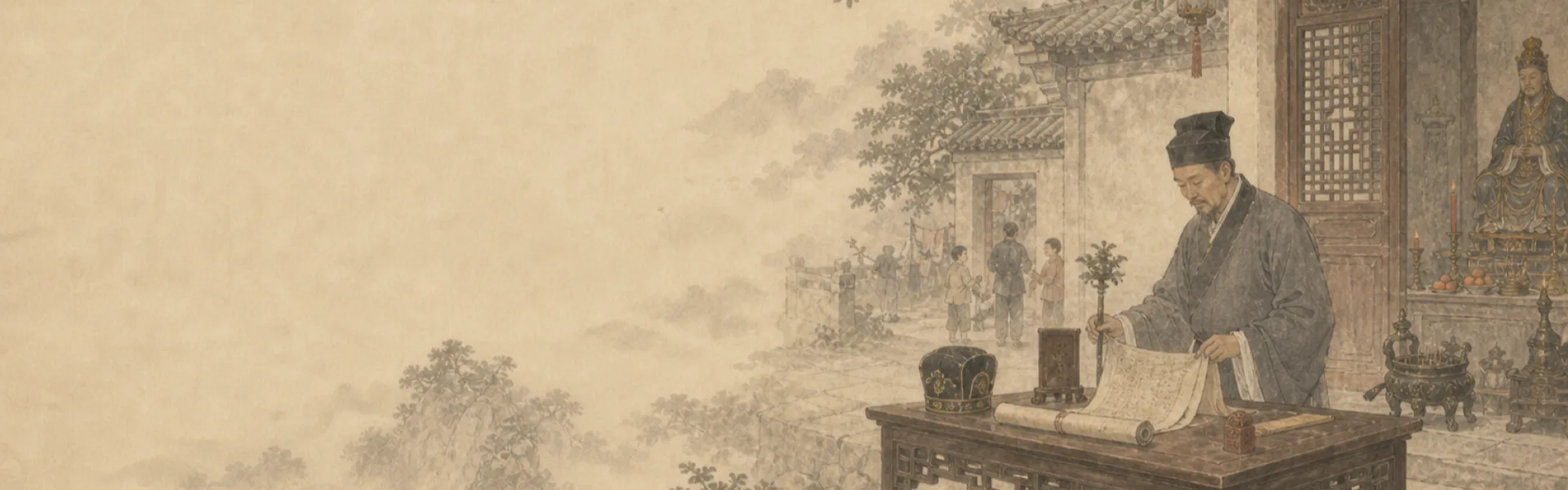
The founding of the Celestial Masters and their covenant
The conventional date is the middle of the second century, in what is now Sichuan. Zhang Daoling is said to have received a direct commission from the deified Laozi, establishing a covenant that gave him and his successors authority over the spirit world.
The word covenant is worth dwelling on, because it sets the tone for everything that follows. This was not presented as a philosophical insight or a mystical union. It was presented as an agreement conferring jurisdiction — a grant of authority, with terms. The name Orthodox Unity itself refers to that covenant rather than to any doctrine of unity in the philosophical sense.
The claim being made was also competitive. The covenant was understood to supersede the miscellaneous local spirit cults and unlicensed ritual practitioners of the region, bringing them under a single legitimate authority. From the very beginning, Taoism defined itself partly by declaring what was not legitimate.
How the early Celestial Masters governed communities
Under Zhang Daoling's son and grandson the movement became a functioning state in the mountainous region between Sichuan and the Han river valley, and it governed there for a generation before coming to terms with the warlord who would found one of the Three Kingdoms.
The details of that administration explain almost everything about later Taoist ritual. Member households contributed a fixed measure of grain, which gave the movement its popular name. Territory was divided into parishes, traditionally twenty-four, each under an appointed officer. Members were entered in registers. Roadside shelters offered food to travellers. There were rules about conduct, and penalties were often public works rather than punishment.
Most significantly, illness was understood as a consequence of moral fault. The remedy was to withdraw to a quiet chamber, reflect, and produce a written confession, which was then submitted in triplicate to the offices of Heaven, Earth and Water. That single practice is the origin of Taoism's documentary character: petitions composed, submitted through channels, and transmitted by burning. Everything from a village funeral to a grand offering ceremony is, structurally, a descendant of that confession.
From the Five Pecks of Rice to Zhengyi Taoism
The tradition did not stay in one place or one form. After the surrender of the theocratic state its adherents dispersed across China, and two important reworkings followed in the fifth century.
In the north, a Celestial Master obtained state adoption of Taoism under a northern dynasty, reforming the movement by removing the tax-like grain contributions and the sexual rites that had attracted criticism, and aligning it with court ritual. In the south, another figure undertook the editorial work of collecting and classifying scriptures, which laid the foundation for the Taoist canon and integrated the Celestial Masters material with the newer Shangqing and Lingbao revelations.
From the Tang onwards the name Zhengyi came to serve as an umbrella for the whole family of traditions based on talismans, registers and ritual command, as distinct from the meditative and alchemical currents. Under the Yuan the Celestial Master at Longhu was granted authority over Taoist affairs south of the Yangtze, which formalised the tradition's institutional position, and Ming policy continued in the same direction.
How registers and talismans confer Zhengyi authority
The technical core of Zhengyi practice is easy to state and explains why the tradition is organised as it is.
A register is a document, conferred at ordination, listing the divine officers and powers the holder is authorised to command. A talisman is a written or drawn instrument that applies that authority in a particular case. A petition is a formal document submitted upward. All three are paperwork, and all three depend on the holder having standing.
This is the crucial point. Ritual authority in Zhengyi is delegated, not personal. A priest does not act on charisma, spiritual attainment or sincerity; he acts on the basis of a document that specifies what he may lawfully summon. Higher ordination rank means a longer register and wider competence. It follows that ordination cannot be self-declared, that a claim to be a priest is in principle a checkable claim about records, and that someone without a register drawing talismans is, within this system, a person without office issuing official documents.
What rituals Zhengyi priests perform
What a Zhengyi priest is actually engaged to do falls into a few recognisable categories.
Offerings and grand ceremonies for a community, which may run for days and are historically funded by a village, guild or lineage rather than an individual. Funerary and salvation rites for the dead, which are the largest part of most priests' work. Consecration of buildings and images. Protective rites for a household, a boat, a shop or a village. And the resolution of afflictions understood as having a ritual cause — which is where the exorcistic and healing side of the tradition operates, in direct continuity with the second-century treatment of illness as fault.
The style is documentary and often loud. Chanting, percussion, formal patterned movement, seals, written petitions, and burning as the means of delivery. Much of the ritual grammar in use is inherited from the Lingbao tradition rather than being original to the Celestial Masters, which is a good example of how Taoism layers rather than replaces.
How Zhengyi householder priests live and serve
Zhengyi priests are not monks and this is the practical difference from Quanzhen. They may marry, live at home, hold ordinary employment and pass the role to a child. They are not celibate and are not required to be vegetarian, though they observe restrictions before major rites.
Transmission is frequently within a family, and the working library — ritual manuals, petition formats, musical notation — is often a family possession, handed down and sometimes closely guarded. A priest serves a defined community and is engaged when needed, which makes his position closer to that of a professional practitioner than of a monastic.
This arrangement has a consequence worth noting. Because his livelihood depends on being engaged again, a Zhengyi priest is subject to a very direct form of accountability: work badly and the community stops calling. That constraint does not come from a monastic code. It comes from making a living.
Zhengyi Taoism today
The tradition is very much alive, and in some regions it is the dominant form of Taoism in practice. It is strongest across southern China — Fujian, Jiangxi, Hunan, Guangdong — and in Taiwan and overseas Chinese communities, where household priests continue to conduct the ritual life of local temples and families.
Two honest qualifications. First, the hereditary succession to the office of Celestial Master has been disputed since the mid-twentieth century, when the incumbent left the mainland; more than one claim has been advanced and no arrangement is universally accepted. This site takes no position. Ordination at Longhu was suspended for a long period and has since resumed, and the gap means some current lineage claims cannot be traced through it.
Second, and importantly for anyone reading about Taoism, this tradition is under-documented relative to its actual importance. Its work is local, its manuals were often unpublished family property, and it produced far fewer famous names than monastic Taoism. The imbalance in the available literature reflects what was written down, not what mattered.
Key points about Zhengyi Taoism
The Celestial Masters tradition, later called Zhengyi or Orthodox Unity, is where organised Taoism begins, in second-century Sichuan.
Its founding claim was a covenant conferring authority over the spirit world — a grant of jurisdiction, not a philosophical insight.
The covenant was competitive, superseding local cults and unlicensed ritual practitioners.
The movement governed territory for a generation, with grain contributions, parishes, appointed officers, registers of members and roadside shelters.
Illness was treated as moral fault, remedied by written confession submitted to the offices of Heaven, Earth and Water — the origin of documentary ritual.
Fifth-century reworkings in the north and south removed contested practices and began the editorial work that produced the Taoist canon.
From the Tang, Zhengyi served as an umbrella for the talisman-and-register traditions, and the Yuan granted its Celestial Master authority south of the Yangtze.
A register lists the divine officers a priest may command; talismans and petitions apply that authority. Ritual power is delegated, not personal.
Ordination therefore cannot be self-declared, and a claim to priesthood is in principle checkable against records.
The repertoire covers grand offerings, funerary rites, consecration, protective rites and the resolution of ritually caused afflictions.
Priests may marry, live at home, work ordinary jobs and pass the role to a child; ritual manuals are often family property.
Their accountability is economic — poor work means no further engagements — rather than monastic.
The tradition is strongest in southern China, Taiwan and overseas communities, and is under-documented relative to its importance.
The hereditary succession has been disputed since the mid-twentieth century; this site takes no position on competing claims.