Taoist Ordination and Lineage Today: How Transmission Is Verified
今日道教传承与授箓传戒:如何核实师承
Taoism has no pope, no synod and no central body that can certify a teacher as orthodox. What it has instead is lineage: a documented line of transmission from a master to a disciple, recorded in a ceremony and, in the Zhengyi case, in an actual certificate. Everything that functions as a credential in Taoism is a form of that record.
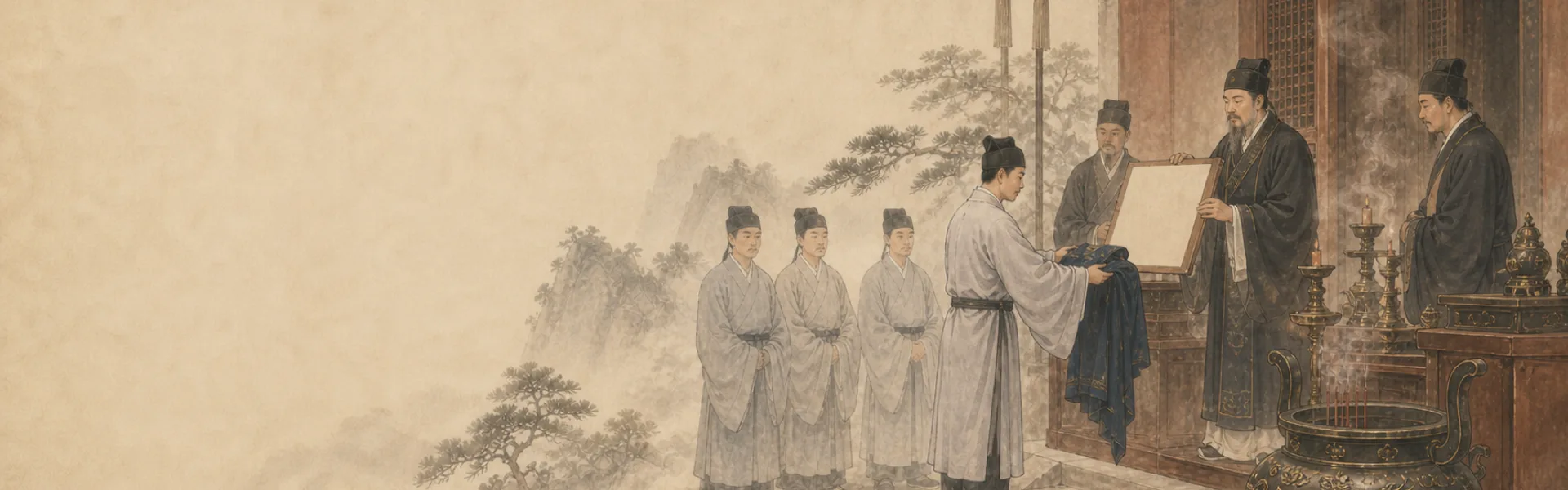
This page describes how transmission and ordination actually work now, in the early twenty-first century, rather than how they worked in the Ming. That distinction matters more here than on most pages of this site, because the twentieth century interrupted Taoist transmission severely, and a great deal of what exists today was rebuilt within living memory.
Why lineage is the central Taoist credential
In a tradition without a doctrinal court, the question "is this person a real Taoist priest?" cannot be answered by examining their beliefs. It is answered procedurally: who ordained them, in which lineage, at which temple, and is there a record. This is why Taoist biography is so preoccupied with naming teachers, and why generation poems exist — a poem whose characters are assigned one per generation, so that a monk's religious name encodes his position in the line.
The practical consequence is that authority in Taoism is delegated rather than personal. A priest performing a ritual is not acting on his own charisma; he is exercising a commission. He announces his lineage and his rank in the ritual itself, because the document is part of what makes the ritual effective in the tradition's own terms.
It also means that lineage claims can be checked, at least in principle. A person who cannot say who ordained them, where, and when, has not been ordained. That is a low bar, but it eliminates a surprising amount of confusion.
How the twentieth century disrupted Taoist transmission
Any honest account of modern Taoist transmission has to begin with the fact that it stopped for a period. From the 1950s onward, and most severely from 1966 to 1976, monasteries across mainland China were closed or converted to other uses, clergy were returned to lay life or dispersed, ordinations ceased, and manuscripts were destroyed or hidden. The Zhengyi ordination centre at Mount Longhu did not conduct public ordinations for decades. Quanzhen transmission of the precepts stopped as well.
Reopening began in the late 1970s and accelerated through the 1980s. The Chinese Taoist Association, founded in 1957, resumed operation; temples were returned, often as protected cultural relics before they were returned as places of worship; and a small number of elderly clergy who had survived became the link across the gap. Public ordination resumed at Mount Longhu in the 1990s, and Quanzhen precept transmission was revived at White Cloud Temple and elsewhere.
The reconstruction was real but uneven. Some lineages were carried through intact by a handful of people. Others were reassembled from manuscripts, from the memory of laypeople who had attended rituals, or from related traditions in Hong Kong, Taiwan and Southeast Asia where continuity had not been broken. In some cases the honest description is that a practice was restored rather than transmitted.
This is why a temple's antiquity tells you very little about the continuity of what happens inside it. A hall built in 1413 may house a lineage that was interrupted for thirty years and rebuilt from documents. Both facts can be true, and neither is a scandal; but conflating them produces a false picture.
Guanjin and chuanjie: the Quanzhen ordination route
Becoming a Quanzhen monastic today normally follows a sequence. A candidate first stays at a monastery as a guest, without status, for a period that may run from months to years. This is deliberate: it allows both sides to find out whether the arrangement will work, and it filters out people attracted by an idea of monastic life rather than its actual daily content.
If accepted, the candidate takes a master within the monastery and undergoes guanjin — the capping ceremony, in which the hair is bound up and the cap conferred. This is the formal entry into clerical status. A religious name is given, usually drawn from the lineage's generation poem. From this point the person is a Taoist monk or nun in the ordinary sense, wears clerical dress, and takes on monastery duties.
The higher step is chuanjie, the transmission of the precepts. Historically this was codified in the seventeenth century by Wang Changyue at White Cloud Temple in Beijing, who conducted large-scale ordinations and put the Longmen lineage's procedure into writing. The precepts are transmitted in three grades — the Initial Perfection precepts, the Middle Ultimate precepts and the Great Precepts of Celestial Immortality — over a retreat lasting weeks, with instruction, examination and a public ceremony. Modern revivals have been held periodically since the 1990s, with candidates drawn from monasteries across the country.
Precept transmission is not a licence to perform rituals; that comes from training and from appointment to monastery office. It is closer to full membership: a formal statement that this person has received the tradition's ethical and doctrinal core and stands in the line.
Shoulu: the Zhengyi ordination route
For householder priests in the Zhengyi tradition, the decisive procedure is shoulu — the conferral of a register. The register is a document. It names the rank conferred, and it lists the celestial officials and spirit generals that the holder is thereby authorised to summon in ritual. Its authority comes from the line that issues it, not from the recipient's personal attainment.
The seat of this system is Mount Longhu in Jiangxi, the ancestral centre of the Celestial Masters lineage. Registers are graded, traditionally described in a series of ranks, and advancement depends on years of service and a record of rituals actually performed. Candidates are typically already practising as priests, trained within a family or a local altar, and come to Longhu to have that practice formally recognised.
Because the register is a document, it can be produced. This is the single most useful fact for anyone trying to evaluate a claim: a Zhengyi priest of rank has papers, and there is no tradition of concealing them. Ordination ceremonies at Longhu are public, reported, and photographed.
One complication should be stated plainly. The hereditary succession of the Celestial Master title has been disputed since 1949, when the sixty-third holder left the mainland for Taiwan. Competing claims exist, involving Taiwan-based lines and mainland institutional arrangements. This site takes no position on that dispute, and readers should be aware that sources on modern Zhengyi ordination often argue for one side of it without saying so.
What Taoist colleges and certificates do—and do not—prove
Three separate systems are routinely confused, and separating them saves a great deal of trouble.
The first is lineage transmission — guanjin, chuanjie, shoulu. This is religious, internal to the tradition, and is what makes someone a priest.
The second is academic study. Taoist colleges operate in mainland China, the largest at Mount Qingcheng and in Beijing, teaching scripture, ritual, music, history and general subjects. They award educational qualifications. A graduate of a Taoist college is not thereby a priest, and a priest need not have attended one.
The third is state registration. Religious personnel in mainland China are registered with the relevant authorities through their national association, and hold identity documents in that capacity. This is an administrative permission to serve in a registered venue. It is not a judgement about spiritual attainment, and it does not exist at all in Taiwan, Hong Kong or overseas in the same form.
A senior monastic will usually have all three. A village priest in Fujian may have the first and third but not the second. Someone teaching Taoist practice in Europe may have none of them, and may still have received a genuine transmission privately — or may have received nothing.
How Taoist transmission works outside mainland China
Continuity outside mainland China followed different paths. In Taiwan, both Zhengyi and Quanzhen traditions continued without the mid-century interruption, and Taiwanese temples and priests became an important resource for reconstruction on the mainland after the 1980s. Taiwanese Zhengyi practice is unusually well documented, partly because it was accessible to researchers during decades when the mainland was not.
Hong Kong developed a distinctive institutional form, with large lay-managed temple organisations combining worship, charity, schools and clinics. Southeast Asian Chinese communities, particularly in Singapore, Malaysia and Indonesia, maintained temple networks and ritual specialists, often with strong regional colouring from the Fujianese and Cantonese communities that founded them.
Western Taoism is a separate phenomenon and should not be mistaken for a branch of the above. Most of what is taught in Europe and North America under the name of Taoist practice descends from twentieth-century qigong, from martial arts lineages, or from Wu-Liu internal alchemy texts in translation, rather than from ordained clergy. Some Western teachers do hold real transmissions; many do not; and the vocabulary is identical in both cases.
How to evaluate a Taoist teacher and lineage claim
This site does not endorse teachers or schools, and cannot, because no accreditation system exists that would make such an endorsement meaningful. What can be offered is a short list of things that are checkable and a warning about what is not.
Checkable: the name of the ordaining master and the temple; the year and place of ordination; whether the person is resident at a registered temple; whether a register or precept certificate exists; whether the lineage they name is one that historians recognise. None of this requires special access — most of it can be established by asking directly, and a straightforward answer is itself informative.
Not checkable, and worth treating with caution: claims of secret transmission that leave no record; claims to a title that no institution confirms; genealogies that reach an ancient founder without intermediate names; and any assertion that the tradition's real teaching is unavailable through ordinary channels. Secrecy has a legitimate place in Taoist practice, but it is not evidence.
The uncomfortable conclusion is that lineage and teaching quality are close to independent variables. Because transmission was interrupted, a person with impeccable papers may have learned relatively little, and a person with no papers may have been taught carefully by a surviving practitioner who never regularised their own position. Documents tell you about standing within an institution. They do not tell you whether someone is a good teacher, and no one should pretend otherwise.
Sources and limits. This page draws on published accounts of precept transmission at White Cloud Temple, reports of ordination ceremonies at Mount Longhu, the public regulations of national Taoist associations in mainland China and Taiwan, and academic studies of the reconstruction of Chinese religion after 1978. It provides no practice instructions, endorses no teacher or school, and takes no position on disputed successions.
Key points about Taoist ordination and transmission
Taoism has no central doctrinal authority; lineage — a documented line of transmission — is the only credential the tradition recognises.
Authority is delegated rather than personal: a priest exercises a commission and announces his lineage and rank within the ritual itself.
Transmission on the mainland was severely interrupted from the 1950s to the 1970s; ordinations resumed at Mount Longhu and White Cloud Temple from the 1990s.
Reconstruction was uneven. Some lineages passed through intact; others were restored from manuscripts or from unbroken traditions in Taiwan, Hong Kong and Southeast Asia.
The Quanzhen route runs from a probationary stay, through guanjin (capping) to chuanjie (transmission of the precepts in three grades).
The Zhengyi route centres on shoulu, the conferral of a graded register at Mount Longhu — an actual document that names the ranks and spirit officials commissioned.
Lineage transmission, Taoist college qualifications and state registration of religious personnel are three separate systems and are routinely confused.
The Celestial Master succession has been disputed since 1949; this site takes no position, and many sources argue one side without saying so.
Because transmission was broken, lineage and teaching quality are close to independent variables. Papers indicate institutional standing, not competence.