The Wu-Liu School: A Clearer System of Taoist Internal Alchemy
伍柳派:较为清晰的道教内丹体系
Wu-Liu is not an ancient school. It is a late one — Ming and Qing rather than Tang or Song — and it matters for a reason that has nothing to do with antiquity. It is the point at which internal alchemy was written down clearly. Earlier alchemical literature is deliberately obscure, and Wu-Liu set out to explain in ordinary language what the older texts had hidden. Most modern accounts of Taoist inner cultivation, including a great deal of what circulates in English, descend from this school whether or not they know it.
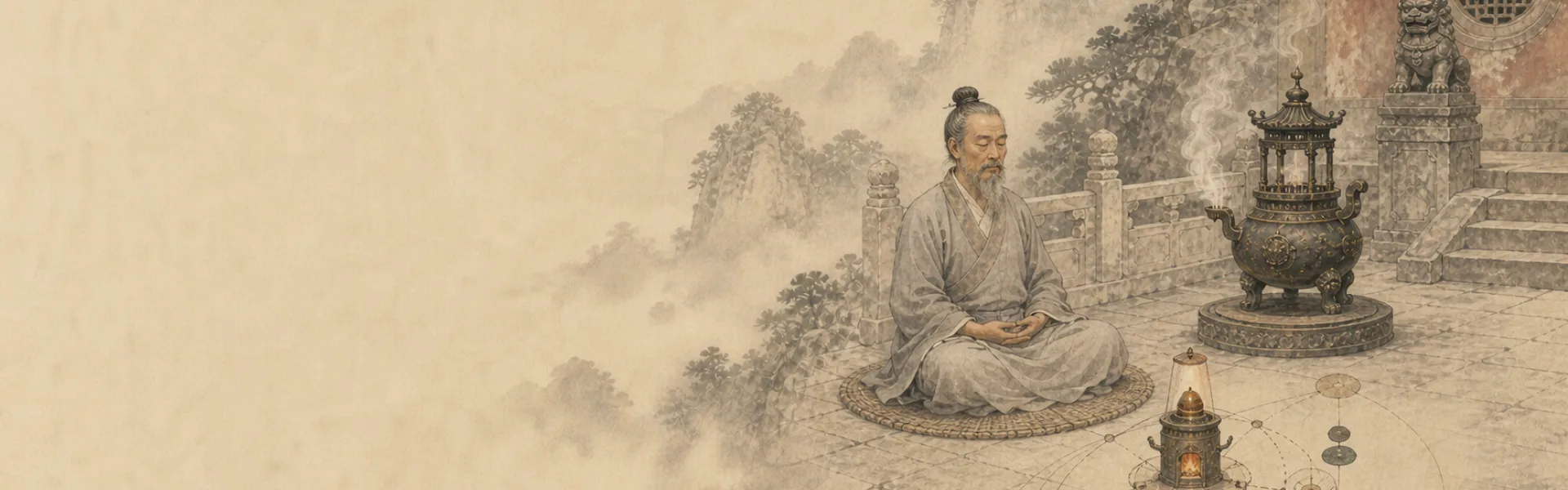
Wu Shouyang and Liu Huayang, founders of the Wu-Liu School
The school is named for two writers who never met, separated by roughly a century and a half.
Wu Shouyang was born in 1573, in Jiangxi, and trained within the Longmen branch of Quanzhen. He held office briefly, left it, and spent his life on cultivation and writing. His works set out the internal alchemical process as a sequence of definite stages with stated criteria for each, which was itself a departure: he treated the subject as a technical discipline that could be described.
Liu Huayang was born in the eighteenth century and came to the material from the other direction. He was a Buddhist monk who found the meditation instruction available to him incomplete, sought out Taoist teaching, and then wrote to reconcile the two. His books are more explicit than almost anything before them, and openly use Buddhist terms for Taoist stages.
Neither man founded an organisation. The pairing of their names into a single school came later, when their writings were published together in the late nineteenth century, and it is best understood as an editorial rather than an institutional event. There is no Wu-Liu temple, no Wu-Liu ordination and no Wu-Liu clergy.
What Taoist internal alchemy means in plain terms
Some background is needed, because the vocabulary is the main obstacle.
Early Taoist alchemy was external. Practitioners worked with minerals — cinnabar, lead, mercury — in furnaces, seeking a compound that would transform the body. It was a genuine chemical enterprise, and it was dangerous; a number of its ingredients are poisonous, and this was noticed.
Internal alchemy relocated the entire operation inside the body and reinterpreted the mineral vocabulary as metaphor. The furnace, the cauldron, the lead and mercury, the firing schedule — all were retained as terms and reassigned to internal referents. The body became the vessel; breath, attention and the vital basis of the organism became the materials; and the regulation of practice over time became the fire.
This is why the literature reads so strangely. It is describing meditation and breath work in the technical language of a metallurgical process, on purpose. Once you know the substitution has taken place, the texts become much less impenetrable — though not, as the next sections explain, straightforwardly usable.
The three stages of Wu-Liu internal alchemy
Wu-Liu's contribution was to lay out the process in orderly stages with described transitions. The standard formulation names three transformations, preceded by a preparatory phase.
The preparatory phase — laying the foundation — is concerned with health, regularity, the calming of the mind, the reduction of dissipation, and the repair of ordinary damage. The tradition insists this is not optional and that most failures occur through skipping it.
Then the three transformations: refining the generative basis into energy; refining energy into spirit; and refining spirit back into the undifferentiated. The scheme is deliberately parallel to a smelting sequence, with each stage taking a coarser substance and producing a finer one. Associated with these are the circulation of energy along described pathways, the passage of specific points along the spine, and criteria said to mark the completion of each stage.
Two honest observations. First, this scheme is a map, and different lineages draw the map differently; the neat three-stage version is itself a simplification produced by writers trying to be clear. Second, the descriptions of what should be experienced at each stage are traditional claims, and this site reports them as claims rather than endorsing them as physiology.
How Wu-Liu combined Taoist and Buddhist ideas
The second half of the school's character is its explicit reconciliation of Taoist alchemy with Buddhist meditation, and this is where Liu Huayang's contribution is decisive.
His argument was that the two traditions describe the same process in different languages, and that each has a defect the other repairs: Buddhist meditation, in his account, attends to mind and neglects the physical basis, while Taoist alchemy attends to the physical basis and can lose sight of the final emptiness. He therefore used Buddhist terms for the later stages and Taoist terms for the earlier ones, and argued that the culmination is the same.
This was contentious and remains so. Practitioners on both sides have objected that the identification is too quick and that it flattens real differences in aim — release from rebirth is not the same goal as transcendence in a refined body. What is not in dispute is the influence: the blended vocabulary became standard in later cultivation writing, which is why so much modern material moves freely between Taoist and Buddhist terms.
Why Wu-Liu used plain language and why that was debated
Earlier alchemical texts are obscure by design. Key steps are omitted, substitutions are unexplained, and warnings replace instructions — because the missing parts were transmitted orally by a teacher, and because the tradition held that unsupervised practice was dangerous and that unqualified recipients would misuse it.
Wu-Liu broke with this. Both writers state that excessive secrecy had caused more harm than disclosure, that sincere practitioners were being lost for want of clear explanation, and that they intended to say what others had concealed. Their books consequently contain the plainest descriptions of internal alchemical stages in the classical literature.
The counter-argument, made at the time and since, is that clarity on paper is not the same as competent transmission. A written description allows a reader to believe they are following a method when they are not, and internal work carried out on a misreading is understood within the tradition to carry real risk — of physical strain, of psychological disturbance, and of persistent error. It is worth noting that even Wu-Liu's plain texts assume a teacher, and say so.
How Wu-Liu teachings reached the modern world
The school's influence outside Taoism is much larger than its size would suggest, and the route is traceable.
Its writings were collected and printed together at the end of the nineteenth century, which made them accessible at exactly the moment printing was cheap and interest in self-cultivation was rising. One of Liu Huayang's works was translated into a European language in the early twentieth century and circulated alongside another Taoist text in an edition that reached a wide Western readership, largely through the interest of psychologists rather than religious scholars. Later, the twentieth-century qigong movement drew heavily on this material, and much of what is presented today as generic Taoist energy practice is Wu-Liu vocabulary at one or more removes.
This matters for a reader trying to get oriented. When a modern book describes stages of refining essence into energy and energy into spirit, it is not reporting a universal Taoist consensus. It is reporting one late, unusually articulate school, whose clarity gave it disproportionate influence on what the world now takes Taoist cultivation to be.
How this guide presents Wu-Liu teachings
Three things should be stated directly.
This site describes internal alchemy historically and structurally. It does not provide instructions, and it does not present traditional claims about physiological effects as established fact. The tradition itself holds that this material requires personal transmission and supervision, and the honest position is to say so rather than to supply a method a reader might attempt alone.
Nor does this site endorse teachers or schools. There is no accreditation system for internal cultivation, lineage claims cannot always be verified because twentieth-century disruption broke transmission in many places, and lineage and teaching quality are in any case close to independent variables. Where a claim about method or lineage cannot be checked, this site says that it cannot be checked.
Key points about the Wu-Liu School
Wu-Liu is a late school, Ming and Qing, and matters because it wrote internal alchemy down clearly rather than obscurely.
Wu Shouyang, born 1573, trained in the Longmen branch of Quanzhen and described the process as definite stages with criteria.
Liu Huayang, an eighteenth-century Buddhist monk, sought out Taoist teaching and wrote to reconcile the two traditions.
The two never met. Their pairing into a school came from a late nineteenth-century joint publication; there is no Wu-Liu temple or ordination.
Early Taoist alchemy was external and worked with minerals, several of which are poisonous.
Internal alchemy relocated the operation inside the body and reinterpreted the mineral vocabulary as metaphor, which is why the texts read strangely.
The scheme has a preparatory foundation phase, then three transformations: generative basis to energy, energy to spirit, spirit back to the undifferentiated.
The tradition insists the foundation phase is not optional and that most failures come from skipping it.
The neat three-stage map is itself a simplification, and descriptions of stage experiences are traditional claims, not physiology.
Liu Huayang argued Taoist and Buddhist practice describe one process, each correcting the other's defect; this remains contested.
The blended vocabulary became standard, which is why modern cultivation writing moves freely between Taoist and Buddhist terms.
Wu-Liu deliberately broke with secrecy, arguing that concealment had cost more than disclosure.
The counter-argument is that clarity on paper is not transmission, and even these plain texts assume a teacher.
Late nineteenth-century printing, an early twentieth-century European translation, and the modern qigong movement carried the school's vocabulary worldwide.
This site describes the material historically, provides no instructions, endorses no teachers, and states plainly where claims cannot be verified.