Quanzhen Monastics and Zhengyi Householder Priests: What Is the Difference?
全真出家道士与正一在家道士有什么不同
Taoism has two kinds of clergy, and the difference between them is one of the most useful things a newcomer can learn. It is not a difference of belief. It is a difference in how a religious specialist lives, how he trains, how he is paid, and what he does for other people. Getting this clear removes a great deal of confusion, including most of the confusion about who is and is not a Taoist priest.
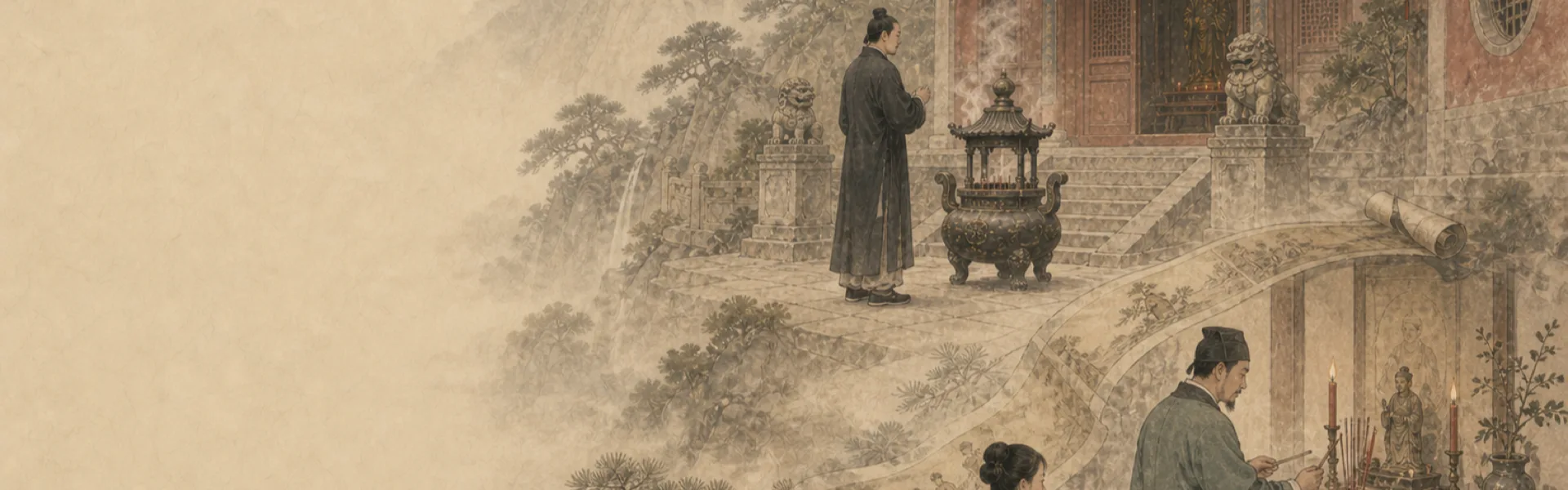
Quanzhen monastics and Zhengyi householders: two ways of life
Quanzhen clergy are monastic. They are celibate, vegetarian by rule, resident in a temple, and organised communally under a written code. They do not marry, do not have families to support, and hold their position for life.
Zhengyi priests are householders. They may marry, live in their own homes, hold ordinary employment, and pass the role to a child. They are not celibate and are not required to keep a vegetarian diet, though they observe restrictions before major rites. A common regional term for them translates roughly as hearth-dwelling priests, which captures the arrangement neatly.
Both are fully legitimate and both are ancient in their own terms — the householder pattern goes back to the second-century origins of organised Taoism, while the monastic pattern was introduced in the twelfth century. Neither is a reform or a decline of the other. They are two answers to the question of how someone whose work is religion should be positioned in society.
What Quanzhen monastic life involves
Less mystery and more timetable than most visitors expect. A Quanzhen monastery runs to a schedule: morning and evening services with scripture recitation, meals at fixed hours in a refectory, and work between them.
The work is ordinary. Cleaning, repair, cooking, gardening, receiving visitors, keeping accounts, dealing with the secular administration where a temple sits inside a managed site. Individual practice — meditation, study, breath work — occupies what remains, and on a busy mountain there may be less of it than an outsider imagines.
Seniority governs seating, precedence and order of movement, and it derives from ordination and length of residence rather than from age. Appearance follows the code: hair grown long and coiled under a cap, plain blue or black gowns for everyday wear, embroidered vestments only for ritual. The person sweeping a courtyard in a plain gown and the person in elaborate robes at a ceremony are frequently the same person.
The commitment is total in a specific sense: the monastery is the residence, the workplace, the community and the economic support all at once. Leaving means leaving all of them.
What life as a Zhengyi householder priest involves
A very different shape. He lives at home, often in the community he serves, and much of the time he is not functioning as a priest at all. He may farm, teach, run a business or work a trade. Then he is engaged for a specific occasion, prepares, performs, and returns to ordinary life.
Preparation is not trivial. Before a major rite there is fasting, bathing, abstention and the assembly of materials, and during the ritual period the restrictions on him may be stricter than a monastic's ordinary rule. The difference is that his discipline is episodic rather than continuous.
His working equipment is a library: ritual manuals, petition formats, talisman patterns, musical notation and lists of divine names. These are often family property, inherited, sometimes annotated by several generations, and sometimes closely guarded. For many lineages the manuscripts are the most valuable thing the family owns, and their loss is the end of the lineage's competence.
How Quanzhen and Zhengyi training and ordination differ
Both traditions require formal, recorded transmission, but the mechanisms differ.
The Quanzhen path runs through residence. A candidate enters a temple, lives there, works, studies, and after a period receives an initiation marking formal entry into the clergy. Later, and often years later, comes precept transmission — graded, in stages, conferred at a monastery authorised to do it, historically the great ordination centres. The precepts govern conduct, and rising through the grades is a matter of both training and standing.
The Zhengyi path runs through registers. A candidate trains under a master, usually a relative, and is ordained by the conferral of a register: a document listing the divine officers and powers he is authorised to command, together with a rank. Higher rank means a longer register and wider ritual competence. This has historically been tied to the Celestial Master's seat.
The shared principle is worth stating. In both traditions, ordination is a documented act with a recognised conferring authority. It is not a self-description, not a matter of inner conviction, and not something a person can acquire by study alone. A claim to be a Taoist priest is in principle a claim about records.
How Quanzhen monastics and Zhengyi priests are supported
This is rarely discussed and explains a lot.
A monastery is supported collectively: donations, temple income, historically land and endowments, and at managed sites an arrangement with the secular administration. The individual monastic has no personal income from ritual work, which is why donation boxes are voluntary and unattended and why the temples themselves charge nothing for worship. The economic unit is the institution, not the person.
A householder priest is paid for services. He is engaged, he performs, he is compensated, and that is how his family eats. This is entirely proper within the tradition and has been for eighteen centuries.
The consequence is a different accountability structure. A monastic answers to a code and to a community he cannot easily leave. A householder answers to a market: perform badly and the village stops calling. Neither mechanism is obviously superior, and both have visible failure modes — institutional complacency on one side, commercial pressure on the other.
One clarification for visitors. Where selling appears at a temple site, it is very often not the clergy at all. Leased commercial concessions carry revenue targets without monastic accountability, which is the structural reason selling tends to concentrate exactly where religious authority does not. Anyone offering paid religious services outside a site's registered framework has no standing to do so.
How Quanzhen and Zhengyi serve their communities
Monastics maintain places. They keep temples running, conduct the daily and calendrical liturgy, preserve scripture and transmission, receive pilgrims and visitors, and hold the institutional memory. They are the reason a mountain still has functioning halls.
Householders serve families. They are engaged for funerals and rites for the dead, for the consecration of buildings and images, for protective rites for a household or a boat or a shop, and for community offerings. In much of southern China this is the form of Taoism ordinary families actually meet, and it is a good deal less documented than monastic Taoism precisely because it happens in villages and homes rather than in famous institutions.
The available literature is therefore skewed. Monastic Taoism produced famous names, printed texts and imperial records; householder Taoism produced unpublished family manuscripts. The imbalance in what you can read reflects what was written down, not what mattered.
How to distinguish the two and why it matters to visitors
At a mountain temple such as Wudang, the clergy you meet will overwhelmingly be Quanzhen. Recognise them by the coiled hair under a cap, the plain daily gown, and the fact that they are engaged in the temple's work. Address them as daozhang — never shifu, which implies a teaching relationship you are not in, and never the Buddhist fashi.
Householder priests are not usually encountered as temple staff. You would meet one at a funeral, a village ceremony or a local temple festival, and he may be dressed in ordinary clothes until the ritual begins.
The practical warning is the same one that applies across this site. Clothing proves nothing. Martial arts students frequently wear Taoist-style gowns as training dress, and this is the single commonest source of misidentification at Wudang. Judge by behaviour and setting. And bear in mind that the twentieth century broke transmission in many places, ordination was suspended for long periods, and records were lost — so some claims made today cannot be verified from surviving records, while lineage and teaching quality remain close to independent variables.
Key points about Quanzhen and Zhengyi clergy
Taoism has monastic clergy, Quanzhen, and householder priests, Zhengyi. The difference is in how they live, train, earn and serve, not in belief.
Quanzhen clergy are celibate, vegetarian by rule, temple-resident and communally organised under a written code.
Zhengyi priests may marry, live at home, hold ordinary jobs and pass the role to a child.
The householder pattern dates from the second-century origins of organised Taoism; the monastic pattern was introduced in the twelfth century.
Monastic daily life is a timetable of services, fixed meals and ordinary work; seniority follows ordination and residence, not age.
A householder's discipline is episodic — strict before major rites, ordinary in between — and his working library of manuals is often inherited family property.
Quanzhen ordination runs through residence and graded precept transmission; Zhengyi ordination confers a register naming the powers a priest may command.
In both, ordination is a documented act by a recognised authority, never a self-description.
Monasteries are supported collectively, so individual monastics have no ritual income and temples charge nothing for worship.
Householder priests are paid for services, which is entirely proper and has been for eighteen centuries.
Accountability differs: a code and a community for one, a local market for the other, each with its own failure modes.
Selling at temple sites is often by leased concessions with revenue targets and no monastic accountability, not by clergy.
Monastics maintain places and institutional memory; householders serve families, and their work is under-documented relative to its importance.
At Wudang expect Quanzhen clergy; address them as daozhang, and never read a Taoist-style gown as evidence of ordination.