Lingbao Taoism: Numinous Treasure Scriptures and Communal Ritual
灵宝道:经典、普度与共同体科仪
Lingbao, Numinous Treasure, is the tradition most visitors to a Chinese temple encounter without ever hearing its name. It no longer exists as an institution, but if you watch a major Taoist ceremony anywhere in the world today, the structure of what you are watching is largely Lingbao. It supplied the liturgy, the documentary form of ritual, and the idea that salvation is something conducted on behalf of everyone rather than achieved by an individual.
How Lingbao differed from Shangqing Taoism
Lingbao appeared at almost the same time as Shangqing, in the same part of southern China, among the same kind of educated families — and it went in the opposite direction on the question that matters most.
Shangqing turned inward: the practitioner works alone, visualising deities inside the body, on an individual path to transcendence. Lingbao turned outward: priests conduct large-scale ceremonies on behalf of communities, addressing the celestial hierarchy through formal written petitions, for the benefit of the living and the dead together.
Neither displaced the other, and this is one of the clearest illustrations of how Taoism handles disagreement — by keeping both. Later Taoism does inner cultivation with Shangqing's vocabulary and public liturgy with Lingbao's grammar, and sees no contradiction in a single priest doing both.
Where the Lingbao scriptures came from
The Lingbao corpus emerged around the turn of the fifth century and was attributed to a descendant of Ge Hong, the fourth-century writer on alchemy and transcendents. The claim was that ancient talismans and scriptures, transmitted within the family, were now being brought to light.
Modern scholarship treats the corpus as substantially composed at the time it appeared, drawing on older material. That does not make it fraudulent in the way a modern forgery would be. The convention throughout this period was that authority came from antiquity and from revelation, so new scriptures were presented as recovered rather than written. The Shangqing corpus was presented the same way, and so were many Buddhist texts produced in China.
The name itself is informative. Numinous Treasure refers to the scriptures and talismans as objects of power — not merely information but instruments. This matters for understanding Taoist attitudes to texts: a scripture is handled with both hands, kept properly, and transmitted formally, because it is closer to a seal of office than to a book.
How Buddhism influenced Lingbao Taoism
Lingbao borrowed extensively from Buddhism, which had by then been established in China for several centuries, and the borrowing is worth naming rather than glossing over.
What came across includes: vast cycles of cosmic time replacing a single creation; the idea that merit can be generated and transferred to others; salvation extended to all beings rather than to the practitioner; formal vows undertaken for the benefit of others; and a good deal of the vocabulary and cadence of scripture itself. Some Lingbao passages closely parallel Buddhist ones.
Two things should be said about this. First, the traffic went both ways over the centuries, and Chinese Buddhism absorbed a great deal of Taoist and indigenous material in return. Second, the borrowing was structural rather than superficial: Lingbao did not add Buddhist decoration to a Taoist core, it adopted a Buddhist conception of what religion is for and executed it with Taoist means — talismans, registers, petitions and a celestial bureaucracy.
Universal salvation in the Lingbao tradition
The central Lingbao idea is that ritual can be performed for the benefit of all beings, including the dead, including those nobody remembers, and including those with no descendants to care for them.
This transformed the social function of Taoist priesthood. A tradition centred on individual transcendence has little to offer a village that has just lost people in a flood. A tradition centred on universal salvation has a great deal to offer, and can be commissioned to provide it. From this point onwards the Taoist priest becomes a figure a community engages at scale, and the great offering ceremonies — funded by villages, guilds and lineages rather than individuals — become possible.
The consequences are still visible in the calendar. The seventh lunar month's rites for the dead, including offerings for the unremembered and the badly deceased, are Lingbao logic operating in ordinary practice fifteen centuries later. So is much of what a Zhengyi priest is engaged to do at a funeral.
How Lu Xiujing organised the Taoist canon
As with Shangqing, the tradition was made usable by an editor. In the fifth century Lu Xiujing collected and arranged the Lingbao scriptures, established which were authentic, and — more consequentially — devised a classification of the whole of Taoist literature into three main divisions.
That threefold scheme became the organising principle of the Taoist canon, and its top division is named for Shangqing while the second is named for Lingbao. So the canon's very structure preserves a fifth-century judgment about the relative standing of two traditions, which is a good example of how institutional decisions fossilise into apparently neutral categories.
Lu Xiujing also systematised the purification and fasting rites, producing graded schemes of observance. This is where the paired vocabulary of Taoist ritual gets its shape: preparatory purification followed by the grand offering. Almost every large Taoist ceremony still runs on that structure.
The Lingbao ritual grammar still visible today
If you attend a major Taoist ceremony, most of what you observe is Lingbao inheritance, and knowing that makes it legible.
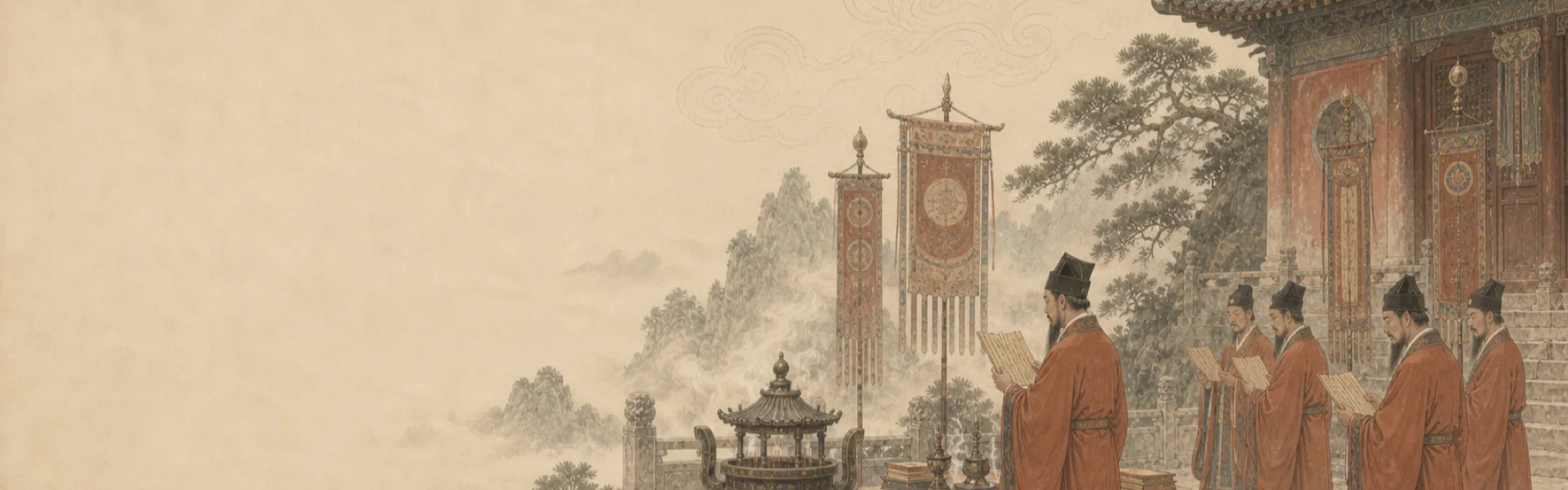
A ritual area is established and purified. A principal officiant works at the centre of the axis, with assistants at defined positions. Documents are composed, held with both hands, read aloud, and burned to transmit them. Seals are used to validate. Chanting proceeds to percussion, with wind and string instruments. Movement follows prescribed paths, and specific footwork carries technical meaning that is not explained to onlookers. Vestments are elaborate and colour-coded by role. The sequence works through purification, invitation, presentation, and dismissal.
This is why the etiquette for observers takes the form it does. No flash, no video with sound, and nothing photographed from the front along the axis past the officiant — because the axis is functional, not decorative. Stand at the side or outside.
What Lingbao means for temple visitors today
Three practical points follow from all this.
First, no temple you visit will describe itself as Lingbao, because no institution carries the name. If a priest tells you which tradition he belongs to, the answer will be Quanzhen or Zhengyi. The Lingbao inheritance is in what he does, not in what he is called.
Second, the ceremonies most worth seeing are collective ones, and they are scheduled locally rather than nationally. A temple's biggest days are its own principal deity's festival and any grand offering that has been commissioned, and neither can be reliably predicted from outside. Keep an itinerary flexible if a ceremony matters to you.
Third, this site does not reproduce liturgical texts. They are ritual instruments transmitted formally within a lineage, not reading material, and describing their structure is a different act from publishing their contents.
Key points about Lingbao Taoism
Lingbao no longer exists as an institution, but the structure of major Taoist ceremonies today is largely its inheritance.
It emerged at the same time and place as Shangqing and took the opposite emphasis: collective liturgy rather than individual interior practice.
Later Taoism kept both, using Shangqing vocabulary for inner work and Lingbao grammar for public ritual.
The corpus appeared around the turn of the fifth century, attributed to a descendant of Ge Hong and presented as recovered rather than written.
Presenting new scripture as ancient was the normal convention of the period, for Buddhist as well as Taoist texts.
The name means the scriptures and talismans are instruments of power, which is why texts are handled formally rather than read casually.
Lingbao borrowed structurally from Buddhism: vast time cycles, transferable merit, salvation for all beings, and formal vows for others.
It adopted a Buddhist conception of religion's purpose and executed it with Taoist means — talismans, registers, petitions and a celestial bureaucracy.
Universal salvation made the priest a figure a whole community could engage, which made large funded offering ceremonies possible.
The seventh-month rites for the unremembered dead are Lingbao logic still operating fifteen centuries later.
Lu Xiujing collected and authenticated the corpus and devised the threefold classification that structures the Taoist canon.
He also graded the purification rites, producing the enduring pairing of preparatory purification followed by grand offering.
Observable Lingbao features: a purified ritual area, an officiant on the axis, documents read and burned, seals, percussion, prescribed movement and role-coded vestments.
The axis is functional, which is why frontal photography past the officiant is not acceptable.
No temple calls itself Lingbao; priests identify as Quanzhen or Zhengyi. This site describes liturgy but does not reproduce liturgical texts.