Quanzhen Taoism: Monastic Life, Inner Cultivation and Wudang
全真道:出家生活、内在修炼与武当
Quanzhen, usually translated Complete Perfection, is the monastic half of Taoism and the tradition you will actually meet at Wudang. It is much younger than the Celestial Masters — twelfth century rather than second — and it introduced something that had not previously been standard in Taoism: full monasticism, with celibacy, vegetarianism and communal residence under written rules.
Why Quanzhen offered a new model of Taoist life
By the twelfth century Taoism had been running for a thousand years and had accumulated a great deal: liturgy, talismans, registers, alchemical literature, and a priesthood that mostly lived in the world and served communities. What it did not have, as a norm, was monasticism.
Quanzhen's founder proposed a different arrangement. Instead of a ritual specialist embedded in a village, a community of full-time practitioners withdrawn from ordinary obligations, living together under a code, whose central work was personal cultivation rather than service to clients. The shift was from ritual competence to inner transformation as the defining activity of a religious life.
This was not a rejection of the older tradition. Quanzhen clergy perform liturgy, maintain temples and serve worshippers, and they do so using ritual grammar inherited from earlier traditions. But the centre of gravity moved. In Zhengyi the priest's authority comes from a register conferring delegated power; in Quanzhen it comes from training, discipline and attainment.
Wang Chongyang and the Seven Perfected of Quanzhen
The founder, Wang Chongyang, was born in 1113 in what is now Shaanxi. He had a conventional early career, failed to make anything of it, and turned to religious practice in middle age after reported encounters with immortals. His asceticism was severe: he is said to have lived for years in a pit he called the tomb of the living dead, an image that captures the tradition's early temper better than any doctrinal summary.
In 1167 he travelled east to Shandong and began gathering disciples. Seven of them became the Seven Perfected, each founding a branch. They matter individually as well as collectively, and two are especially worth knowing. Qiu Chuji later travelled across Central Asia to meet Genghis Khan and obtained recognition and tax exemption for Quanzhen, which turned a regional movement into the dominant form of Taoism in northern China. Sun Bu'er was a woman, and her presence among the founding figures is not incidental — Quanzhen took female practitioners seriously and produced a substantial literature on women's cultivation.
Wang Chongyang died in 1170, three years after arriving in Shandong. The movement's expansion was almost entirely the work of his disciples.
How Quanzhen Taoism developed monastic institutions
Quanzhen monasticism did not appear from nowhere. Buddhism had been running monasteries in China for many centuries by this point, with well-developed codes governing residence, meals, seniority, ordination and daily observance, and the Chan schools in particular were institutionally strong in exactly the regions where Quanzhen emerged.
The borrowing is visible in the structure: celibacy, vegetarianism, shared quarters, a daily timetable of services, a monastic code, ordination as a formal stage, and abbots with defined authority. Quanzhen was explicit about drawing on the other teachings, and its founder held that the three traditions of China — Taoism, Buddhism and Confucian ethics — were compatible at the level that mattered, differing in expression rather than in substance.
It is worth saying this plainly rather than obscuring it, because the borrowing is not a weakness. A tradition that wanted full-time communities needed institutional technology for running them, and that technology existed next door. What Quanzhen supplied was the content: an internal alchemical programme that is distinctively Taoist and owes little to Buddhism.
What Quanzhen Taoism teaches
The core formulation is the joint cultivation of nature and life — two terms that need unpacking because the translation conceals what is at stake.
Nature here means the mind, awareness, one's original disposition: the aspect addressed by stillness, meditation and the reduction of desire and attachment. Life means vitality, the physical and energetic basis of existence: the aspect addressed by breath, body and the internal alchemical work of refining and circulating. Quanzhen's position was that either alone is incomplete. Cultivating mind without vitality leaves you with insight and a failing body; cultivating vitality without mind leaves you with health and no transformation.
The practical programme therefore combines sitting meditation, breath work, internal alchemy, scripture recitation and a great deal of ordinary discipline — regulated sleep, plain diet, restraint in speech, and manual work. The early tradition was notably suspicious of technique for its own sake and of practitioners chasing powers. The founder's short treatise setting out fifteen points for establishing the teaching is largely about conduct and attitude rather than method.
Daily life in a Quanzhen monastery
A Quanzhen monastery runs on a timetable, and the ordinary day is unremarkable in a way that surprises visitors expecting mystery.
There are morning and evening services with scripture recitation, and these are the fixed points of the day. Meals are at set hours in a refectory, vegetarian, taken quietly. Between services there is work: cleaning, repair, cooking, gardening, receiving visitors, administration. Individual practice — meditation, study — occupies the remaining time. Seniority governs seating, order of movement and precedence, and it is based on ordination and residence rather than age.
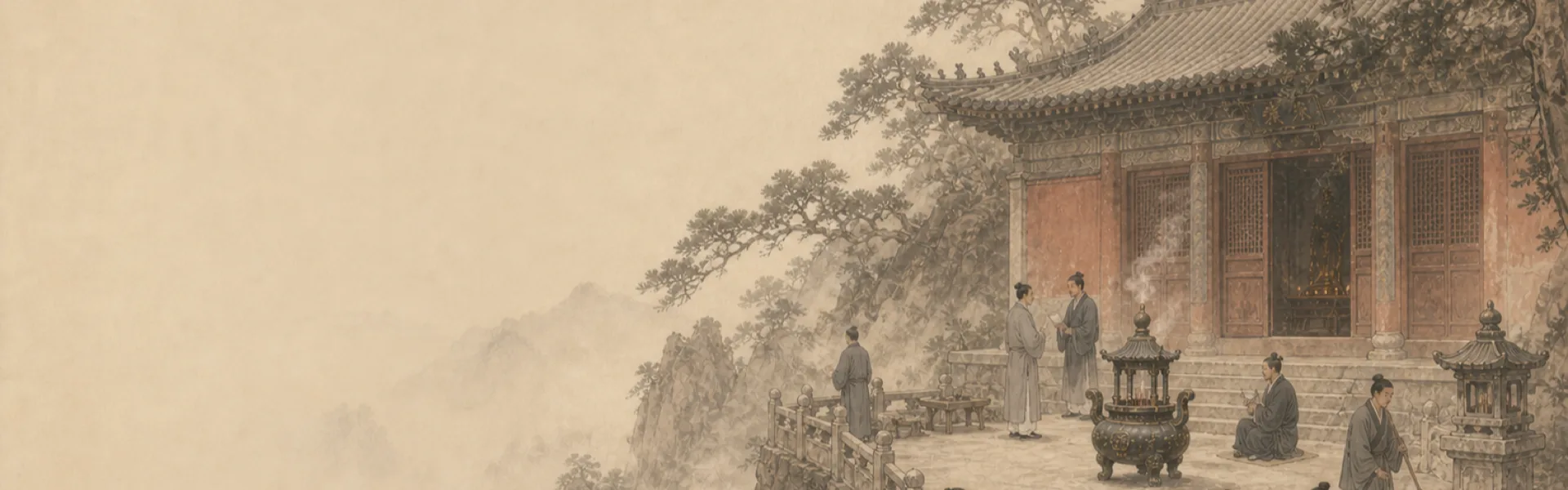
Appearance follows the code. Hair is grown long and coiled under a cap, plain blue or black gowns are worn for everyday work, and embroidered vestments come out only for ritual. The clergy you see sweeping a courtyard in a plain gown and the clergy you see in elaborate robes conducting a ceremony are the same people.
Open monasteries were obliged to receive ordained clergy of any lineage who arrived and asked properly, which is why so much of this is written down rather than left to local custom.
Quanzhen branches, disruption and restoration
Each of the Seven Perfected founded a branch, but one came to dominate: Longmen, descending from Qiu Chuji. Most Quanzhen clergy today trace their transmission through it.
The tradition's history is not a smooth ascent. Mongol patronage produced rapid expansion, and rapid expansion produced problems — too many temples acquired too quickly, with rules and trained personnel lagging behind. Periods of disorder and reform alternate thereafter. The most important restoration came in the seventeenth century, when Wang Changyue, as abbot of the White Cloud Temple in Beijing, conducted large-scale ordinations and codified Longmen transmission in writing, putting formal ordination back on a systematic basis.
That pattern — disruption, then reconstruction by a capable administrator on a documented basis — recurs. It is the reason Quanzhen has a written institutional memory at all, and it is also the reason the twentieth-century break was so damaging: when ordination stops and records are lost, there is no mechanism for verifying what resumes.
Quanzhen Taoism today and at Wudang
Quanzhen is the dominant form of Taoism in northern China and the form that occupies most famous mountain monasteries. The clergy at Wudang are overwhelmingly Quanzhen, and everything a visitor there notices about clergy follows from the code described above.
Practical implications for a visitor. Address clergy as daozhang, not shifu and not the Buddhist fashi. Expect vegetarian food and a fixed meal hour. Understand that a monastery is a residence and a workplace, so the governing test for behaviour is whether you would do the same thing in a stranger's home. And do not read a gown as evidence of ordination: martial arts students frequently wear Taoist-style gowns as training dress, and this is the commonest source of misidentification at Wudang.
One honest note. The twentieth century broke transmission in many places, ordination was suspended for long periods, and records were lost. Formal training and ordination have resumed, but some lineage claims made today cannot be verified from surviving records — and lineage and teaching quality are, in any case, close to independent variables.
Key points about Quanzhen Taoism
Quanzhen is the monastic half of Taoism, founded in the twelfth century, and introduced celibacy, vegetarianism and communal residence as standard.
It shifted the centre of religious life from ritual competence for clients to personal cultivation within a community.
Wang Chongyang, born 1113, turned to practice in middle age and was severely ascetic; he gathered disciples in Shandong from 1167 and died in 1170.
Seven disciples became the Seven Perfected, each founding a branch. Sun Bu'er was a woman, and Quanzhen produced a real literature on women's cultivation.
Qiu Chuji obtained recognition and tax exemption from Genghis Khan, which made Quanzhen dominant in northern China.
Its monastic institutional structure draws openly on Buddhist precedent; its internal alchemical content is distinctively Taoist.
The core teaching is joint cultivation of nature and life — mind and vitality — on the principle that either alone is incomplete.
Practice combines meditation, breath work, internal alchemy, scripture recitation and ordinary discipline, with early suspicion of chasing powers.
Daily life runs on a timetable: morning and evening services, fixed vegetarian meals, work, and individual practice. Seniority follows ordination and residence, not age.
Hair is coiled under a cap and plain gowns are daily wear; embroidered vestments appear only for ritual.
Longmen, descending from Qiu Chuji, became the dominant branch.
Rapid Mongol-era expansion outran rules and personnel; Wang Changyue's seventeenth-century ordinations restored the system on a documented basis.
Wudang's clergy are overwhelmingly Quanzhen. Address them as daozhang, and do not read a Taoist-style gown as evidence of ordination.
Twentieth-century disruption means some current lineage claims cannot be verified, and lineage is close to independent of teaching quality.