Shangqing Taoism: Highest Clarity Revelations and Inner Visualisation
上清道:最高明启、存思与身体内的神明
Shangqing, Highest Clarity, no longer exists as a separate institution, and you will nevertheless meet its name constantly. It supplied the interior half of Taoist practice — visualisation, meditation on deities within the body, and an individual path to transcendence — and almost everything later Taoism says about inner cultivation runs through it. It also set the pattern for how a Taoist school comes into being: a revelation, a family, an editor, and a mountain.
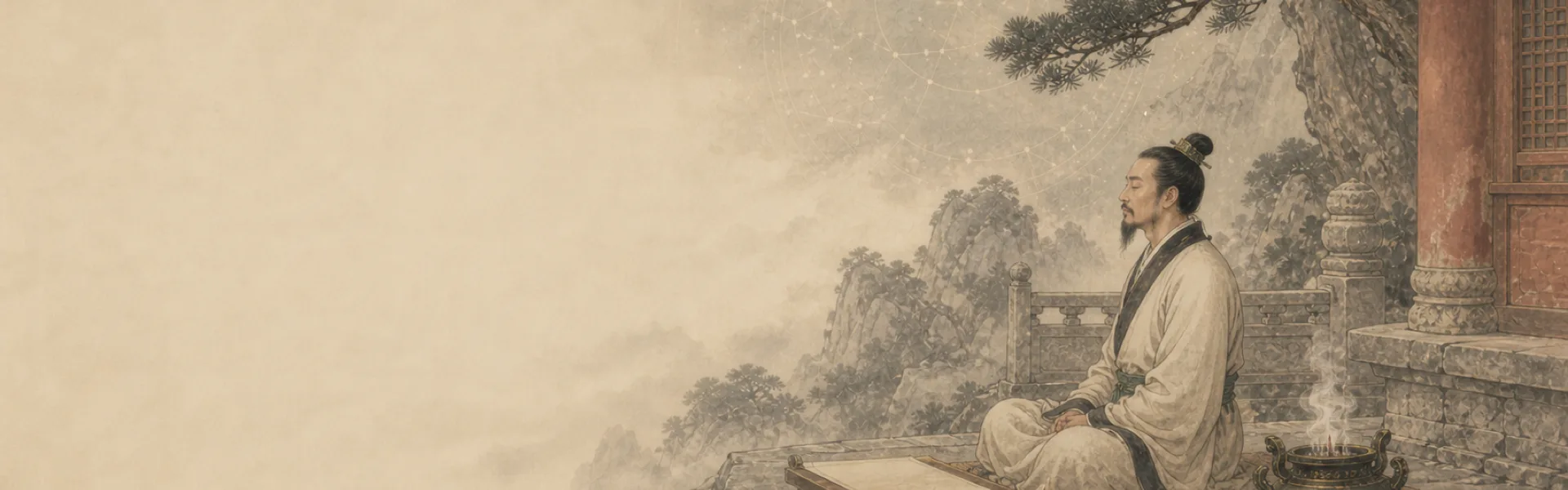
How Shangqing revelations emerged among the southern gentry
The revelations that founded the tradition took place in the second half of the fourth century, in the south of China, in the household of a family of educated gentry. A man named Yang Xi received a series of communications from perfected beings over several years, in trance, and wrote them down. The recipients and sponsors were his patrons, members of a locally prominent family.
The social setting matters more than it might appear. This was not a mass movement collecting grain from peasant households, as the Celestial Masters had been. It was a literate, aristocratic, southern phenomenon, produced by and for people with classical education, leisure and libraries. The style of the resulting texts reflects that: allusive, poetic, technically demanding, and assuming a reader who could handle difficulty.
There was also a political dimension. The southern gentry of this period had been displaced in status by northern émigré families, and a revelation conferring privileged access to the highest heavens was, among other things, a claim to spiritual distinction by people who had lost worldly distinction. That does not make the material insincere. It does explain why it took the form it did.
Lady Wei Huacun and the Shangqing chain of transmission
The principal figure in the revelations is a woman, Wei Huacun, who had lived in the previous century and was understood to have attained transcendence and to be transmitting from the perfected state. She is the source to whom the founding texts are attributed, and she remains one of the most important female figures in Taoism.
This is worth pausing on. A tradition founded on the authority of a female transcendent, received through a male medium, and sponsored by a lay family, is not the picture most people carry of Chinese religion. Shangqing took female practitioners and female authority seriously, and it produced a body of material on women's cultivation that later traditions inherited.
The mountain associated with the school is Maoshan in what is now Jiangsu, which became its centre, and the school is often called after it. As with other Taoist traditions, the lineage is inseparable from a specific place.
How Shangqing made the body the site of cultivation
The decisive innovation is a relocation. Earlier practice approached the divine as an external administration: you submitted petitions to offices outside yourself. Shangqing turned inward and located the whole apparatus inside the practitioner.
The body, in this scheme, is populated. It contains deities with names, appearances and residences; it has palaces, chambers, gates and fields; it corresponds in detail to the cosmos outside. The work is to visualise these inhabitants and places accurately and repeatedly, to summon and maintain them, to travel among them, and to preserve their presence — because their departure is what death consists of.
Two consequences follow. First, the practice is intensely private and cannot be performed on behalf of a client, which is the opposite of Zhengyi ritual. Second, it needs no equipment and no altar. What it needs is instruction, memory and time, which is why it flourished among people who had all three.
Shangqing also downgraded, without abolishing, the mineral alchemy of earlier centuries. The transformative process was increasingly understood as something conducted inside the body rather than in a crucible — a shift that eventually produced internal alchemy proper.
How Tao Hongjing organised Shangqing into a school
A revelation is not yet a school. What turned the Shangqing material into a tradition was editorial work, carried out about a century and a half later by Tao Hongjing.
He collected the scattered manuscripts, distinguished genuine from spurious material, established what had been revealed to whom and in what order, and published the result with his own annotations. He also wrote on practice, compiled ritual and pharmacological works, and served as an adviser to the imperial court while living on Maoshan. His pharmacological writing is independently significant in the history of Chinese medicine.
The general lesson is worth extracting. Taoist traditions are made by editors as much as by visionaries. Someone has to decide what is canonical, arrange it, and write the commentary that makes it usable. The same pattern appears with the Lingbao corpus and again with the codification of monastic rules centuries later.
What Shangqing texts ask practitioners to do
The core Shangqing scriptures are difficult, and it is honest to say so. They consist largely of names, visual descriptions, instructions for sequence and timing, and warnings — with the connective explanation absent, because it was transmitted orally by a teacher who had received it.
The most widely known text associated with this current describes the interior of the body as a landscape of chambers and residences occupied by deities, and is meditated on rather than merely read. Its actual date and affiliation are debated among specialists.
This has a practical implication that should be stated plainly. Reading these texts is not the same as receiving the practice, and the texts were not written to be self-sufficient. Where a modern book presents Shangqing meditation as a set of instructions anyone can follow, it is filling in gaps the tradition deliberately left. This site describes what the tradition claims and does not present it as a method for the reader.
Why Shangqing mattered and how it was absorbed
Shangqing became the prestige form of Taoism among the educated elite, and by the Tang dynasty it was close to the court's preferred version of the religion. Its scriptures occupied the highest division of the emerging Taoist canon, which is why the canon's top section is named after it. Emperors patronised Maoshan; leading literati were initiated.
It did not survive as an independent institution. From the Song onwards its material was absorbed — into the new internal alchemical movements, then into Quanzhen monasticism, and into the general ritual repertoire administered by Zhengyi priests. Maoshan continued as a religious site and remains one, but the school as a distinct organisation dissolved into the traditions it had shaped.
What Shangqing practices survive in later Taoism
More than the name. Internal alchemy inherits Shangqing's basic move of locating the whole operation inside the body. The vocabulary of interior fields, chambers and gates, used constantly in later cultivation literature and in some martial arts writing, is Shangqing vocabulary. The seriousness with which Taoism treats women's cultivation traces substantially to this current. And the assumption that the highest attainment is individual, private and achieved rather than granted is a Shangqing assumption.
What did not survive is the specific pantheon of body deities in its full detail. Later practice retained the structural idea and simplified the population, which is a common fate for elaborate systems: the framework is inherited and the inventory is quietly reduced.
Key points about Shangqing Taoism
Shangqing no longer exists as a separate institution but supplied the interior half of Taoist practice, and its vocabulary is everywhere in later cultivation literature.
The founding revelations came in the later fourth century, received in trance by Yang Xi and sponsored by a southern gentry family.
It was a literate, aristocratic, southern phenomenon, unlike the mass organisation of the Celestial Masters, and its texts are demanding by design.
Its authority derives from Wei Huacun, a female transcendent, and the tradition took women's cultivation seriously.
Maoshan in Jiangsu became its centre, and the school is often named after the mountain.
The decisive innovation was to locate the divine apparatus inside the body: named deities, palaces, chambers and fields corresponding to the outer cosmos.
Practice is private, cannot be performed for a client, and requires instruction, memory and time rather than equipment.
Mineral alchemy was downgraded in favour of transformation conducted inside the body, which eventually produced internal alchemy.
Tao Hongjing, roughly a century and a half later, collected, authenticated, arranged and annotated the corpus — turning a revelation into a school.
Taoist traditions are made by editors as much as by visionaries; the same pattern recurs with Lingbao and with monastic codes.
The scriptures omit connective explanation because it was transmitted orally, so reading them is not the same as receiving the practice.
Shangqing became the elite and court-favoured form of Taoism, and its scriptures head the highest division of the Taoist canon.
It dissolved from the Song onwards into internal alchemy, Quanzhen monasticism and general ritual practice; Maoshan remains a religious site.
What survives is the interior framework and vocabulary; the full detail of the body pantheon was quietly reduced.