Mount Longhu and the Celestial Masters: Centre of Zhengyi Taoism
龙虎山与天师道:正一道的制度中心
If Wudang shows what happens when a dynasty invests in a cult, Mount Longhu in Jiangxi shows something rarer: a religious office held by one family for a very long time. It is the seat of the Celestial Masters and the institutional centre of the Zhengyi tradition, and understanding it is the quickest way to understand how the non-monastic half of Taoism actually works.
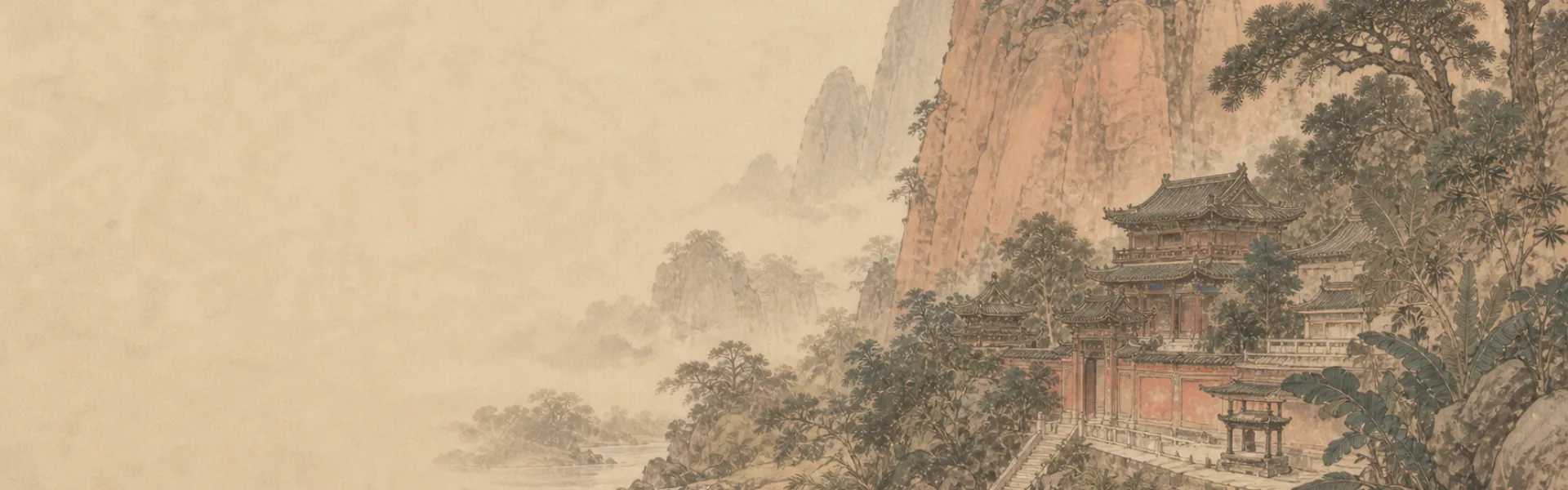
Where the religion began, and where its seat ended up
A distinction has to be made at the outset, because the two are often conflated. Organised Taoism began in the second century in what is now Sichuan, with the movement usually called the Celestial Masters. Its founder, Zhang Daoling, is said to have received a mandate directly from the deified Laozi. That movement collected contributions from households, appointed local officers, kept registers of members, treated illness as a consequence of fault to be resolved by written confession, and for a period governed territory as an autonomous religious state.
Longhu is not that place. Tradition holds that Zhang Daoling spent time here refining an elixir before going to Sichuan, and that a later descendant returned and settled the family here. Whatever the precise history, the mountain became the hereditary seat, and from roughly the Song dynasty onwards it was recognised by the state as the headquarters of the tradition. The Celestial Master's residence, generally called the Celestial Master's Mansion, stands in the town below the mountain.
So Sichuan is the origin and Jiangxi is the seat. Both statements are true and they are not in competition.
A religious office held by one family
The most distinctive feature of the tradition is hereditary succession. The title of Celestial Master passed within the Zhang family, generation by generation, numbered in sequence — an arrangement with very few parallels anywhere in the religious world, and one that made the office as much a lineage as a post.
This gave Zhengyi something Taoism otherwise lacks: a recognisable central address. Successive dynasties dealt with the Celestial Master as the responsible authority for Taoist affairs, granted titles and privileges, and used the office to regulate ordination. It is the closest the tradition has come to an institutional headquarters, though its authority was always partial — Quanzhen monasticism, which emerged later, ran on entirely separate lines.
It is worth being clear that hereditary transmission is not the same as competence, and the tradition itself has said so at various points. What the family provided was continuity and legitimacy, which in a tradition organised around lineage is a substantial contribution in its own right.
What Zhengyi priests actually do
Zhengyi is the non-monastic half of Taoism, and the difference from Quanzhen is practical rather than doctrinal. A Zhengyi priest may marry, live at home, hold ordinary employment and pass the role to a child. He is not celibate, is not required to be vegetarian, and does not reside in a temple.
His work is service to a community as a ritual specialist. He is engaged for specific occasions: offerings and grand ceremonies, funerals and rites for the dead, the consecration of a building, rites of protection for a household or a village, the resolution of an affliction understood as having a ritual cause. The role sits closer to that of a professional practitioner than to that of a monk, and in many regions it is the form of Taoism ordinary families actually encounter.
This has an important consequence for anyone trying to understand Chinese religion from books. The liturgical work that keeps most local religious life running is Zhengyi work, performed in villages and homes rather than in famous monasteries, and it is far less documented than monastic Taoism because it was never centrally recorded.
Ordination and the register
Zhengyi ordination is conferred through a formal procedure historically tied to the Celestial Master's seat. The ordinand receives a register — a document listing the divine officers and powers he is authorised to command — together with a rank, a lineage name and the standing to perform particular rites.
The register is the key concept and it makes the whole system legible. Ritual authority in this tradition is delegated authority, exactly as in a government. A priest does not act on personal charisma; he acts on the basis of a document that names what he may lawfully summon. Higher rank means a longer register and a wider competence. This is why ordination cannot be self-declared, and why a claim to be a Taoist priest is in principle a checkable claim about paperwork rather than an assertion about inner state.
Ordination at the mountain was suspended for a long period in the twentieth century and has since resumed. That gap matters, because records were lost and some current claims cannot be traced through it.
The site itself
The mountain is a red sandstone landscape of the type known as danxia — cliffs, isolated pillars and river gorges, with the Lu River running through it. It was inscribed on the World Heritage list in 2010 as part of a serial nomination covering this landform, which means the listing is geological rather than religious in basis.
The principal built site is the Celestial Master's Mansion, a walled compound in the town rather than a mountain temple, which fits the tradition: this is an administrative seat, not a monastery. There are also temples and cultivation sites on the mountain itself, and the visitor experience is dominated by the river and the cliffs.
Compared with Wudang the built scale is modest. Longhu's significance is institutional, and it does not announce itself architecturally in the way an imperially funded mountain does.
The cliff tombs are older than Taoism
One feature of the site regularly gets absorbed into the religious story and should not be. High in the cliffs above the river are burial chambers cut into the rock, containing coffins placed there roughly two and a half thousand years ago by the pre-Han inhabitants of the region.
These are archaeological, not Taoist. They predate the Celestial Masters by centuries and belong to a culture with no connection to the later tradition. How the coffins were placed is a genuine technical question that has attracted serious study and a certain amount of showmanship.
They are worth mentioning here because this kind of layering is common on Chinese sacred mountains, and separating the layers is most of the work of reading such a site honestly. A mountain can hold a Bronze Age burial ground, a Taoist headquarters and a modern tourist industry without any of them explaining the others.
Why a hereditary priesthood survived at all
A religious office passed down within one family for a very long period is unusual anywhere, and it raises an obvious question: how did an arrangement that looks so fragile last through dynastic collapse, war, and repeated changes in the state's attitude to religion?
Part of the answer is that it was useful to the state. A hereditary religious authority is easy to deal with. It has a single identifiable head, a fixed seat, a documented succession and an interest in stability, and it can be granted titles and held responsible in a way that a diffuse movement cannot. Successive dynasties recognised the office, confirmed its holder and used it as a channel for regulating religious activity across a wide area. The arrangement was, in effect, a licensing system, and the family that held the office had every reason to make it work.
Part of the answer is economic. The office controlled the authority to confer ordination registers, and ordination was something priests across a large part of southern China needed. That created a durable relationship between a central seat and a dispersed body of practitioners, along with the income and the correspondence that came with it. Institutions with a function that other people depend on tend to outlast institutions that only have prestige.
Part of the answer is that the priests it authorised were not monastic. Non-monastic priests live in ordinary households, hold ordinary occupations, and are called in for specific work — funerals, exorcisms, temple festivals, the consecration of a new building. A tradition organised this way has no large vulnerable estate to seize and no resident population to disperse. When conditions became hostile, the practice could contract into family transmission and domestic ritual, and it did, more than once. Monastic institutions, which depend on buildings and endowments and resident communities, are far more easily broken.
Set against this is the twentieth century, which was harder than anything earlier. The seat itself was damaged, activity was suppressed for an extended period, and the line of succession became contested in a way that has not been resolved to everyone's satisfaction. Reconstruction since has been substantial, and the site now functions again, but honesty requires saying that continuity here is a claim with a genuine gap in it, and that different parties describe the gap differently.
The general lesson is worth taking away from this page. Institutional forms that look weak on paper sometimes prove durable in practice, and forms that look impressive sometimes do not. A hereditary office with a licensing function and a dispersed, non-monastic clientele turned out to be remarkably hard to eliminate — which tells you something about how Chinese religion actually persisted, and it was not mainly through the survival of buildings.
The succession question today
This needs stating plainly rather than being smoothed over. The Celestial Master who held the office in the mid-twentieth century left the mainland in 1949 and died in Taiwan two decades later. The succession after him has been disputed, with more than one claim advanced and no arrangement accepted by everyone concerned.
The mansion at Longhu continues to function, ordination is conducted, and the Zhengyi tradition is very much alive in practice across southern China, Taiwan and overseas Chinese communities. But the single unbroken hereditary line that gave the tradition its distinctive shape is not currently in an undisputed state, and this site does not take a position on the competing claims.
The wider lesson applies throughout Taoism. Lineage is the tradition's mechanism for legitimacy, disruption in the twentieth century damaged that mechanism in many places, and the honest response is to describe how the system is meant to work and say clearly where the evidence stops.
Key points
- Organised Taoism began in second-century Sichuan; Longhu in Jiangxi became the hereditary seat. Both facts are true and not in conflict.
- The Celestial Master's Mansion, in the town below the mountain, is an administrative seat rather than a monastery.
- The title passed within the Zhang family by numbered generations, giving Taoism its closest thing to a central address.
- Successive dynasties dealt with the Celestial Master as the responsible authority for Taoist affairs and used the office to regulate ordination.
- Zhengyi is non-monastic: priests may marry, live at home, work ordinary jobs and pass the role to a child.
- Their work is community ritual — offerings, funerals, consecrations, protective rites — and it is far less documented than monastic Taoism.
- Ordination confers a register naming the divine officers a priest may command, so ritual authority is delegated, not personal.
- This makes a claim to priesthood checkable in principle, and it is why ordination cannot be self-declared.
- The landscape is red sandstone danxia terrain, listed as World Heritage in 2010 on geological rather than religious grounds.
- The cliff tombs above the river are roughly two and a half thousand years old and pre-date Taoism entirely.
- The hereditary succession has been disputed since the mid-twentieth century, and this site takes no position on the competing claims.