White Cloud Temple in Beijing: Quanzhen Taoism’s Urban Monastery
北京白云观:全真道的城市宫观
Almost everything else in this section is a mountain. The White Cloud Temple in Beijing is not, and that is exactly why it is worth a page. It is a city monastery in a capital, and city monasteries do a different kind of work: they deal with government, they train clergy, they serve a dense urban population, and they survive or fail according to political conditions rather than weather and drainage.
Why a city temple matters
The mountain temple is the image most people carry of Taoism — seclusion, cultivation, distance from ordinary life. It is a real image, and it is incomplete. Taoism has always also been an urban institution, and the urban institutions are where the tradition dealt with the state.
A temple in a capital is close to power, which is both an opportunity and an exposure. It receives patronage, imperial visits, honours and land. It also receives supervision, and when policy turns against religion it is the first to feel it. Its clergy are administrators as much as ritualists, and its records are consequently much better than those of remote sites.
The White Cloud Temple is the clearest surviving example in northern China, and it has been the administrative centre of Quanzhen Taoism for long stretches of its history.
Eight centuries under several names
A site here goes back to the Tang dynasty, when a temple was founded in the eighth century under a different name. It was rebuilt and renamed under the Jin dynasty, and again under the Mongols, when it became the residence of the most politically important Taoist of the age. The name by which it is now known dates from the Ming.
This sequence of names is not trivia. It is the ordinary life history of a Chinese religious institution: a continuous site, repeatedly rebuilt, renamed by successive dynasties as patronage and politics changed, with each new name marking a change of standing rather than a new foundation. Continuity is carried by the ground and the community, not by the building or the name.
The same reasoning applies to the fabric. Most of what stands today is Ming and Qing work with later repairs, and dated stelae in the compound are more reliable historical evidence than any hall.
Qiu Chuji and the Mongol connection
The single most consequential episode in the temple's history concerns Qiu Chuji, one of the direct disciples of the founder of Quanzhen and the leader of the movement in the early thirteenth century.
In his seventies he travelled an enormous distance across Central Asia at the summons of Genghis Khan and met him. What he obtained from that meeting was not doctrinal but administrative: recognition, protection, and exemption from taxation and labour service for Quanzhen clergy and institutions. The consequences were immediate and vast. Under Mongol protection Quanzhen expanded rapidly, took over large numbers of temples, and became the dominant form of organised Taoism in northern China. Qiu Chuji spent his last years at this site and died here.
It is worth being clear-eyed about this. A monastic movement founded on withdrawal from the world achieved its historical breakthrough through a successful diplomatic mission and a tax exemption. That is not a scandal; it is how institutions survive. But it does illustrate that the history of Taoism is not only a history of cultivation, and that the monastic and administrative sides of the tradition have always been the same tradition.
Wang Changyue and the restoration of ordination
The temple's second decisive moment came in the seventeenth century, under the early Qing, when Wang Changyue served as abbot.
The preceding period had been disruptive, and Quanzhen ordination had become irregular. Wang Changyue conducted large-scale ordinations here and codified the transmission rules of the Longmen branch, putting formal ordination back on a systematic footing. His written teachings on the monastic code became standard, and they are part of the reason temple etiquette and monastic conduct exist in written form rather than as local custom.
The hall associated with these ordinations is still identified in the compound. The pattern he represents recurs throughout Taoist history: disruption breaks transmission, and a single capable administrator later reconstructs it on a documented basis. Recognising that pattern is useful, because it explains why the tradition's institutional memory is strong in some periods and thin in others.
What is in the compound
The layout is a standard formal plan on a north–south axis, which is easier to read here than on a mountain because the ground is flat and nothing had to be fitted to a slope.
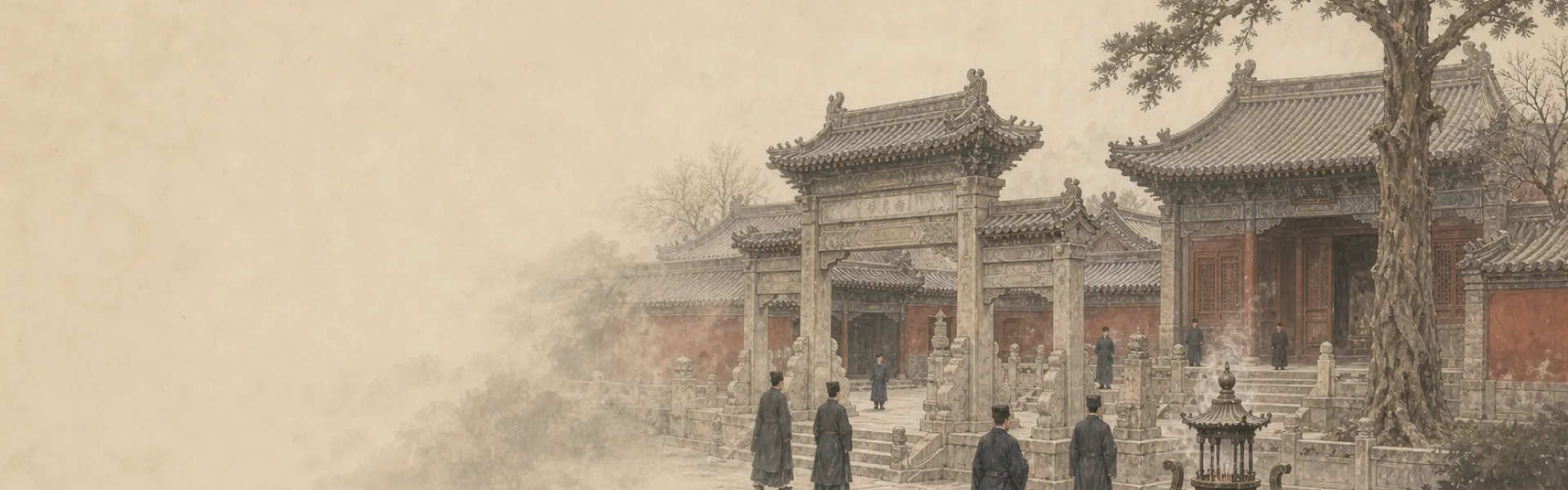
You pass through gates into a sequence of courtyards. The main axis carries the principal halls, rising in seniority, with an upper hall for the Three Pure Ones and the four highest sovereign deities. Side halls house deities with specific portfolios — wealth, medicine, the thunder department, and the patriarchs of the lineage. There is a hall dedicated to Qiu Chuji himself, and residential, refectory and library buildings occupy the parts of the site visitors notice least. A garden occupies the rear.
The standard etiquette applies throughout: enter halls by a side door since the central axis belongs to the deity, keep to the sides, step over raised thresholds, and leave the exact-centre cushion for the officiant.
The sixty year-deities and the New Year fair
One hall here is unusually popular and worth understanding, because it is a clear demonstration of how Chinese cosmology turns into religious practice.
It houses sixty deities, one for each combination in the sixty-year cycle formed by the ten heavenly stems and twelve earthly branches. A visitor identifies the deity governing their own birth year and makes offerings there. This is the calendrical machinery of Chinese metaphysics converted directly into a devotional act, and it is among the busiest parts of the temple.
The New Year temple fair is the other thing the temple is locally famous for. It is old, large and thoroughly popular in character, with customs that have nothing to do with liturgy: rubbing carved stone monkeys hidden around the compound for luck, and throwing coins at a suspended target. Purists sometimes disapprove. It is also a genuine and continuous part of the institution's life, and a reminder that a working temple serves a city, not only a doctrine.
How a city temple differs from a mountain one
If you have visited a mountain site and then visit here, the contrast is instructive, and it is not simply a matter of scenery. The two types of institution were shaped by different pressures and they do different work.
A mountain temple is remote by design. Difficulty of access is part of what it offers: the ascent takes time, the isolation supports sustained practice, and the landscape itself carries a good deal of the meaning. Its constituency is people who travelled deliberately to reach it. Its economy has historically depended on patronage from a distance — imperial grants, wealthy donors, pilgrim traffic — because there is no local population large enough to support it. Its vulnerability is that when patronage stops, there is nothing nearby to replace it.
A city temple is embedded in a population. People come because it is on their way, not because they made a journey, and they come repeatedly for small reasons throughout the year rather than once for a large one. That produces a completely different rhythm: constant low-level activity, heavy concentration around particular dates, and a relationship with the surrounding neighbourhood that is social as much as religious. It is also a place where the clergy are in continuous contact with ordinary lay people, which mountain clergy are not.
The functional consequences are significant. City temples became the administrative centres of the tradition, because that is where officials, records, printing and correspondence were. Training and ordination concentrated in them for the same reason. When a tradition needed to organise itself — to standardise ordination, to negotiate with government, to publish texts, to represent itself nationally — the work happened in cities, not on peaks. The mountain sites supplied prestige and depth of practice; the urban sites supplied administration and continuity.
Urban temples also proved more resilient in some periods and far more exposed in others. Being in a city meant being visible to whatever authority held the city, so an urban temple could be seized, repurposed as a school or a barracks or a warehouse, and then returned, all within a few decades. A mountain temple was more likely to be simply abandoned and left to decay, which is a slower and quieter form of loss. Many mountain buildings that look ruined were never confiscated; they were just left.
For a visitor, the practical point is that the two show you different things and you need both. A mountain site shows you the environment the tradition idealised and the physical scale of imperial sponsorship. A city temple shows you the tradition as an ongoing institution with staff, records, a calendar and a public. Seeing only mountains produces a romantic picture of Taoism as withdrawal, which is a substantial distortion of what it has mostly been.
Its role today
The temple functions as the seat of the national Taoist association, established in the 1950s, and as a centre for the formal training of clergy. That makes it the closest thing Taoism has to an administrative headquarters in the present day, though its authority is organisational rather than doctrinal — there is still no body that can define Taoist belief.
For a visitor the practical implications are straightforward. It is an active monastery with resident clergy, in the middle of a large city, receiving both worshippers and tourists. Photography restrictions apply during services: no flash, no video with sound, and nothing photographed from the front along the axis past the officiant. The governing test is the usual one — would you do this in a stranger's home? A working temple is a home and a workplace, and the one thing genuinely expected of you is not to interrupt.
Key points
- The White Cloud Temple is a city monastery, not a mountain site, and city monasteries are where Taoism dealt with the state.
- Proximity to power brings patronage and supervision alike, and produces much better records than remote sites.
- A temple has stood here since the eighth century under several successive names, each marking a change of standing rather than a new foundation.
- Most standing fabric is Ming and Qing; dated stelae are better evidence than the halls.
- Qiu Chuji, a direct disciple of Quanzhen's founder, travelled across Central Asia to meet Genghis Khan in his seventies.
- He obtained recognition and tax and labour exemption, which allowed Quanzhen to expand rapidly and dominate northern Chinese Taoism. He died here.
- In the seventeenth century Wang Changyue conducted large-scale ordinations here and codified Longmen transmission rules in writing.
- That pattern recurs: disruption breaks transmission, and a later administrator reconstructs it on a documented basis.
- The plan is a standard formal axis with sequential courtyards, easier to read than a mountain layout because the ground is flat.
- A hall of sixty deities corresponds to the sixty-year cycle of stems and branches; visitors make offerings to the deity of their birth year.
- The New Year fair is old, large and popular in character, with customs unrelated to liturgy.
- The temple is the seat of the national Taoist association and a training centre, giving Taoism an organisational but not doctrinal headquarters.
- It is an active monastery: standard hall etiquette and photography restrictions during services apply.