Mount Tai: China’s Foremost State Sacred Mountain
泰山:中国最重要的国家祭祀名山
Mount Tai in Shandong is the most important sacred mountain in China and it is not a Taoist mountain. Keeping that distinction clear is the whole point of this page. Taoism is heavily present there, two of its most popular deities are based there, and Taoist clergy have served its temples for centuries — but the mountain's authority comes from the state, not from any religious tradition.
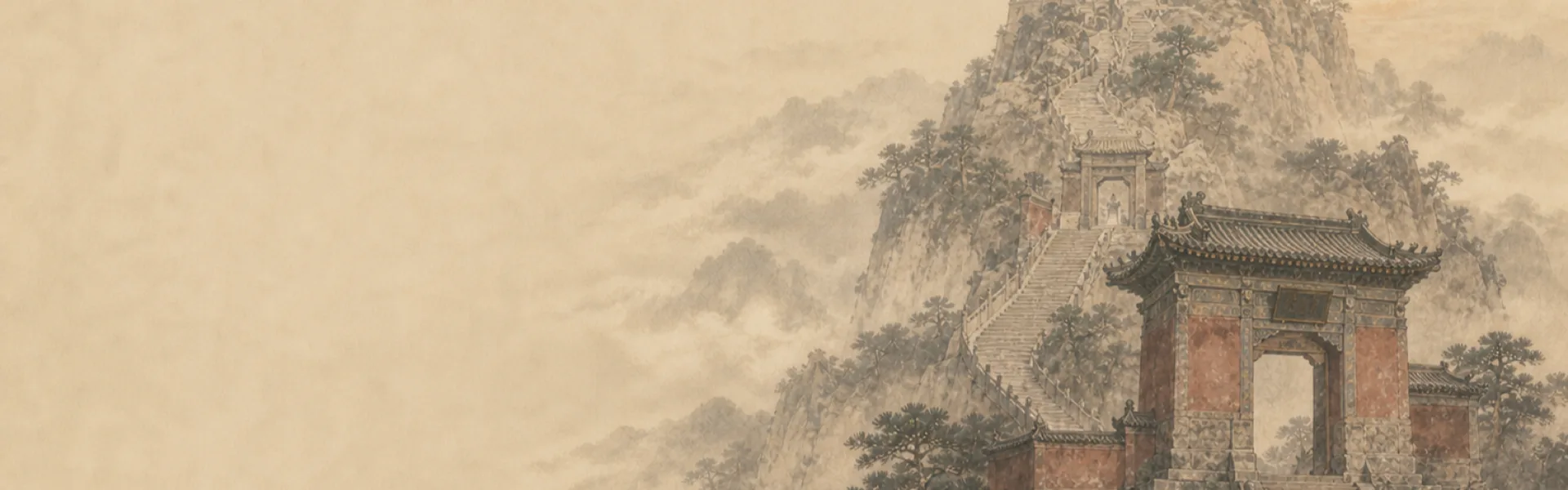
A state mountain, not a Taoist one
Mount Tai is the eastern member of the Five Great Mountains, the marchmounts that mark the cardinal directions of the empire. That system is a state institution, and it predates organised Taoism by many centuries. Its purpose was imperial sacrifice: the emperor, as the person responsible for the relationship between the human world and Heaven, made offerings at designated peaks.
Among the five, Tai holds first place. The reason is the east: the direction of sunrise, spring, beginning and growth in the standard system of correspondences. A mountain in the east is where things start, which made it the natural site for the most consequential imperial rites.
Taoism arrived later and fitted itself in, as it did everywhere. What you see on the mountain today is a state institution with Taoist religion layered onto it, plus Buddhist traces, plus Confucian commemoration, plus a very old popular pilgrimage. Treating any one of those layers as the real meaning of the mountain gets it wrong.
The imperial sacrifices
The rites performed here were the most politically loaded ceremonies in Chinese history. They involved offerings to Heaven at the summit and to Earth at the foot, and they amounted to a formal report from the emperor to Heaven that the realm was in order.
Because that claim was so large, the rites were rarely performed. An emperor who conducted them was asserting that his reign had achieved something worth reporting, and a ruler with a weak record risked ridicule by attempting it. The first unifier of the empire performed them, as did several of the most consequential emperors afterwards; the last full performance was in the early eleventh century, by the same Song emperor who elevated the Jade Emperor. After that the ritual lapsed, partly because it had become associated with overreach.
The detail worth keeping is that these were state rites, not Taoist liturgy. They belonged to the imperial sacrificial tradition, which is one of the sources the Taoist pantheon later drew on but is not the same thing as Taoism.
The Great Emperor of the Eastern Peak
The mountain's own deity is the Great Emperor of the Eastern Peak, and his portfolio follows directly from the mountain's position in the system of correspondences.
The east governs beginnings, so the eastern peak governs the allocation of life — and therefore of death, since the two are the same ledger read from opposite ends. He is understood to hold the registers of human lifespans and to have authority over the dead. His great temple stands in the town at the foot of the mountain rather than on it, which is itself informative: a deity with administrative responsibilities is housed where the administration is.
This is one of the clearest cases of a deity whose character was generated by the cosmological system rather than remembered from a life. He has no biography worth speaking of. He has a jurisdiction.
Bixia Yuanjun and who actually climbs
The deity most people climb for is his daughter, the Princess of the Azure Clouds, whose shrine stands near the summit. Her cult grew enormously from the Ming dynasty onwards and eclipsed her father's in popular devotion, which is a good illustration of how the pantheon actually works: rank and popularity are independent variables.
She is petitioned above all for children, safe childbirth, and the health of families. Her worshippers have historically been overwhelmingly women, and the pilgrimage to her shrine was for centuries one of the few socially sanctioned long journeys available to women in rural north China. That social function is a substantial part of the cult's history and should not be treated as incidental to it.
The contrast with the imperial rites is worth holding in mind. The same mountain hosted the most exclusive ceremony in the empire, performed by one man perhaps once in a century, and one of its most inclusive popular pilgrimages, walked by enormous numbers of ordinary people every year. Both are Mount Tai.
The ascent and its structure
The classic route is a stone stairway from the town to the summit, with something in the region of six thousand steps, punctuated by gates that divide the climb into stages. The upper section is the steepest and best known, a series of tight switchbacks below a gate named as an entrance to heaven.
The organising logic is the same one visible at Wudang: the path is the axis, gateways rather than walls mark the stages, and the ascent is designed as a sequence to be walked in order. The summit at just over 1,500 metres is not high, but the stair climb is sustained and the upper section is genuinely demanding. Cable cars exist; the walk is the point for pilgrims.
The mountain as a written surface
Mount Tai's most distinctive physical feature is not a building. It is inscription. The rock is covered with carved text: imperial declarations, poems, dedications, single characters cut at enormous scale, and commemorations left by visitors over two thousand years.
This makes the mountain a documentary archive in a literal sense, and it fits everything else about Chinese religious practice — a culture that approaches the divine through documents also leaves its record in writing on the landscape. There is a famous stele at the summit bearing no text at all, traditionally attributed to an early emperor and much argued over, which is a striking exception on a mountain otherwise saturated with words.
Dated inscriptions are the most reliable historical evidence here, as at every Chinese religious site. They name the year and the sponsor, and they cannot be rebuilt into something else the way a hall can.
The five marchmounts and what the scheme was for
This mountain is normally introduced as the first of five, so it is worth explaining what that set actually is, since it is regularly misdescribed as a Taoist list.
The scheme assigns one mountain to each of the four directions and one to the centre. It is a scheme of state ritual, not of religious devotion, and its purpose was to make the territory legible as a single ordered thing. A ruler who sacrificed at the five peaks was making a claim: that his authority reached to all four quarters and that the arrangement of the empire matched the arrangement of the cosmos. The mountains were the fixed points of that claim, and their selection had at least as much to do with where the early centres of power were as with any quality of the mountains themselves. Several of the five are not the most impressive peaks in their regions.
Two consequences follow. The first is that the set is a political geography that religion later moved into, rather than a religious geography that the state adopted. Taoist institutions established themselves on these mountains because they were already important, already visited and already funded, and being present at a site of state ritual brought recognition and protection. Buddhist institutions did the same. The mountains are shared, and at several of them the Buddhist presence is larger than the Taoist one.
The second is that the specifically Taoist geography is a different list. Taoist texts organise sacred space in terms of grotto-heavens and blessed sites — a large numbered set of caves and places understood as interiors, connected to each other, and suitable for the kind of work the tradition was actually interested in. That list overlaps the five peaks only partially. It includes places that are obscure, small, and of no interest whatever to a dynasty, because what mattered was the conditions for practice rather than the visibility of a claim.
Wudang is the clearest illustration of the difference. It is not one of the five, and it was nonetheless developed on a scale that dwarfs most of them, because it mattered to one dynasty for reasons of its own. If the five peaks were the Taoist list, that would be inexplicable. Once you separate state ritual geography from religious geography, it is straightforward.
The practical use of all this is in reading signage. Explanatory boards at any of these mountains tend to run the two systems together, presenting imperial sacrifice, Taoist practice, Buddhist foundations and modern heritage designation as one continuous story of sacredness. They are related, but they are four different systems with four different purposes, and separating them is most of what it takes to understand what you are looking at.
What Tai teaches about Chinese sacred mountains
Three lessons transfer usefully to any other site, including Wudang.
First, sacredness in China is frequently administrative in origin. A mountain matters because it was designated, and designation was a state act. Second, layers accumulate and none of them cancels the others: state cult, Taoist temples, Buddhist carvings, Confucian commemoration and popular pilgrimage coexist without any authority ever having reconciled them. Third, popularity and rank move independently, which is why a daughter deity can draw more worshippers than the emperor of the peak and why the busiest hall in a temple is rarely the most senior one.
Mount Tai was inscribed on the World Heritage list in 1987 for both cultural and natural value, one of the earliest Chinese sites listed. As at Wudang, that inscription makes conduct towards the fabric a matter of law rather than custom.
Key points
- Mount Tai is the foremost of the Five Great Mountains, which are a state institution predating organised Taoism, not a Taoist system.
- It ranks first because the east means sunrise, spring and beginning in the standard correspondences.
- The imperial sacrifices performed here were a formal report from emperor to Heaven and were rarely attempted; the last full performance was in the early eleventh century.
- Those were state rites belonging to the imperial sacrificial tradition, not Taoist liturgy.
- The Great Emperor of the Eastern Peak holds the registers of lifespans and authority over the dead, because the east governs beginnings.
- His main temple is in the town at the foot, not on the mountain — a deity with administrative duties is housed where the administration is.
- He has a jurisdiction rather than a biography, a clear case of a deity generated by the cosmological system.
- The Princess of the Azure Clouds, his daughter, eclipsed him in popular devotion and is petitioned for children and family health.
- Her pilgrimage was for centuries one of the few socially sanctioned long journeys open to women in rural north China.
- The ascent is roughly six thousand stone steps divided into stages by gates, with the path functioning as the axis, as at Wudang.
- The rock is covered in carved inscriptions, making the mountain a documentary archive; dated inscriptions are the best evidence.
- Three transferable lessons: sacredness is often administrative in origin, layers accumulate without being reconciled, and popularity is independent of rank.
- World Heritage inscription came in 1987 for both cultural and natural value.