Mount Qingcheng: How Organised Taoism Took Institutional Form
青城山:有组织道教如何形成制度
Mount Qingcheng in Sichuan is where organised Taoism became an institution. Not where the ideas were written — that happened elsewhere and earlier — but where a religion with members, officers, registers and territory first took shape. If you want to see where the administrative character of Taoism comes from, this is the place to look.
What “birthplace” does and does not mean
The claim needs care, because three different things get compressed into it.
The philosophical texts are much older and have nothing to do with this mountain. The revelation itself is traditionally placed on a neighbouring mountain in the same region, where Zhang Daoling is said to have received a mandate directly from the deified Laozi in the mid-second century. Qingcheng is where the resulting movement was organised and taught, and where its institutional memory settled.
So the honest formulation is that Qingcheng is the cradle of Taoism as a religion rather than as a philosophy, and that it shares the earliest ground with nearby sites rather than owning it outright. Local traditions in this part of Sichuan disagree about details, which is what you would expect of events eighteen centuries old attested mainly by later sources.
The Five Pecks of Rice and the parish system
The movement founded here is often called the Way of the Five Pecks of Rice, from the contribution expected of member households. That name is worth pausing on, because it tells you immediately that this was not a school of thought.
The organisation had officers, jurisdictions and paperwork. Territory was divided into parishes — traditionally twenty-four of them — each with an appointed officer responsible for the households in it. Members were entered in registers. Illness was understood as a consequence of moral fault, and the remedy was procedural: a written confession, submitted through the proper channel. Contributions supported the officers and funded shelters where travellers could take food.
For a period the movement governed real territory as an autonomous religious state, before coming to terms with the imperial government. This is the origin of almost everything characteristic of Taoist ritual: the documents, the seals, the registers, the sense that approaching the divine means submitting a properly composed petition to the correct office. The bureaucratic character of the Taoist otherworld is not a metaphor invented by scholars. It is a memory of how the religion actually operated.
What the parish system actually achieved
The early movement based here is usually described in terms of its beliefs. What made it historically important was closer to administration, and this is worth separating out because it is the point at which Taoism stops being a set of ideas held by individuals and becomes an institution.
The organisation divided its territory into units, each with an appointed officer responsible for the households registered in it. Registration was the key mechanism. A household that joined was recorded, contributed a fixed amount in grain, and in return had access to the officer's services and stood inside a community with obligations running both ways. Members were expected to confess faults, since illness was understood as a consequence of wrongdoing rather than as a random misfortune, and treatment therefore involved a written admission submitted upward and an act of repair rather than a drug.
Several features of this are worth noticing because they persisted long after the movement itself was dispersed. The relationship between practitioner and community was formalised and recorded, not personal and improvised. Documents moved upward through ranks, which is the same logic later found in ritual petitions addressed to the celestial administration. Officers held rank by appointment and could be promoted, which established the idea of a clergy with graded authority. Contributions were fixed and known rather than negotiated, which is why later Taoist practice has generally been uncomfortable with priced religious service.
The movement also ran genuinely practical operations. There were rest houses on roads stocked with food that travellers could take, and public works undertaken as a form of expiation, so that a person who had committed a fault repaired a road instead of paying a fine. Whatever you think about the theology, this was a functioning local administration providing services that the imperial state at that moment was not providing, in a region far from the capital during a period of disorder.
That is also why it ended. An organisation with registered members, collected revenue, appointed officers and territorial control is a government, and no state can tolerate a second one indefinitely. The movement was eventually incorporated: its leadership relocated, its members dispersed across a much wider area, and its structure absorbed into something that no longer governed territory. The dispersal is the reason its influence spread so widely, and it is a recurring pattern in Chinese religious history that suppression by absorption spreads a tradition more effectively than tolerance would have.
When you visit here, none of this is visible in the buildings, which are much later. What you are standing in is the place where a religion first worked out how to be organised, and the structures it invented — registers, ranks, written petitions, fixed contributions — are still recognisable in a temple today.
Why Sichuan
The location is not incidental, and several factors line up.
Sichuan was rich, agriculturally productive and densely populated, but geographically enclosed by mountains, which made it politically distinct and periodically hard for central government to control. A movement that needed room to organise had it. The region also had strong indigenous religious traditions — local spirit cults and ritual specialists — which supplied both the raw material the movement organised and the competition it organised against.
There is a further factor specific to the area. This is the region of the great irrigation works that made the Chengdu plain productive, engineered in the third century before the common era, and the engineer responsible was himself deified and given temples. The habit of promoting effective human beings into the divine administration was already local practice before the Celestial Masters arrived.
The main sites
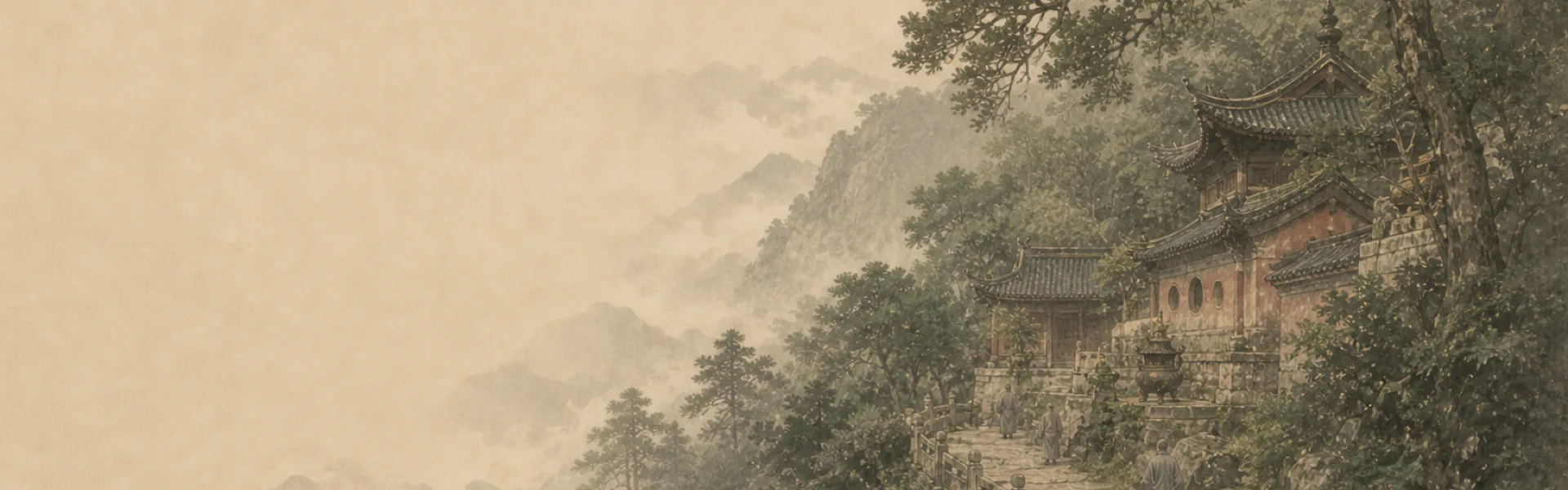
The mountain is thickly forested, wet and green, and its traditional reputation is for seclusion rather than grandeur — an explicit contrast with the more dramatic sacred peaks. The buildings are modest in scale and set among trees rather than displayed on terraces.
Near the foot stands a temple that serves as the main entrance point to the religious sites. Higher up is the complex built around the cave traditionally associated with Zhang Daoling, which is the principal historical focus and holds an old statue said to represent him. Above that, further temples occupy the upper slopes, including one named for the Highest Clarity heaven. The ascent is a walk through forest rather than a climb up stairs cut into rock, and the whole site is on a smaller and gentler scale than Wudang.
The Tang consolidation
Qingcheng's second important period came in the Tang dynasty, when Taoism enjoyed something close to state-religion status and the court took an active interest in mountain temples.
The most significant figure associated with the mountain in this period was a scholar-priest who served at court, wrote extensively on liturgy and doctrine, and retired here. His work matters because it belongs to the phase when Taoism was consolidating a canon and a coherent ritual system out of several centuries of accumulated revelation. Qingcheng was therefore not only a place of origins but a place where the tradition did the editorial work of becoming organised.
This is a pattern worth noticing at several Taoist sites. A mountain associated with a founding event tends to acquire a second layer of significance as a centre of scholarship, because the prestige of the origin attracts people doing serious textual work.
Listed together with an irrigation system
Qingcheng was inscribed on the World Heritage list in 2000, jointly with the neighbouring ancient irrigation works. That pairing looks odd at first and is actually instructive.
The two sites are a few kilometres apart and were shaped by the same regional history. One is a hydraulic engineering scheme, in continuous operation for well over two thousand years, that made the surrounding plain agriculturally secure. The other is the mountain where that prosperous, self-contained region produced an organised religion. Reading them together makes the point that religious history is not separable from economic and administrative history. A movement that collected contributions from households needed households with a surplus to contribute.
Earthquake, rebuilding and what that tells you
The area was close to the epicentre of the major earthquake that struck this part of Sichuan in 2008, and buildings on the mountain were damaged. Repair and reconstruction followed.
This is worth mentioning for what it illustrates about Chinese religious architecture generally. Rebuilding on the same site to the same plan is normal practice and is not regarded as a loss of authenticity — a genuinely different attitude from the European one. Timber burns, water rots foundations, and earthquakes bring down walls; continuity is maintained by the site, the plan and the community rather than by the survival of original material.
Which is why, here as at Wudang, dated stone stelae are usually the most reliable evidence available. A hall may be recent while the ground under it has been continuously in religious use for eighteen centuries, and it is the second fact that matters.
Key points
- Qingcheng is where Taoism became an organised religion, not where the philosophical texts were written.
- The revelation is traditionally placed on a neighbouring mountain in the same region; Qingcheng is where the movement was organised and taught.
- The movement is known as the Way of the Five Pecks of Rice, from the contribution expected of member households.
- It had appointed officers, registers of members and territory divided into parishes, traditionally twenty-four.
- Illness was treated as moral fault resolved by written confession — the origin of Taoism's documentary ritual.
- For a period the movement governed territory as an autonomous religious state.
- Sichuan suited it: prosperous, populous, mountain-enclosed and politically distinct, with strong local religious traditions.
- The regional habit of deifying effective humans predated the Celestial Masters, as the deified irrigation engineer shows.
- The mountain is forested and modest in scale, known for seclusion rather than grandeur; the cave complex associated with Zhang Daoling is the main historical focus.
- A second layer of importance came in the Tang, when a court scholar-priest retired here during the consolidation of canon and liturgy.
- World Heritage listing in 2000 paired the mountain with nearby ancient irrigation works, linking religious history to economic history.
- Earthquake damage in 2008 was repaired; rebuilding to the same plan is normal and not considered inauthentic. Dated stelae remain the best evidence.