Taoist Pilgrimage and Temple Etiquette: A Practical Guide
道教朝山进香与宫观礼仪:实用指南
Chinese pilgrimage has almost nothing in common with the image the English word suggests. It is not usually solitary, not usually penitential, and not usually silent. It is normally a group undertaking, sociable in character, with a practical purpose, and it has its own well-developed etiquette. This page explains what pilgrims are actually doing and what is expected of anyone else who happens to be in the same courtyard.
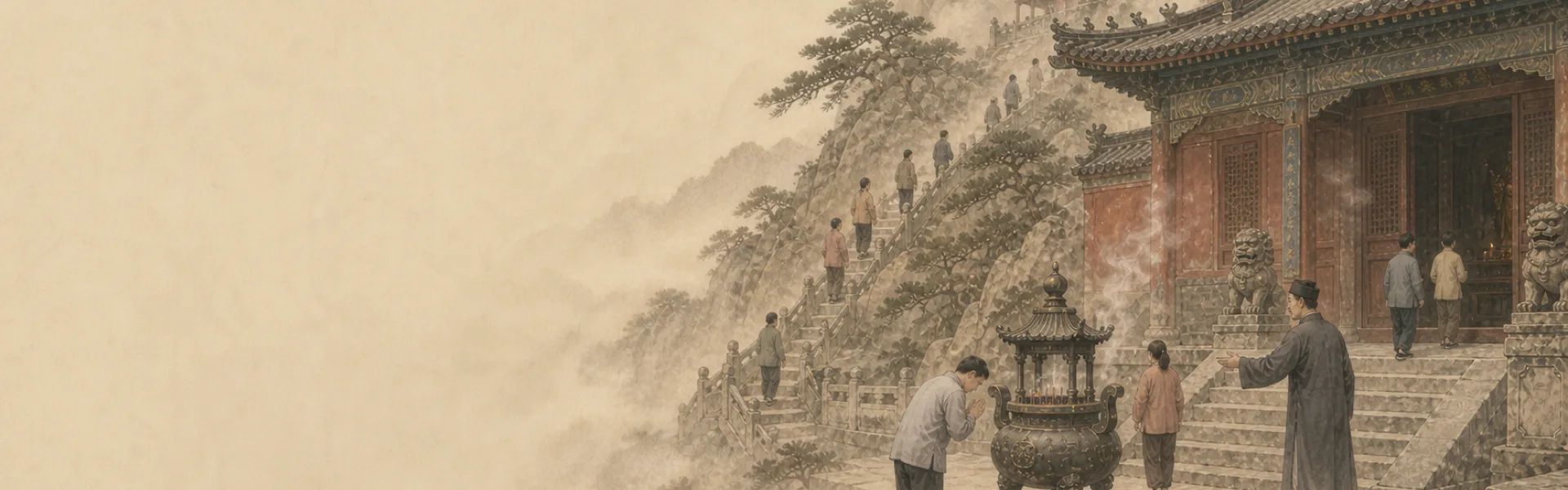
What pilgrimage means here
The ordinary term for the activity is simply offering incense, and the phrase for going to a mountain to do it means, roughly, presenting oneself at the mountain. Both are matter-of-fact. Neither implies an inner journey.
The purpose is usually specific: to make a request, or to fulfil a vow made earlier when a request was granted. The second half of that pair is why so many pilgrims are repeat visitors. A vow undertaken in difficulty creates an obligation that is felt as real, and fulfilling it may involve a long journey, a particular offering, or funding a repair.
Distance and effort are part of the offering, which is the one respect in which the English word fits. Walking up rather than taking the cable car is a meaningful choice for a pilgrim in a way it is not for a tourist. But this does not make the atmosphere solemn. Chinese temple courtyards are sociable places, and a pilgrimage often has the character of a shared undertaking with a good deal of conversation, eating and photography attached.
Incense associations and group pilgrimage
Historically, most pilgrimage was organised. Neighbourhoods, trades, villages and family networks formed incense associations — standing groups that saved money together, chose destinations, engaged transport, appointed a leader who knew the route and the customs, and travelled as a body.
These organisations mattered more than the individual devotion of their members. They handled logistics, negotiated with temples, carried banners identifying the group, and gave people who could not have travelled alone a way to travel. For women in particular, the association was often the mechanism that made a long journey socially possible.
They still exist, and you will see them: groups in matching clothing, carrying a banner or a group offering, moving through a compound together and following someone who plainly knows the procedure. If you are unsure what to do in a hall, watching such a group is the most reliable instruction available, better than any written account including this one.
Why the etiquette is written down
Taoist temple etiquette is unusually codified, and there is an institutional reason for that which is worth knowing.
The principal temples on major mountains, including Wudang, were open monasteries — obliged to receive ordained clergy of any lineage who arrived and asked properly. An institution that must accommodate strangers needs written rules, because it cannot rely on everyone having grown up with local custom. So rules were written: on residence, on meals, on seniority, on conduct in the halls, and on the treatment of a travelling priest requesting lodging. Yuan-dynasty rules of purity and the Qing master Wang Changyue's Longmen teachings are the standard references.
Family or lineage temples, passed down within a line, had no such obligation and correspondingly less need for written codes. The contrast is a useful reminder that etiquette here is an administrative product, not an atmosphere.
Recognising clergy and how to address them
The clergy you meet at a Taoist mountain temple will overwhelmingly be Quanzhen: monastic, celibate, vegetarian by rule, hair grown long and coiled under a cap, plain blue or black gowns for everyday wear with embroidered vestments reserved for ritual. Zhengyi priests, who may marry and live at home, serve communities rather than residing in monasteries.
The correct address is daozhang. Do not use shifu, which belongs to a teacher-student relationship you are not in, and do not use the Buddhist fashi. If you greet someone with a gesture, the Taoist salute is a closed hand with the left over the right, held at the chest. Palms pressed together is Buddhist. Full prostration — three bows and nine kneelings — exists but is not expected of visitors.
One caution that resolves the most common error at Wudang: martial arts students frequently wear Taoist-style gowns as training dress, and this is the single largest source of misidentification. The garment indicates nothing about ordination. Judge by behaviour and setting. For the same reason, buying and wearing a souvenir Taoist gown is best avoided.
In the hall
The rules are few and consistent, and they all follow from one idea: the central axis belongs to the deity.
Enter by a side door. The central door is often shut, and where it is open it is not for general use. Step over raised timber thresholds rather than treading on them. Keep to the sides of the hall. Do not linger directly in front of the offering table, and leave the exact-centre cushion alone — it is for the officiant. There is no circumambulation in Taoist practice; walking around an image is Buddhist.
Incense follows a standard procedure: three sticks, flame extinguished by waving rather than blowing, held at chest height with both hands while you bow, then inserted with the left hand into the burner, which normally stands outside in the courtyard. So the sequence moves outward from the image. More is not better, and clergy will say so; excess is understood as a misunderstanding, and on a working mountain it is also a fire risk.
Photography and liturgy
Photography of buildings and courtyards is generally unproblematic, and clergy are used to it. There are three firm limits during services and one general principle.
During liturgy: no flash, no video with sound, and nothing photographed from the front — that is, from the axis, past the officiant. Stand at the side or outside. The reason is straightforward: the officiant is working on the axis, and photographing from there puts you in the position the ritual reserves for the deity.
The general principle covers everything else, including whether to photograph clergy, meals, dormitories or people at prayer. Would you do this in a stranger's home? A working temple is a home and a workplace, and the presence of tourists does not change what it is. At World Heritage sites, including Wudang, touching, climbing and drones are matters of law rather than custom.
Meals, lodging and being a guest
Temple vegetarian food is plain, cheap and often genuinely good, but it is a community meal served at a fixed hour, not a restaurant service. Arrive on time or not at all. The refectory is quiet by convention. Take only what you will finish, because wasting food carried up a mountain is genuinely resented.
Overnight accommodation on a mountain is a different matter and should not be assumed. Some establishments described as temple accommodation are commercial operations; school lodging is aimed at enrolled students; and foreign visitors need to confirm that a given establishment is able to register non-Chinese guests. A travelling priest asking to stay at an open monastery is exercising a recognised right under the monastic code. A visitor is not, and should ask rather than assume.
Donation boxes are voluntary and unattended, and the temples themselves charge nothing for worship. Where a scenic-area entrance charge exists it is collected by a separate secular administration and pays for access, not for religious services. Anyone selling religious services outside the site's registered framework has no standing to do so.
Finally, the one thing genuinely expected of you is quiet — not silence, and not solemnity. You are not being asked to keep the rule. You are being asked not to interrupt people who are.
Key points
- Chinese pilgrimage is usually a sociable group undertaking with a practical purpose, not a solitary penitential journey.
- The purpose is typically to make a request or to fulfil a vow made when an earlier request was granted.
- Effort and distance form part of the offering, which is why walking up rather than riding matters to a pilgrim.
- Incense associations organised most historical pilgrimage, handling money, transport, route knowledge and negotiation with temples.
- They still operate, and watching an organised group is the most reliable guide to correct behaviour in a hall.
- Etiquette is codified because major temples were open monasteries obliged to receive clergy of any lineage, so rules had to be written.
- Clergy at mountain temples are overwhelmingly Quanzhen: celibate, vegetarian by rule, hair coiled under a cap, plain gowns daily.
- Address clergy as daozhang, never shifu or the Buddhist fashi. The Taoist salute is left hand over right at the chest.
- Martial arts students in Taoist-style gowns are the commonest source of misidentification; judge by behaviour and setting.
- In the hall: side door, step over thresholds, keep to the sides, leave the centre cushion for the officiant, no circumambulation.
- Incense: three sticks, extinguish by waving, bow, insert with the left hand into the courtyard burner. More is not better.
- During liturgy: no flash, no video with sound, nothing photographed from the front along the axis.
- Temple meals are community meals at a fixed hour; take only what you will finish.
- Do not assume overnight lodging; confirm arrangements, and note that some “temple accommodation” is commercial.
- Donation boxes are voluntary and unattended; temples charge nothing for worship. The one real expectation is not to interrupt.