Wudang Mountain in Taoism: Zhenwu, the Ming Court and Sacred Status
道教中的武当山:真武信仰、明廷与圣地地位
This page explains what Wudang is and why it holds the position it does in Taoism. It is a religious and historical account rather than a visitor's guide — practical matters such as routes, timings, difficulty and accommodation are covered in this site's dedicated section on the mountain.
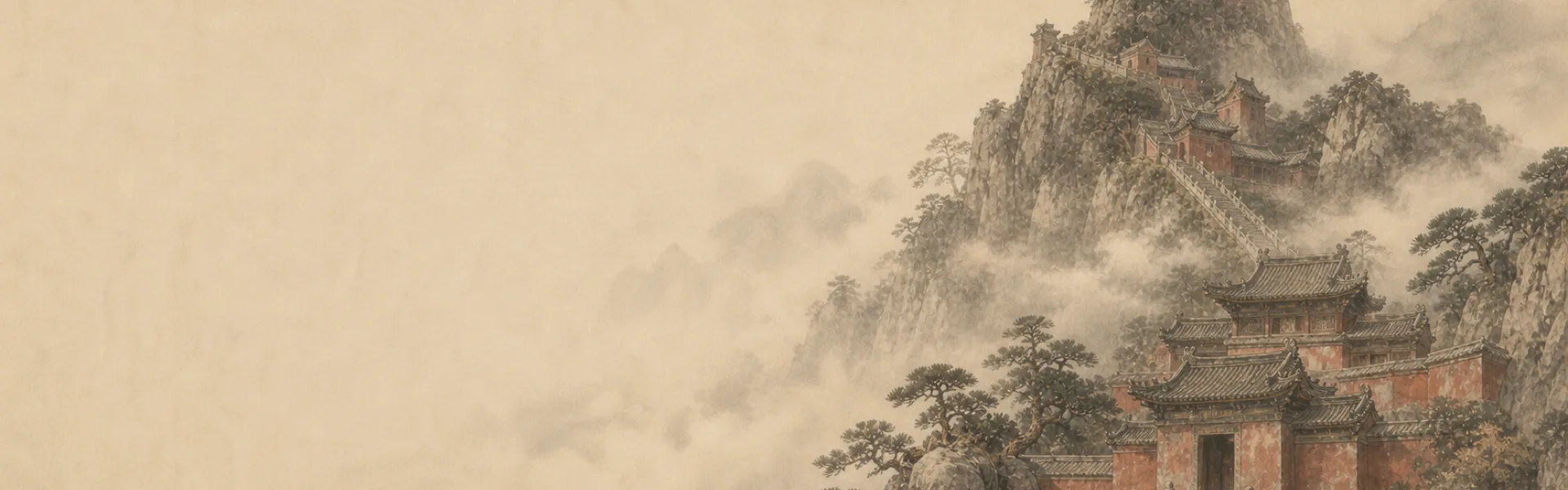
Why Wudang holds the position it does
Wudang is not one of the Five Great Mountains. Those are a state institution, marking the cardinal directions of the empire and serving imperial sacrifice, and they predate organised Taoism. Wudang's standing comes from somewhere else, and it is more specific: it is the centre of a single cult, and in the fifteenth century that cult had the full backing of a dynasty.
In 1412 the Ming court began a building programme here on a scale unmatched at any other Taoist site, and the mountain was given a title ranking it above the five marchmounts. That was an act of policy, not an ancient given. The hierarchy of Chinese sacred mountains was argued about, and the arguments were settled by decree.
So Wudang is the best surviving example of what happens when Taoist religious practice and imperial resources arrive at the same place at the same time. Other mountains are older in the tradition, and Longhu and Qingcheng matter more for the origins of the religion. None of them shows the state's investment as completely.
The deity and the mountain
Wudang is a single-deity mountain, which is unusual. Its principal deity is Zhenwu, the Perfected Warrior, also called the Supreme Emperor of the Dark Heaven — a martial god of the north whose authority covers exorcism and the subduing of malign forces.
He did not begin as a person. He began as Xuanwu, the emblem of the northern quarter of the sky, which is why the decisive marker in his images is a tortoise entwined with a snake at his feet. The name changed in the Song because the character xuan became taboo through an imperial ancestor's name. His biography as a prince who renounced the succession, cultivated here for decades and attained on a cliff terrace is far later than the emblem, and it grew as the cult grew in political importance.
The mountain's own topography was read as confirmation. Seventy-two peaks were described as bowing toward the highest summit, and Ming planners treated this as given fact and built to reinforce it. The highest point, Tianzhu Peak, is just over 1,600 metres — enough to generate its own weather, not enough for altitude sickness.
The Ming programme
The building campaign began in 1412 under the Yongle emperor and ran for roughly a decade. Contemporary accounts describe some three hundred thousand soldiers, artisans and conscripted labourers. Tradition summarises the result as nine palaces and eight temples, which is a formula rather than an exact inventory.
Two decisions shaped everything that followed. The court ordered that the terrain not be altered, so buildings were fitted to the ground as found rather than the ground being levelled for them. And the organising element is the road, not any single building: the shendao, the divine way, is the deity's road, and gateways rather than walls divide the ascent into stages beginning far out on the plain. Buildings get smaller with altitude, so the summit concentrates rather than accumulates.
The material gradient follows from maintenance and physics rather than taste: timber low down, increasing masonry higher up, and bronze at the summit. Terracing manufactures the flat ground, and the retaining walls are often the real engineering and the first thing to fail. Drainage is the invisible half of the project and the main reason anything survives, since water has destroyed more here than fire or war.
The reason for all this expenditure is political and worth stating plainly. Yongle had seized the throne from his nephew. Building the mountain of the northern deity was a public argument that heaven approved, and the imperial stelae are that argument set in stone with dates attached.
What is actually on the mountain
The major surviving complexes run from the plain to the peak, and the sequence tracks Zhenwu's story: the needle-grinding well, where a woman patiently grinding an iron needle taught the discouraged prince about persistence; the Prince's Slope, for the stage before attainment; Zixiao Palace, the great mid-mountain complex and the most complete working temple on the site; Nanyan, the cliff terrace associated with his attainment; and the Golden Summit with its bronze hall.
The Golden Hall is worth understanding as engineering. It imitates timber forms in cast bronze — columns, beams, bracket sets, tiles — and was cast off the mountain and assembled on site as a kit, because loads had to be concentrated onto bedrock where there is no room to spread them.
Away from the main route, Yuxu Palace survives as a fraction of its original extent, Wulong is largely ruins, and Yuzhen Palace was physically lifted above the rising Danjiangkou reservoir in connection with the South–North Water Transfer rather than being lost. Zixiao and Nanyan are, by many accounts, more rewarding than the peak itself.
Two administrations, one site
This is the single most useful practical fact about the mountain, and it explains most of what visitors find confusing.
The Wudang Mountain Taoist Association is responsible for the halls, the liturgy and the clergy. A separate secular scenic-area administration handles ticketing, the shuttle buses, the paths and heritage management. The scenic area sells managed access; the temples themselves charge nothing for worship, and donation boxes are voluntary and unattended.
The sites are formally registered under national regulations on religious affairs, which is why there is an official plate at each entrance. Anyone selling religious services outside that framework has no standing to do so. Note also that leased commercial concessions carry revenue targets without monastic accountability, which is the structural reason selling tends to concentrate exactly where religious authority does not — a pattern not unique to Wudang and not even especially bad there.
The martial arts question
Wudang is famous internationally for martial arts, and the relationship needs stating carefully. Wudang is a religious site with a martial arts scene attached, not the reverse. The link between Zhenwu and specific fighting traditions is much later than either the deity or the mountain's religious importance, and Zhenwu's martial character is cosmological before it is athletic: he subdues demons, not opponents.
Zhang Sanfeng, the figure to whom internal martial arts are traditionally attributed, is enshrined here, and the honest position is that his historicity is uncertain. What is documented is the imperial interest in him and the temple built in his honour. What is not documented is the man.
Schools on and around the mountain are independent businesses, separate from the Taoist association. Enrolling gives no religious access a visitor could not otherwise have. One practical note: martial arts students wearing Taoist-style gowns as training dress are the single commonest source of misidentification here. Judge by behaviour and setting rather than clothing.
What survived the twentieth century
The mid-twentieth century was severely disruptive for religious institutions in China, and Wudang was not exempt. Buildings were damaged or repurposed, clergy dispersed, and transmission broken in places — which is why some lineage claims made here today cannot be verified from surviving records.
The building complex was inscribed on the World Heritage list in 1994 as the Ancient Building Complex in the Wudang Mountains. That has a practical consequence: touching, climbing and drones are matters of law here, not custom. It also has an interpretive one. Heritage framing pushes visitors towards a museum reading, and the halls are in daily use.
Dated stone stelae remain the most reliable evidence on the mountain, better than the buildings themselves, which have burned and been rebuilt, and considerably better than interpretation boards. Imperially sponsored gazetteers in the Wudang Shan Zhi tradition record what was built and by whose order.
Key points
- Wudang is not one of the Five Great Mountains; its standing comes from being the centre of the Zhenwu cult with full Ming dynastic backing.
- In 1412 it received a title ranking it above the five marchmounts — an act of policy, not an ancient given.
- Zhenwu began as Xuanwu, emblem of the north; the tortoise and snake at his feet are the trace of that origin.
- Seventy-two peaks were said to bow toward the summit, and Ming planners built to reinforce that reading. Tianzhu Peak is just over 1,600 metres.
- The programme ran about a decade with some three hundred thousand workers, and the terrain was not to be altered.
- The road is the organising element; buildings get smaller with altitude; drainage and retaining walls are the real engineering.
- Yongle had seized the throne, so the mountain functions as a political document with the stelae as its dated evidence.
- The route follows Zhenwu's story from the needle-grinding well through the Prince's Slope, Zixiao and Nanyan to the Golden Summit.
- The bronze Golden Hall imitates timber forms and was cast off site and assembled as a kit, concentrating loads onto bedrock.
- Yuzhen Palace was lifted above the rising Danjiangkou reservoir; Yuxu is a fraction of its extent and Wulong largely ruins.
- Two administrations share the site: the Taoist association for religion, a secular body for access. Temples charge nothing for worship.
- Wudang is a religious site with a martial arts scene attached; Zhang Sanfeng's historicity is uncertain and schools are independent businesses.
- World Heritage inscription came in 1994, making touching, climbing and drones legal matters. Dated stelae are the best evidence.