The xiao zhoutian (小周天), the “small heavenly circuit”, often translated “microcosmic orbit”, is one of the best-known ideas in Taoist internal alchemy and one of the most misused. In the texts it names a stage of long, supervised training. In much modern teaching it has become a technique promised in a weekend. This page explains what the tradition describes, what is claimed for it today, and why, unlike the other pages in this series, it does not give you a method.
For the sitting practices this series does teach, start with Taoist Meditation, Guarding the One and Inner Observation.
A circuit named after the sky
“Zhoutian” is an astronomical word: a full circuit of the heavens, the path the sun and stars complete in a year. Internal alchemy (neidan 内丹) takes the body as a small cosmos and borrows the image. The “small” circuit is the body’s own round, as the year is the sky’s.
In the classic internal alchemy sequence, practice moves through three stages after a period of “laying the foundation”: refining essence into qi, refining qi into spirit, and returning spirit to emptiness. The small heavenly circuit belongs to the first stage; a “great heavenly circuit”, which the texts trace through further vessels, belongs to the second. Texts also call the circuit the “river chariot” (heche 河车), turning like a waterwheel. The method was set out in its fullest form by Wu Shouyang (伍守阳, 1574–1644) in the late Ming and Liu Huayang (柳华阳) in the eighteenth-century Qing, teachers of the Wu-Liu school, who wrote about it in unusual detail and still insisted that it be learned from a teacher.
The map in the texts
The texts describe two paths. One rises along the back, the dumai (督脉); the other descends along the front, the renmai (任脉). Along the back are three “passes” said to be hard to cross: at the base of the spine, between the shoulder blades and at the back of the head. The tongue resting on the palate, the same detail as in the meditation posture, is called the “magpie bridge” because it joins the two paths.
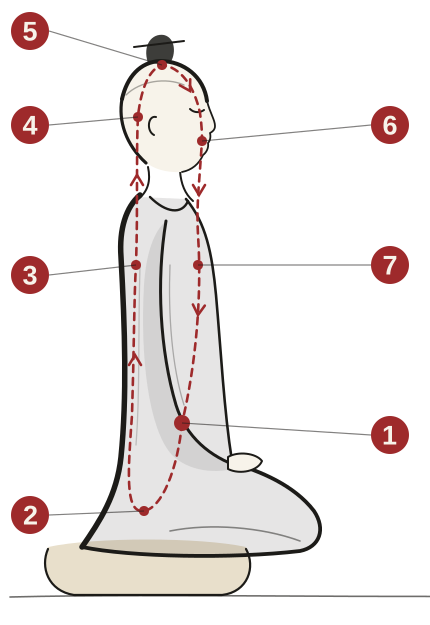
The small heavenly circuit as internal alchemy texts describe it: up the back through three passes, over the crown and down the front. A map in traditional language, not anatomy, and not an instruction to move anything.
- Lower dantian, where the circuit is said to begin and end
- Weilü 尾闾, the pass at the base of the spine
- Jiaji 夹脊, the pass between the shoulder blades
- Yuzhen 玉枕, the “jade pillow” pass at the back of the head
- Niwan 泥丸, the crown
- The “magpie bridge” (queqiao 鹊桥): the tongue against the palate joins the two paths
- The front path down to the dantian (renmai 任脉); the rising back path is the dumai 督脉
This is a map in the tradition’s own language. It describes what practitioners report and how teachers organise training. It is not anatomy: no physical channels of this kind have been found, and reading the drawing as a diagram of nerves or blood vessels misunderstands it.
What is claimed today
Popular books, videos and courses often present the circuit as something anyone can “open” in a few weeks by visualising energy moving around the loop or by breathing in a particular rhythm, and they attach large promises to it: health, youth, special powers. The old texts do speak of a “hundred days to lay the foundation” (bairi zhuji 百日筑基), but as the opening phase of a long discipline under a teacher, built on moral conduct and steady sitting.
What can be said honestly is modest. People who sit quietly for long periods often report warmth, tingling or a sense of movement along the back and front of the body, and such sensations are well known in the tradition. Studies of qigong and meditation suggest benefits for relaxation and wellbeing. Specific claims about the circuit itself have not been shown.
Why this page gives no method
The tradition’s strongest warnings attach to exactly this practice. Its name for practice gone wrong, zouhuo rumo (走火入魔), is most often used of attempts to push qi along these paths. Chinese psychiatry has also recorded it: successive editions of the Chinese Classification of Mental Disorders, from 1989 to CCMD-3 in 2001, list a “qigong-induced mental disorder” (气功所致精神障碍) among culture-related conditions. Problems reported include a sense of qi rising or trapped in the head, headaches and pressure, heat, palpitations, insomnia, anxiety or panic, and, rarely, perceptual or dissociative episodes that need medical care. They are associated with forcing the breath, intense visualisation, very long sessions and practising without guidance.
For that reason, this page follows its teachers’ advice: do not try to circulate qi from a book or a video. If you want to study the circuit, find a qualified teacher in an established lineage who will assess you in person. And if you notice warmth or movement during ordinary sitting, treat it as the series has suggested throughout: notice it, do not chase it, and let it come and go.
What to practise instead
- Guarding the One: light, steady attention below the navel, the foundation that every serious teacher builds first.
- Inner Observation: watching what arises, including sensations, without following it.
- Zuowang: the discipline of simplifying life that the old masters set before any of this.
If any practice leaves you with persistent headaches, pressure, sleeplessness or distress, stop and seek medical advice.
Further on the site
- The Wu-Liu school: the lineage that wrote most fully about the circuit.
- The Taoist View of the Body: organs, channels and the dantian.
- Taoist Meditation: the five methods, the posture and a first practice.